
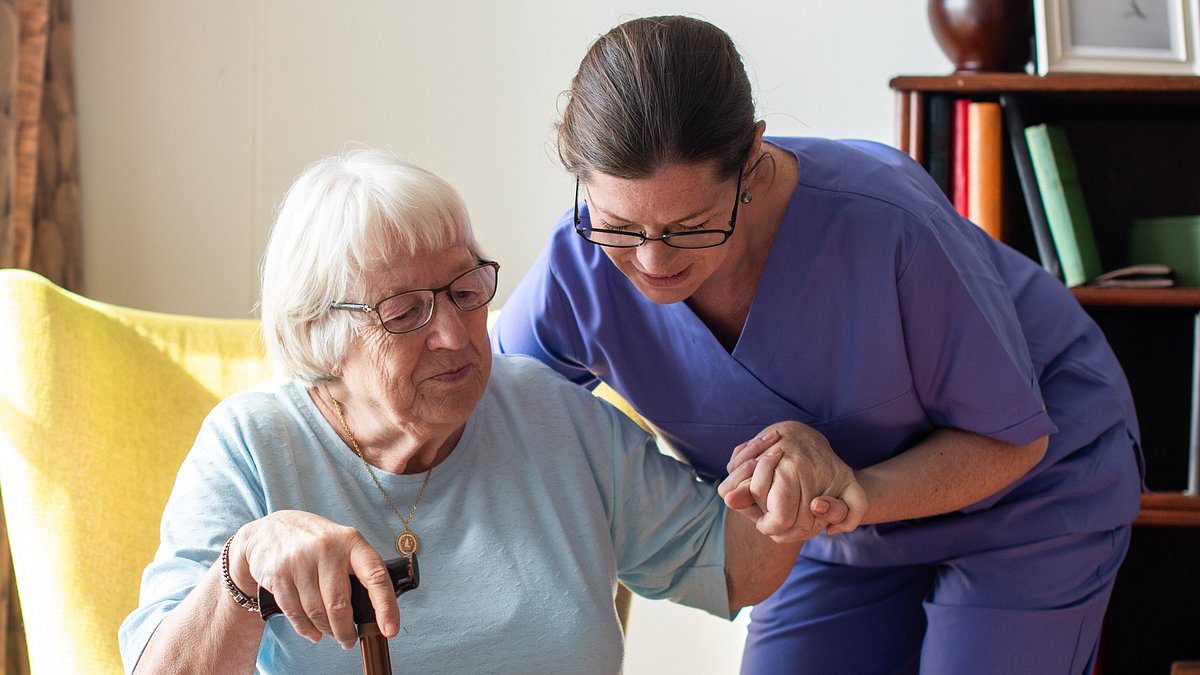
The 15-year freeze on the threshold at which state help with care fees starts is costing families an extra £12,400 of their own money, a study has found.The £23,250 floor for the assets and savings you need to hold before Government funding kicks in would be over £35,600 now if it had been revised in line with inflation since 2010-11, according to the new calculation.This 'stealth tax' should be addressed in the overhaul of the social care system in England that Prime Minister Andy Burnham promised after taking office, says charity and think-tank the King's Fund.It says there are around 220,000 'self-funders' in England who must pay all their own social care bills, which can cost tens of thousands of pounds a year.The King's Fund also says these people face higher fees than those funded by the local authorities, as they subsidise lower rates paid for care by councils. Social care: Costs have soared but the threshold at which state help begins has not changed for yearsIt points to a Competition and Markets Authority report in 2017 that found a 41 per cent difference in rates charged.The King's Fund says there is nothing to suggest the gap has been addressed, and it means self-funders keep less of their savings and also see them disappear more quickly because they are charged higher fees.It is calling on Burnham to revise the threshold at which help with care begins and bring it in line with inflation, as part of a fundamental review it says should tackle issues including access, catastrophic costs, quality and market failures.Simon Bottery, senior fellow for social care at the King's Fund, said: 'The 15-year freeze to the thresholds is just one symptom of an unfair social care system resulting from reform being put off for decades.'Governments have talked about change and even legislated for it but have not had the courage to implement it.'We welcome the new Prime Minister's aim to buck this decades long trend. His words and actions have shown a renewed drive from the centre to force reform through, something that had been sorely lacking, and has put this issue near the top of the political agenda.'Burnham has said previous Governments have failed to get a grip on the care system, and vowed to find a political consensus and win public backing for how it is delivered and funded in future.In the past Burnham has floated the idea of a 10 per cent 'death tax' on all estates to fund the social care system.After becoming Prime Minister, he said he wanted to work with the Conservatives and Liberal Democrats and was ready to 'give and take' to find common ground. However, he did not rule out tax rises, and warned of 'difficult decisions'.Burnham asked Baroness Louise Casey to bring forward publication of her care review, looking at how to deliver and fund a 'National Care Service' to run alongside the NHS, to summer 2027.Who pays for care now?At present, someone in England who needs to go into a care home has to spend their own money and deplete their assets down to £23,250 before they get help with care fees. This usually means people have to sell their home and use the money to pay for care, before getting any state assistance. If you need care in your own home, your assets must have dwindled to a level set by your local council, which cannot be lower than £23,250. However, the value of your home is excluded from this means test.The floor for assets before help from the state kicks in applies to England.Scotland offers free personal care, Wales runs a different means-tested system where people may have to pay up to £100 a week for non-residential care, and Northern Ireland has different rules again.You can get the NHS to pay for care based on health needs, but the assessments and red tape when applying for what is known as 'NHS continuing healthcare' are challenging.People do not have to sell their homes to pay for care if a spouse or certain other categories of people – relatives aged over 60 or under 18, for example – still live there. This is Money has guides to applying for NHS CHC and making an appeal if you are refused, written by expert James Urquhart-Burton, head of continuing healthcare claims at Winston Solicitors.SIPPS: INVEST TO BUILD YOUR PENSIONAJ BellAJ Bell0.25% account fee. Full range of investmentsHargreaves LansdownHargreaves LansdownFree fund dealing, 40% off account feesInteractive InvestorInteractive InvestorFrom £5.99 per month, £100 of free tradesInvestEngineInvestEngineFee-free ETF investing, £100 welcome bonusProsperProsperNo account fee and 30 ETF fees refundedAffiliate links: If you take out a product This is Money may earn a commission. These deals are chosen by our editorial team, as we think they are worth highlighting. This does not affect our editorial independence.Compare the best Sipp for you: Our full reviews
Social care stealth tax costs families extra £12,400 after 15-year freeze on threshold for state funding
Full Article
Original Source
Read the full article at Dailymail →KhanList aggregates and links to publicly available news content. We do not host full articles from third-party sources. Always verify important information with original sources.