
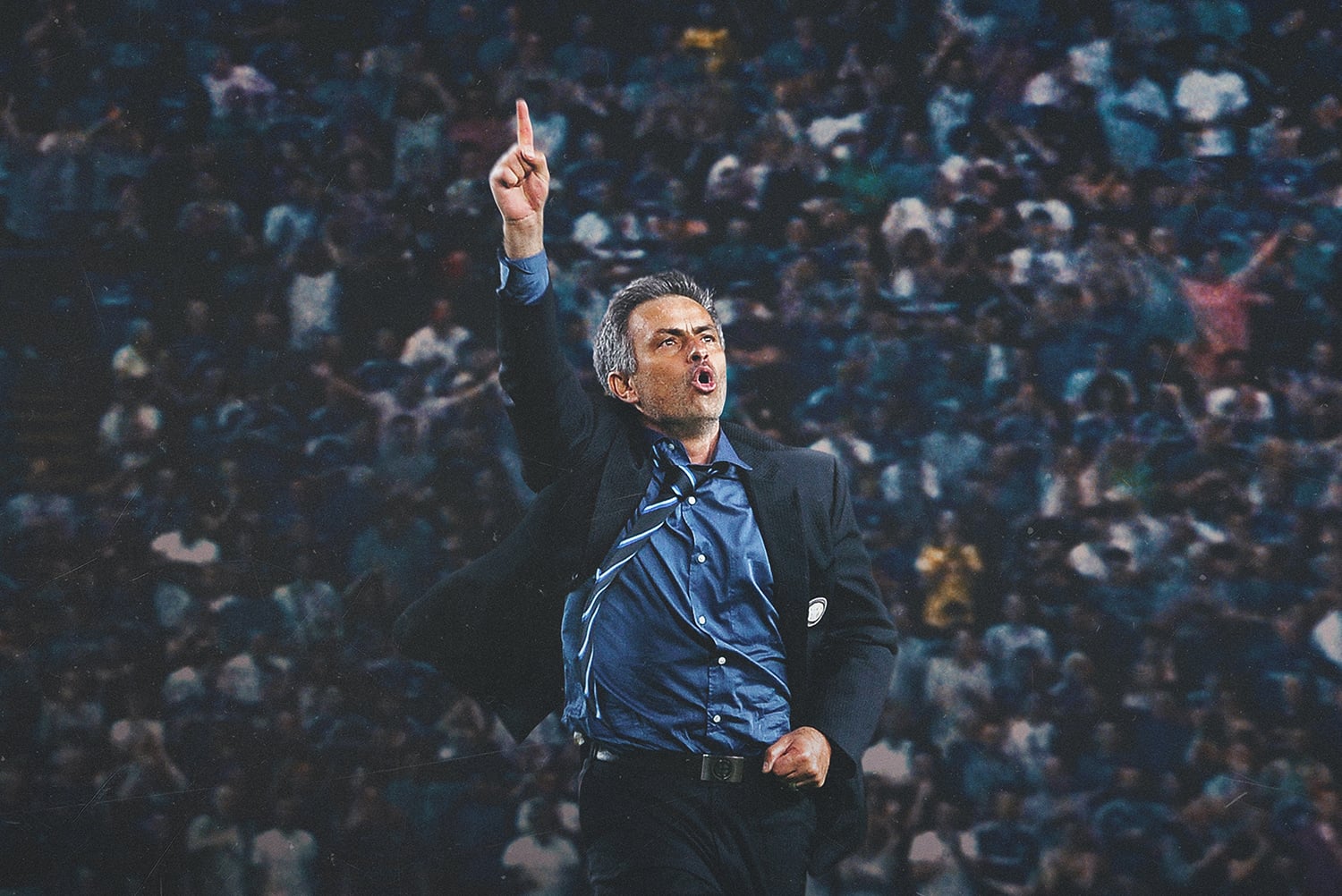
“I sell. That’s as simple as that,” says José Mourinho, the legendary soccer coach, in an eponymous new documentary on Netflix. He could be talking about the American Express advertisement the interview highlights, or any of the plethora of brands he has lent his face to, from Coca Cola to Kalshi. But what Mourinho means is that he is the ultimate draw. Mourinho sells like sex sells. The message is that the brands he endorses are all the richer for their association with him—as are the soccer teams, superstar players, and fans who have been fortunate enough to be graced by his aura. That aura and persona is something Mourinho has spent his entire life crafting. And it is predicated on two fundamental obsessions: football (as soccer is called in most of the world) and winning. Mourinho has won every major trophy in European soccer across the sport’s biggest leagues, with its biggest teams, multiple times over. “Football is to win. And … I won a lot,” he says matter-of-factly, one of several quintessential Mourinho quotes peppered throughout the three-part series. “You don’t do a documentary with a guy that wins nothing.” While I am an obsessive football fan myself, that’s not the reason I wanted to write about the self-anointed “Special One” (more on that below) for Foreign Policy. Rather, it’s what his life, career, and relentless self-aggrandizement can tell us about geopolitics and the world we live in today. As the documentary lays out, Mourinho expects and inspires unflinching loyalty and will ruthlessly cast aside anyone who fails to give it to him. He has a need for ultimate control, a litany of grievances against his perceived enemies, and a deep conviction that no one can be bigger than him. If you stand against him, either you leave, or he does. It’s Mourinho versus the world. You just have to decide which side you want to be on. Sound familiar? A close-up of a man making a puffed-cheek expression while holding both hands up, palms facing forward. Mourinho during a press conference at the Chelsea training ground on Feb. 25, 2005.Getty Images “He didn’t even have to say anything to make you aware that you could get on the wrong side of him,” says England football legend Frank Lampard, who played for Mourinho in the mid-2000s and is one of several superstars interviewed in the documentary. “You’re either with him or against him.” Mourinho, in other words, is football’s ultimate authoritarian. As a viral social media post once put it, he was “born to be a dictator” but “forced to be a football coach.” He serves as a potent symbol for the world we seem to be living in—one where might makes right, winning is everything, and empathy is scoffed at rather than emulated. One can debate whether that is the right approach to leadership, but Mourinho’s ever-growing mythology and continued success—despite openly embracing the role of villain—is something most politicians would kill for. How much of it is an act and how much of it is really Mourinho? In the documentary, he reveals just enough for viewers to wonder but not enough to answer the question. “People think they know me, but they don’t know me. And I’m happy they don’t,” he says. “It’s a privilege for the ones that know me.” A young man with dark, styled hair wearing a yellow T-shirt with blue trim smiling, standing on a dirt field with another person in a green long-sleeve shirt behind him. A photo of a young Mourinho from the documentary.Netflix Mourinho grew up in the 1960s and ’70s in Setúbal, Portugal, where his mother was a teacher and his father played and then coached football professionally at the local club. Mourinho followed that career path but says he was “not a very good player,” quitting in the late 1980s before embarking on a coaching career that took him across Portugal and Spain’s top leagues as a translator and assistant coach. But the documentary focuses on a series of big breakout moments that began in 2002—months after he took charge of top-tier Portuguese club FC Porto—when he boldly pledged that he would win them the league title the following year. He did. He also won the UEFA Cup, at the time the continent’s second-most prestigious club honor. The next year, he went one better, topping the league once again but this time also winning the Champions League, Europe’s most prestigious club competition. Days later, he moved to the English Premier League, widely considered the world’s most competitive, to take charge of London team Chelsea. That was where his aura would go truly global, powered by the British tabloids and media. Mourinho won back-to-back titles with Chelsea in his first two seasons, breaking the dominance of two of the greatest managers in English history—Manchester United’s Alex Ferguson and Arsenal’s Arsene Wenger. Backed with a hefty budget to sign players thanks to Russian billionaire Roman Abramovich’s purchase of Chelsea, Mourinho and his team seemed unstoppable. “The one thing that José did have at the time was complete strength and power at the club,” Lampard says. A group of soccer players wearing blue uniforms celebrating around a trophy pedestal, while a man in a suit lies flat on his back on the grass directly in front of them with his legs raised. Mourinho celebrates along with players during the trophy presentation after Chelsea won the League Cup final at Wembley Stadium in London on March 1, 2015. Glyn Kirk/AFP via Getty Images But what happened next showed the limits of how much authority a coach could have. Mourinho repeatedly clashed with Abramovich over some of the Russian owner’s personnel decisions; Chelsea failed to get a three-peat; and Abramovich sacked Mourinho early into his fourth season in charge. While politics has sometimes shown otherwise, in football, when an authoritarian goes up against an oligarch, the oligarch often wins. Mourinho simply went and continued winning elsewhere. He joined Italian giants Inter Milan, winning the Italian league in his first year and another Champions League in his second—defeating Chelsea on the way to the trophy. His recounting of that win over Chelsea in the documentary shows that in Mourinho’s worldview, no one matters but him. Not the 22 players on the pitch. Not the fans. Just him. “I was playing against a guy that sacked me. I go home happy, and he goes upset,” he said of Abramovich. “I know how much he loves Chelsea. I know how much he loves to win. But I needed revenge. Because football belongs to people like me.” There are two consistent themes about Mourinho’s career that he repeatedly comes back to throughout the documentary. One is his unbridled obsession with football at the cost of everything else; the other is his perception of football not as sport but as something far more serious. “It was not to play football. It was to resist in a war,” he said of the Inter Milan defeat of Chelsea. A man in a dark suit running across a soccer pitch while pointing his index finger up toward the sky, with blurry players in red and blue jerseys visible in the background. Mourinho charges forward in celebration after Inter Milan wins a Champions League match against Barcelona in Spain on April 28, 2010. Filippo Monteforte/AFP via Getty Images Mourinho refers to football as “war” or “battle” several times through the documentary, and the players interviewed—all of them superstars in their own right—make clear how much he instilled that mindset in them. “He made me want to fight for him,” says former Chelsea captain John Terry, laying out what he described as Mourinho’s “magical spell” over the players. “I’ve never seen a group of individuals follow one person like we did him,” he adds. “I would leave that pitch in a coffin for him.” It continued beyond Chelsea. “José was our leader,” says former Inter Milan defender Marco Materazzi (the recipient of that famous World Cup headbutt). “We were all willing to die on the field to get to the final.” Swedish striker Zlatan Ibrahimovic, who won trophies with Mourinho at two different clubs and is known for his own narcissistic arrogance, says Mourinho “changed my game, he made me more of a killer. So when I entered the field, I was feeling untouchable. I could destroy anyone.” But no one is as good at mythologizing Mourinho as Mourinho himself. “Strong guys, I make them stronger,” he says. “Shit people, they are in trouble.” A man in a suit jacket and blue shirt being lifted into the air on the shoulders of several people wearing white jackets. Mourinho celebrates after the Copa del Rey final between Real Madrid and Barcelona at Estadio Mestalla in Valencia, Spain, on April 20, 2011. Manuel Queimadelos Alonso/Getty Images The documentary offers several windows into how Mourinho sees himself, but one of the most revealing is when he talks about being Portuguese. “I feel proud of what we were before—this little corner in the end of Europe, navigators discovering new places,” he says, referring rather romantically and casually to colonialism. He then makes it clear that he sees himself as a modern-day conquistador of sorts. “I feel responsibility because I am one of the faces of our country. I’m not an ambassador, but I am,” he says. “I am a navigator, centuries later, fighting for life, fighting for career, with talent and courage.” Mourinho’s conquests continued after he won the 2010 Champions League with Inter Milan. Days later, he took the biggest job in world football, one that even casual watchers of the sport would know, by taking the helm at Real Madrid. “I went to Real Madrid to break the dominancy of Barcelona,” he says in the documentary, referring to the club’s archrivals. There’s a mythological backstory there too. Mourinho was assistant coach at Barcelona in the 1990s, where one of his main roles was working as a Spanish translator for the English head coach Bobby Robson (a characterization he bristles at). But Barcelona appointed its former captain Pep Guardiola as manager in 2008, in what was seen by many as a snub to Mourinho. Guardiola would turn Barcelona into one of the most dominant teams in Europe, with one Lionel Messi as its star player. Mourinho did break that dominance, winning the Spanish league title in his second season with a star of his own in Cristiano Ronaldo. But he was sacked again before completing his third season after clashing with several players, including club captain Iker Casillas and even Ronaldo himself. Fights follow Mourinho wherever he goes—with the press, with rival managers, with his own players. “I don’t run away from controversy,” he says. “And I try to use it when I feel that it can be positive for my side.” A man in a dark suit sitting inside a covered dugout on a soccer field, looking directly at a crowd of press photographers surrounding him with cameras pointed at him. Mourinho sits on the bench as photographers mob him during the Champions League Group H match between FC Porto and Chelsea in Porto, Portugal, on Dec. 7, 2004.Christopher Lee/Getty Images The pattern of euphoria followed by implosion has become another hallmark of his career, and following his early period of success, the highs have gotten shorter and less impressive. After Madrid, he returned to Chelsea, winning another league title before being dismissed acrimoniously midway through the following season when results fell apart. He continued in England with Manchester United (a stint I’m painfully familiar with, as a fan of the club) and Tottenham; moved back to Italy to manage Rome’s top team, AS Roma; had a brief Turkish sojourn with Fenerbahce; and then went back to Portugal to manage Lisbon-based Benfica. Many of those stints saw him win a handful more trophies but also ended with premature sackings. In the documentary—as in his life—Mourinho’s self-aggrandizement is relentless. “I wanted to make history, and nothing was going to stop me,” he says. While talking about his win over Ferguson’s Manchester United en route to his famous Champions League triumph with Porto, he describes it as “the moment when I introduced myself to the world.” There are several moments where he gets to the edge of humility or self-reflection, only to retreat back into his ego. “Was I naive? Arrogant?” he asks at one point, only to quickly follow up with: “I don’t think so.” In another monologue, he admits that he can be “really nasty” and “aggressive,” before adding: “It’s a place where, normally, I win.” Mourinho even tries to downplay his most famous quote, uttered during his first press conference with Chelsea back in 2004, when English journalists questioned his ability to manage in a tougher league. “Please don’t call me arrogant,” he said at the time, “but I’m European champion and I think I’m a special one.” “The Special One” became a nickname in the British tabloid headlines, one that has followed him throughout his career and one that it’s clear he revels in. But in the documentary, he takes pains to point out that he said a special one, not the special one. “The Special One is some special shit, some guys in England they found for me,” he tells the filmmakers while showing them the trophy room in his home in Setúbal, to which one of them promptly replies: “I love that you’re saying that while there’s a mural of yourself behind you.” A few frames before, the camera reveals the words “Special One” engraved on the side of the Ferrari that Mourinho drives them to his house in. A referee in a bright yellow shirt holding a red card up toward a man in a blue jacket, who looks angry while two men attempt to hold him back. Mourinho, head coach of Benfica, is shown a red card by a referee during a Champions League match between Benfica and Real Madrid in Lisbon on Feb. 17. Angel Martinez/Getty Images The Mourinho Netflix release was sandwiched between two other premieres that put his narcissism and brazenness in even starker relief. One was the latest season of Ted Lasso, which depicts Jason Sudeikis as a folksy (U.S.) football coach from Wichita, Kansas, who hops across the pond to take over an (English) football team, winning over the stuffy Brits with his quintessential midwestern charm. While it’s as wholesome a depiction of trans-Atlantic relations as you’re likely to get, it feels positively anachronistic in the current trans-Atlantic moment. The other release, a week after Mourinho’s, was a behind-the-scenes documentary on his archnemesis Guardiola’s final seasons at Manchester City, with whom he has dominated English football for the past decade. That documentary shows Guardiola crying in front of his players, speaking openly and vulnerably about his divorce, blaming himself for the team’s mistakes, and, even in the middle of reprimanding Norwegian soccer star Erling Haaland, telling him he loves him “like a father.” Mourinho would never. At least not in public. “I’m not nice,” he says in one of the documentary’s more revealing exchanges. When the director asks him how it feels to say so openly, Mourinho promptly replies: “I feel with pride.” In the documentary, Mourinho literally scoffs at Guardiola taking a sabbatical after leaving Barcelona. “Some guys, they need a sabbatical. … I hate that word. For me, sabbatical means weakness,” he says. “I don’t need a rest. I will have a rest when he decides to say: ‘Come up.’” A man in a dark jacket holding one hand up behind his ear in a listening gesture while smiling, with a blurred crowd filling the background. Mourinho gestures toward the crowd during a match between Juventus and Manchester United in Turin, Italy, on Nov. 7, 2018. Isabella Bonotto/AFP via Getty Images Guardiola is now on another sabbatical after departing Manchester, and Mourinho is on to his next, rather surprising, job. In June, after a season with Benfica in which the team finished third in the Portuguese league despite being undefeated, Real Madrid suddenly announced that Mourinho would return to the club—13 years after his bitter departure. He will now be managing some new big egos, including superstars Kylian Mbappé, Jude Bellingham, and Vinícius Júnior. If anyone can do it, it’s probably Mourinho. He’s claimed he is now “calmer” but has already sniped at a journalist who cited sources within the club who said he seems more relaxed. If the documentary is any indication, Mourinho remains unapologetic as ever. “I don’t try to manipulate,” he says. “It’s not about the manipulator, it’s about the people that are open to be manipulated.” And then comes the line that will make you truly thankful he chose to be a football coach and not a dictator. “It’s just when you reach a certain level, you want to stay there forever, no?”
Soccer’s Favorite Strongman
Full Article
Original Source
Read the full article at Foreignpolicy →KhanList aggregates and links to publicly available news content. We do not host full articles from third-party sources. Always verify important information with original sources.