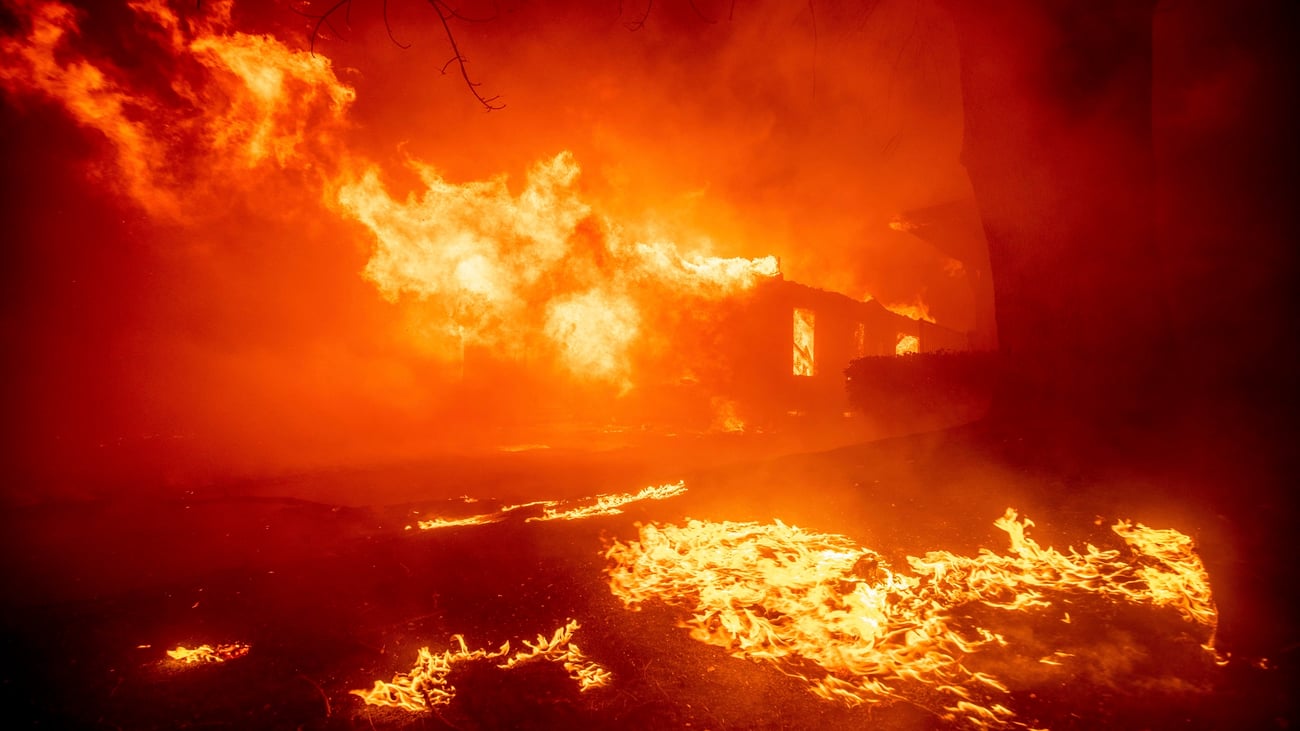
Insurance companies hoping to recover their payouts to policy holders will likely have to go to trial to prevail on their claim Edison's equipment contributed to the fire damage.LOS ANGELES (CN) — Southern California Edison on Tuesday at least temporarily survived a bid by insurance companies to find the utility liable under their inverse condemnation theory for their losses from last year’s Eaton Fire in Los Angeles County.LA County Superior Court Judge Laura Seigle tentatively denied the insurers’ motion for summary judgment because, she said, they hadn’t met their burden to show that, as a matter of law, wildfires are an inherent risk of Edison’s idle power lines.The judge didn’t issue a final ruling at the hearing in downtown LA but took the the motion under submission.The so-called subrogation plaintiffs — who have paid their policy holders’ claims from the wildfire and now seek to recover these payments from Edison — claim the massive Eaton Fire was caused by two electrical arc flashes at an out-of-service utility tower in a canyon above the Altadena community northeast of downtown LA.“Nobody disputes what happened,” Adam Romney, an attorney for the plaintiffs, told the judge. “This sequence of events could not occur if the tower wasn’t there.”Under California law, a public utility can be sued for inverse condemnation if their equipment causes damage to private property notwithstanding whether the utility was negligent or not. This legal cause of action has become a huge headache for Edison, PG&E and Southern California Gas as massive wildfires caused by their equipment have become a more and more frequent occurrence in the state.The Eaton Fire that erupted Jan. 7, 2025, was the fifth deadliest and second most destructive fire in California history, killing at least 19 people, destroying more than 9,000 buildings and burning over 14,000 acres.Insured losses from the Eaton Fire were as high as $17.5 billion, according to an April 2025 report by Aon plc.The fire broke out the same day as the Palisades Fire on the opposite side of LA County, which killed 12 people and leveled more than 6,800 buildings, including homes in the Pacific Palisades, one of the wealthiest neighborhoods in the city of LA.To prevail on their inverse condemnation argument, the insurers must not only show that there is a causal connection between the utility’s equipment and the damage to private property, they must also show that the damage was substantially caused by an inherent risk created by the design, construction and maintenance of the equipment.The judge said in her tentative ruling the plaintiffs failed to provide evidence that Edison’s equipment in question, which hasn’t been used since 1971, presented an inherent risk of causing a wildfire.The purported uncontested matters of fact that the plaintiffs relied on, she said, do not specifically address the question of fires resulting from idle power lines and facilities.“These facts and underlying evidence do not establish that a wildfire is an inherent risk of SCE’s idle lines as a matter of law,” Seigle said in her tentative.Douglas Dixon, an attorney representing Edison, agreed with the judge that a “but for” causal connection between the fire and the utility’s out-of-service equipment wasn’t enough by itself for the plaintiffs to prevail on their inverse condemnation argument.If the judge sticks by her tentative ruling, the subrogation plaintiffs can try to persuade her at a bench trial that they are entitled to damages under the inverse condemnation theory.Subscribe to our free newslettersOur weekly newsletter Closing Arguments offers the latest about ongoing trials, major litigation and rulings in courthouses around the U.S. and the world, while the monthly Under the Lights dishes the legal dirt from Hollywood, sports, Big Tech and the arts.Additional Reads
SoCal Edison sidesteps insurers’ inverse condemnation bid over Eaton Fire
Full Article
Original Source
Read the full article at Courthousenews →KhanList aggregates and links to publicly available news content. We do not host full articles from third-party sources. Always verify important information with original sources.