
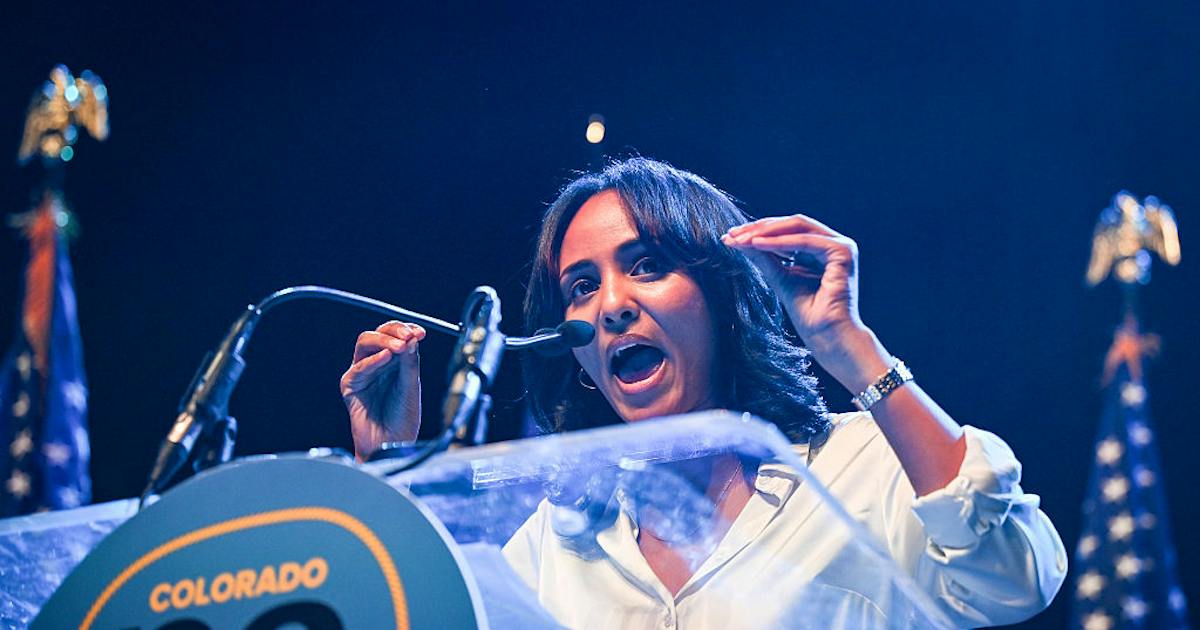
You’re reading The TNR Blue Book. Get daily scoops, strategy, and developments inside the liberal ideas factory delivered right to your inbox. Sign up for free.Inside Washington Democrats have won a massive majority in the House, and amid the celebrations, different factions of the party will be clamoring to claim credit for the blue tsunami. Was it the progressives, the centrists, or even the Bernie dogs who carried the party to victory? And which faction will be calling the shots come January?The answer, to some extent, depends on who you ask. “A Democratic majority is really going to be built on the back of moderate candidates in the House,” said David de la Fuente, deputy director for politics and research at the centrist group Third Way. He pointed to moderate candidates who eventually won on Tuesday night, like Jared Moskowitz in Florida’s 25th congressional district or Bobby Pulido in Texas’s 15th congressional district.Meanwhile, Usamah Andrabi, the communications director of progressive group Justice Democrats, argued that progressives brought the energy and policy platforms that turned the tide. “The mandate from voters across this country is for this majority to look like what many Democrats finally learned to campaign on, which is taking on corporate interests to deliver on an affordability agenda that actually helps working class communities,” he said. “They finally listened to the left.”Andrabi pointed to Justice Democrats’ massive wins this cycle; it was their most successful year by far. The group is poised to send at least seven leaders to Congress, including Donavan McKinney in Michigan, Darializa Avila Chevalier and Claire Valdez in New York, and Melat Kiros in Colorado. These electeds will be joining fellow progressive firebrands like Representatives Alexandria Ocasio-Cortez, Rashida Tlaib, and Greg Casar in Congress. As it stands, the Congressional Progressive Caucus currently has 101 members, while the New Democrat Coalition, which includes more centrist lawmakers, touts 114 members. While it’s too soon to say definitively how those numbers will change, the Congressional Progressive Caucus PAC suggested that the caucus might be adding “over 20” new members, according to an email the group sent previewing a later press call.“Typically, the Congressional Progressive Caucus is bigger than the New Dems when Republicans control the House, and the New Dems are bigger than the progressives when the Democrats control the House, and that’s because, essentially, the New Dems tend to be the majority makers,” de la Cruz said. The term “majority maker” comes from former House Speaker Nancy Pelosi, who famously called the moderate-to-conservative Blue Dogs the “majority makers” for their success in unseating Republicans and contributing to the Democratic majority.But some progressive candidates overturned that orthodoxy on Tuesday. In Michigan’s 7th congressional district, Sunrise Movement co-founder William Lawrence prevailed despite running in one of the most competitive districts in the county, and facing the most Republican spending of any House candidate this cycle—more than $23 million. Similarly, in California’s 22nd congressional district, Randy Villegas declared an early victory over Republican Representative David Valadao, a testament to the size of his win (usually, California results trickle in slowly).Trying to tally up the number of seats that will soon be held by progressives versus moderates creates another problem: “It suggests that there’s just a kind of monolithic progressive ideology and a monolithic centrist ideology, and in my experience, it’s not quite that simple,” Democratic strategist Oliver Libby said.This year, that question became even more complicated with the emergence of a number of so-called Bernie dogs—candidates endorsed by both the Blue Dogs and Senator Bernie Sanders. Those candidates include Sam Forstag in Montana’s 1st congressional district, Rebecca Cooke in Wisconsin’s 3rd congressional district, Brian Poindexter in Ohio’s 7th district, and Bob Brooks in Pennsylvania’s seventh district. All four won.A more useful way of analyzing the Democratic majority—and predicting what they might do come January—could be to look directly at what policies they ran on, regardless of how they identify ideologically. That could help reconcile the simultaneous successes of moderates, progressives, and Bernie dogs, the Progressive Change Campaign Committee suggested in an Election Day memo. These winning policy platforms—including anti-establishment fights against data centers and surveillance tech, oversight of AI companies, and affordable health care—could ultimately provide a roadmap for Dems in 2028 and beyond.—Emma JanssenOutside WashingtonThe humble “I Voted” sticker could turn out to be one of the enduring images of this election. On October 19—the first day of early voting in Texas—Ronaldo Salgado cast a ballot and placed his voting sticker on Houston’s makeshift memorial to his father, who was shot and killed by an ICE officer this summer. Amid a historic rise in early voting, hundreds of other voters proceeded to follow Salgado’s lead, leaving “I Voted” stickers or other messages at the memorial to Lorenzo Salgado Araujo. On Tuesday afternoon, MPR News and other outlets reported that the practice had spread to Minneapolis, with local affiliate Fox 9 reporting “dozens” of “I Voted” stickers at the memorials for Alex Pretti and Renee Good, both of whom were shot and killed by an ICE agents in January.Elsewhere:James Talarico, Gina Hinojosa, and Nathan Johnson won the Senate, gubernatorial, and attorney general races in Texas last night—breaking a 32-year Dem losing streak in statewide races. But if we’re talking long losing streaks: No Democrat has held a seat on the Texas Railroad Commission—an underappreciated body with huge and little understood power to regulate the fossil fuel industry—since 1990. On Tuesday, though, Democrat Jon Rosenthal claimed victory over Republican Bo French, a candidate so prone to nakedly racist rhetoric that even Karl Rove denounced him in The Wall Street Journal in September and vowed to vote for Rosenthal.As of publication time for this newsletter, the race in New Jersey’s 2nd congressional district has not been called. Multiple outlets have reported, however, that four-term Republican Representative Jeff Van Drew has conceded to Democrat Zack Mullock. This is another race that longtime watchers of Democratic politics are going to be talking about today—particularly if a formal winner emerges. You can read more about this race—Van Drew, who used to be a Democrat, “has certainly earned the everlasting animosity of Democrats in the district,” Micah Rasmussen said—in Emma Janssen’s prior TNR Blue Book reporting here. Just a few weeks ago when this was written, analysts that she talked to still thought a Mullock victory was a long shot. Early Wednesday morning, Mullock led by nearly 8,000 votes, with 92 percent in.—Heather Souvaine HornIn ClosingPolitical Trivia Question of the Day If Scott Colom wins in Mississippi, he’ll be the state’s first Black senator since Reconstruction, when two Black men were elected to the Senate from the state. Can you name either? (Sign up for The TNR Blue Book to find the answer in tomorrow’s newsletter.)—Michael TomaskyYou’re reading The TNR Blue Book. Get daily scoops, strategy, and developments inside the liberal ideas factory delivered right to your inbox. Sign up for free.Inside Washington As votes roll in throughout Election Day, most eyes will be on the balance of the House and Senate. But in some states, voters will be directly deciding on some of the biggest political questions of the decade—including how to run a modern democracy. Ballot initiatives in some states could reduce voters’ rights and power. In others, voters have the chance to enshrine those rights and reject partisan gerrymandering.“Amid rising authoritarianism, the fight for democracy is also happening through ballot initiatives,” said Chris Melody Fields Figueredo, the executive director of the Ballot Initiative Strategy Center. “This year, we’re seeing more attacks from politicians on voters’ rights,” agreed Hannah Ledford, the deputy executive director at the Fairness Project. “And voters are having to defend those rights at the ballot box more than ever really, in an election.”Six states are considering voter ID rules, some of which mirror President Donald Trump’s SAVE America Act. Ohio and North Carolina already require identification at the polls, but ballot measures would put that in the states’ constitutions. Nevada, too, is trying to amend its constitution to require photo ID to vote. Arizona has a measure requiring those voting by mail-in ballot to somehow show ID. Even in blue California and Colorado, voters will consider similar measures. Experts say that voter ID laws end up suppressing the votes of Black voters, students, and Native voters, while failing to actually address election fraud (which is exceedingly rare).In North Dakota, South Dakota, and Utah, voters will decide on measures that would make it harder to pass constitutional amendments in the future. Experts say that could remove a key source of power for voters by making it harder for them to practice direct democracy. In recent years, voters have used ballot initiatives to enact progressive policies like raising the minimum wage or protecting abortion rights—to the chagrin of conservative legislators. “Politicians that are really upset with the progress that voters have made in their backyard, trying to take direct democracy back, they are trying to make it harder to use and harder to pass things at the ballot box,” Ledford said.Some ballot initiatives, though, give voters the opportunity to enshrine their rights. Missouri’s Amendment 6 would require 80 percent support in both legislative chambers and another statewide vote to change laws approved by voters or enact laws that voters rejected by referendum. That’s crucially important in a state where voters have approved progressive multiple ballot initiatives that the Republican legislature has then altered or outright reversed. “Voters in Missouri just two years ago passed the right to reproductive freedom at the ballot box. The legislature is trying to take it away and install a near-total abortion ban in the state, and voters are going to decide tomorrow whether or not politicians overreached,” Ledford said. Similar things have happened with paid sick leave and raising the minimum wage.Missouri will also be voting on gerrymandering—specifically, via Proposition A, the redrawn 2025 map that the Supreme Court blocked for this election. “Voters in Missouri, it feels like we are in a battle with our elected officials to have our voices heard, and it’s really frustrating,” said Richard von Glahn, the executive director of People Not Politicians, about the gerrymandered maps. He’s hopeful that voters will reject the Republican maps and, through Amendment 6, will block Republican legislators from reconsidering the maps next year. “Missourians were so angry about seeing our elections really just rigged like this,” he said, “that we actually gathered about three times as many signatures as was needed” to get Prop A on the ballot. “Voters are really indicating that they should be the central focus of our democracy and the ultimate power brokers.”These battles, which could shape the state of U.S. politics for years to come, will be playing out not just through voting rights and gerrymandering measures, but also through ballot initiatives that address abortion and trans rights. Fields suggests watching these initiatives to get a preview of future strategies to restrict bodily autonomy for women and LGBTQ individuals. “I do think ’26 is a testing ground,” she said, “for what conservatives may go full throttle [on] in 2028.”—Emma JanssenOutside WashingtonDemocrat Josh Turek’s race against Republican Ashley Hinson in Iowa could decide the balance of the Senate. On Monday, the Des Moines Register’s Stephen Gruber-Miller reported on the Republican National Committee’s self-described all-out attempt to sway the outcome. Among the efforts: The RNC and the Hinson campaign have executed the first “coordinated ad buy”—which a Supreme Court ruling made possible this summer—worth $5 million. It’s not the only last-ditch Republican attempt to win the state, but this one sounds a little more organized than President Donald Trump’s off-script remarks at a rally in Dubuque over the weekend, wherein he inexplicably went on a tangent about Hinson’s weight loss. The last New York Times/Siena poll had Turek up by one point, which was well within the margin of error.Elsewhere:On Monday, supermarket chains in multiple European countries reported that their cold storage systems had been targeted in a cyberattack overnight, with temps rising as high as 122 degrees, rendering the food unusable. A similar attack occurred in France last month, and the latest cold storage failure in Europe arrived days after Reuters reported, based on anonymous sources, that the Pentagon is treating cold storage failures that happened on military bases in August as a cyberattack, as well. It’s hard to overstate how crucial networks of cold storage facilities (known as the “cold chain”) are to both food and medicine supply chains in the present world—both domestically and for international trade.Media outlets and experts alike were already facing a difficult balancing act on the topic of threat preparedness. But then last week, news on three separate but related fronts raised further alarms: Pete Hegseth’s “FORTRESS America” initiative instructing U.S. military bases to prepare for 90 days without grid power, former Trump FBI Deputy Director Dan Bongino’s call for nationwide household prepping, and the British government’s new “Be Ready” campaign urging people to stock up on canned goods and emergency radios. Combined, those caused a fair amount of anxiety in certain circles. “The line between giving people solid, grounded, actionable information and stirring panic is incredibly fine,” Texas A&M professor Angela Clendenin told Fox Baltimore when asked about Bongino’s remarks in particular. But, properly executed, “preparedness avoids panic,” she added. Several experts, both in the Fox Baltimore piece and in a Guardian piece published on Monday, noted that the U.S. has long recommended that people keep several days’ worth of supplies on hand—and that Trump-era cuts to federal emergency management, along with everything else, have made this an even better idea. —Heather Souvaine HornThe Ideas FactoryIn a new report titled “Tracking the Return on Investment of Trump’s Backers,” the Center for American Progress’s Devon Ombers, Ryan Koronowski, and Will Ragland estimate that more than 75 “individuals and entities” have donated almost $1.7 billion to Trump’s pet projects, and in return, they “have reaped or will reap benefits conservatively estimated at approximately $183 billion.”A new report from Arnav Rao at Open Markets Institute warns that robotaxis could “extend Big Tech’s monopoly power from the digital world into the physical world, putting the future of American transportation under the control of just a few, already-dominant corporations.” Instead of fixating on whether driverless cars are safe, Rao argues, policymakers should be looking at, for example, breaking up vertically integrated monopolies and ensuring that regulators have the tools that they need for this new landscape.—Heather Souvaine HornIn ClosingFour Questions For: Tim Grieve, editor in chief of The Washington Sun Q: Who are you, and what are you working on right now? A: I’m the editor in chief of The Washington Sun, the news publication formerly known as NOTUS. And here’s a sentence you won’t hear a lot in journalism: I spend most of my time hiring. We dove in when The Washington Post pulled back—expanding our coverage of political Washington and adding coverage of local news and sports. We’re the fastest-growing newsroom in D.C., and maybe the world: We started 2026 with 45 journalists. We’re at 110 today, and we’re just getting started. Q: The Washington Sun is launching at a time of layoffs, consolidation, and growing billionaire control of the media. What does a news organization have to do differently to build something durable in this environment? A: Hire the best people, be disciplined about what you do, and find a revenue model to support it. No problem, right? Q: Washington reporting can be a breed of its own, with its fixation on access, insiders, and the daily churn of politics. What does the D.C. press corps understand well, and where does it still have blind spots? A: Not surprisingly, the D.C. press corp understands … D.C. We’ll find out this week how well we understand the rest of the country. Q: What do people outside Washington misunderstand about the way journalism works here? A: Way too many people think that journalists just make stuff up. There have definitely been a few famous fabulists in journalism history. But I’ve worked in this business off and on for more than 40 years, and I can’t think of a single time one of my colleagues made up a story or fabricated a quote, a source, or a fact. Do we get things wrong sometimes? Sure. But journalists at reputable news organizations try very, very hard to get it right.Interview by Indigo OlivierPolitical Trivia Question of the Day You’ve undoubtedly heard over the course of the campaign that Kansas last elected a Democrat to the Senate in 1932. But how many Democrats has the state sent to the Senate in its entire history, going back to 1861? (Sign up for The TNR Blue Book to find the answer in tomorrow’s newsletter.)—Michael TomaskyYou’re reading The TNR Blue Book. Get daily scoops, strategy, and developments inside the liberal ideas factory delivered right to your inbox. Sign up for free.Inside Washington What if the polls are wrong?With four days until the election, Democrats terrified of another disappointment are focused on one big question: Are the polls right? Most polls show Democrats winning the House and, potentially, the Senate—a possibility that seemed improbable even a few months ago. A new CNN poll on Thursday, for example, showed Abdul El-Sayed and James Talarico in strong positions. But the most critical toss-up Senate races are so tight that even a polling error of a few percentage points could shift the outcome from Democratic control to two more years of Republican leadership. FiftyPlusOne modeled how the election would look if polling misses matched those in the 2018 and 2022 midterms, or instead matched 2016, 2020, and 2024—presidential election years when Trump was on the ballot. “The polling errors have been much larger in presidential years than non-presidential years,” explained Guy Molyneux, a Democratic pollster and partner at Hart Research. If polling averages are off by roughly the same margins that they were in the Trump election years, seats like Michigan and Ohio—critical pickups for Democrats this year—could fall to Republicans. Senator Susan Collins could win Maine by nearly four points, and Senator Dan Sullivan could take Alaska by five. In that case, Republicans could keep the Senate. But if this midterm looks more like other midterms in terms of poll error, Democrats might even be able to pick up seats in red states like Iowa and Kansas.Molyneux says he’s inclined to believe that this year’s polls will be closer in accuracy to the 2018 and 2022 polls, which would be good news for Democrats’ prospects. Most election-watchers predict that Democrats will take the House, but nobody is sure whether it will be a blue wave or a blue tsunami. If polling is roughly correct, Democrats could take 238 seats (218 seats is a majority), NBC News estimates. But Dems could potentially pick up some 260 seats or win as few as 220. That’s a majority, but a narrow one.Polls aren’t the only data points people can use to understand the election, stressed Simon Rosenberg, a Democratic strategist. He sees hints of a Democratic advantage everywhere: “We’ve seen it in the candidate fundraising data, where our candidates have raised way more money than their candidates have, which is a far better indication of intensity than the checkbooks of ten oligarchs,” he said—referring to Democrats’ advantage with grassroots donors and Republicans’ advantage with super PAC money funneled from ultrawealthy donors like Elon Musk. Rosenberg also pointed to the fact that Republicans are campaigning in states like Mississippi, South Carolina, Kansas, and Nebraska—areas that ordinarily shouldn’t pose a problem for Republicans. “There’s a lot of inputs here. It’s not just, you know, a handful of New York Times polls in the last few weeks,” he said. Early voting data also suggests that Democrats are in a strong position. As of Thursday, 43 million Americans have already voted, according to the University of Florida’s Election Lab. Hispanic voters have turned out in higher numbers than they did at the same times in 2022 and 2024, which could be a promising trend for Democrats and help candidates like James Talarico in Texas. (Though Hispanic and Latino voters helped Trump win in 2024, some polls have found that only 24 percent of Latino registered voters approve of Trump’s handling of his job, down from 38 percent at the start of his second term.)In the final stretch before Election Day, experts stress that voters should view polls as part of a larger picture, rather than overinterpreting any one number (remember J Ann Selzer’s Iowa poll in 2024, which predicted that Vice President Kamala Harris could win Iowa but was 16 points off?). “Both for accuracy and emotional health, I would urge people to focus mainly on the averages, and not the either scary or hopeful news of the day,” said Molyneux. Though Rosenberg doesn’t like polling averages, he also recommends looking at multiple polls instead of just one, and trying to find a way to live in the uncertainty. “There’s far less certainty in the data that [voters are] being presented than you assume based on how certain it looks when on television you see a graph that has two numbers,” he said. “It’s only a snapshot in time.”—Emma JanssenOutside WashingtonLast-minute polls are rolling in, along with last-minute attack ads. CNN’s latest poll, published on Thursday, has James Talarico leading Ken Paxton in Texas (49–43), Abdul El-Sayed leading Mike Rogers in Michigan (49–42), and neck-and-neck races in Maine and Kansas. While Troy Jackson and Adam Hamilton appear to be leading their Republican opponents 49–45 on paper, there’s a margin of error of 4.5 percentage points. Attack ads in Maine—as in other states—are getting increasingly ugly in the final stretch. Republican Senator Susan Collins last week disavowed a new Republican super PAC ad featuring a song about Jackson that goes: “If he’ll screw his own family, he’ll screw yours too.” But as Jackson’s campaign has pointed out, Politico’s Jonathan Martin asked Collins in a video interview last month whether Jackson’s personal life was “fair game,” and she replied, “Well, I’m not going to bring up the fact that the mother of his two children is his second cousin. I don’t know whether people know that or not.” Meanwhile, in Texas, a super PAC largely funded by Elon Musk recently ran an ad with evangelical influencer Miriam Evans, saying, “Every mom in Texas should be concerned about James Talarico.” The ad (falsely) claims Talarico supports gender-affirming surgeries for minors and jail time for parents who object. In another one of the group’s ads, Tarrant County Sheriff Bill Waybourn opens: “Folks, I’m going to ask you: Where has James Talarico been?” After a pause in which viewers may wonder whether Waybourn’s about to bust the candidate’s alibi in a multiple homicide investigation on Law and Order, Waybourn proceeds to say that Talarico has “been in Austin standing with and donating to a radical group that wants to defund the police”—an apparent reference to Talarico appearing on a video call organized by Texas progressive youth group Texas Rising six years ago. In his own last election in 2024, Waybourn drew scrutiny for the number of people who had died in county custody since he took office in 2017—65 deaths, as compared to 25 in the prior eight-year period—along with a lack of independent investigations as required by law. As of October 18, the number of deaths in Tarrant County Jail during Waybourn’s tenure has increased to 79.Elsewhere:Is it time for Democrats to forgive Ralph Nader for the 2000 election and recognize that he was right about a lot of stuff? The Guardian’s Heather Timmons examines the case, speaking not just with Nader but a variety of think tankers and others on the left, including Robert Weissman of Public Citizen (which Nader co-founded), Lindsay Owens of Groundwork Collaborative, Barry Lynn of Open Markets Institute, and—surprise?—Matt Bennett of the moderate Dem group Third Way. Nader, Timmons reports, has recently “been dialing progressive candidates including Michigan’s Abdul El-Sayed and Maine’s Troy Jackson directly, to present his policy plan he thinks would guarantee their midterm success.”—Heather Souvaine HornThe Ideas FactoryAlasdair Phillips-Robins, Teddy Tawil, and Sam Winter-Levy penned an interesting report for the Carnegie Endowment of International Peace this week about “how middle powers can survive the AI race.” The fundamental problem, they write, is that the U.S. and China control most of the resources. Other countries, “fearful of missing out on the benefits of advanced AI while still bearing the brunt of its harms, are scrambling to respond.” The right strategy for those governments will depend on both the speed of innovation and “the gap between the best systems and open-source or other cheap alternatives.” But “finding sources of leverage at supply chain chokepoints is valuable in almost every technological future.” Sounds … fun. (Warning: This report is unlikely to make you feel better about the AI-riddled future. But there are fancy graphics, if that’s your jam.)The Natural Resources Defense Council has issued a statement on the Trump administration’s proposed rollback of methane leak rules. “Methane leaks are the dumbest kind of pollution because the industry is losing the very product it is selling,” David Doniger, a senior attorney and strategist at the NRDC, said in the organization’s press release. “These leaks are not just bad for the climate, they result in more smog and cancer-causing pollution for nearby communities.”—Heather Souvaine HornIn ClosingGood Week: Barack ObamaThe former president has been making campaign stops as he does for Democrats every election—and is in fine form. His zingers and humor have gotten under Trump’s skin, galvanized Democrats, and made news in the usually slow days right before the end of the campaign. Bad Week: Darline GrahamGraham, who was appointed to be South Carolina’s senator earlier this year after her brother Lindsey—who previously held the seat—passed, has become the poster child for bad candidates. Other Republicans are blasting her as unqualified and such a terrible campaigner that she’s making it possible for Democrats to potentially win in a state where they almost never do. —Perry BaconPolitical Trivia Question of the Day When was the last time Louisiana was represented by two Democratic senators, and who were they? (Sign up for The TNR Blue Book to find the answer in tomorrow’s newsletter.)—Michael TomaskyYou’re reading The TNR Blue Book. Get daily scoops, strategy, and developments inside the liberal ideas factory delivered right to your inbox. Sign up for free.Inside Washington Republican Mike Lawler and Democrat Cait Conley are in a dead heat for the race in New York’s 17th congressional district. Lawler is painting Conley as a radical socialist, while Conley is tying Lawler to President Donald Trump and MAGA. Only one of those strategies is rooted in fact, but either could wind up deciding a race that could, in turn, determine what the next Congress looks like. If Lawler wins, it could also set him up for a higher office, experts say.Polls show a tight race, and the Cook Political Report lists the 17th as a “toss-up.” The district is one of the most centrist in the country—one of just three, nationwide, that voted for a Republican congressperson while also voting for Vice President Kamala Harris in 2024. The district’s Democratic lean has decreased over time, Lawler is quick to point out: President Joe Biden won it by 10 points in 2020, while Harris won it by less than one point.“There’s not a minute in this campaign that we’ve ever thought that he would be easy to beat,” said Jennifer Colamonico, the chair of the Putnam County Democratic Party, about Lawler. In Putnam County, volunteers have knocked on four times the amount of doors than they knocked on in 2024, and Colamonico says that Republicans and independents have been more receptive than they were last cycle. She attributes that in part to Lawler’s association with Trump, who is deeply unpopular in the district and the country.Experts agree that Lawler’s closeness to Trump—the president visited the district in May—could cost him the seat. “Lawler was originally able to wear the mantle of change when he beat the incumbent in 2022, but he now has been in office and is tied to an extremely unpopular president in a district that the president lost,” said Laura Tamman, a professor of political science at Pace University.As Conley attempts to tie Lawler to Trump, especially by emphasizing his vote for the One Big Beautiful Bill Act, Lawler and his allies have tried to tie Conley to New York City Mayor Zohran Mamdani and the Democratic Socialists of America (DSA).“There’s not a ton of evidence that Cait Conley, who served in the military and in the Biden administration, is super tight with Mamdani,” said Tamman. “Like, she’s not in the same city. She shares the same party, but she doesn’t have Mamdani out campaigning for her.”The fact that neither Conley’s platform nor her past fit with the radical socialist attack makes no difference, Colamonico explained. “It doesn’t matter who we run,” she said. “They were going to come at us as being socialists and aligned with DSA and Mamdani.”This narrative about Conley being a secret socialist has been boosted by money from Elon Musk’s super PAC, America PAC. Through that group, Musk has spent more than half a million dollars to boost Lawler. Colamonico has seen the influence of that money firsthand, describing floods of mailers that call Conley a socialist and canvassers dropping off door hangers with the same message.While the narrative about Conley appears to be baseless, it could hurt her with the district’s Jewish population, experts said. Some of those voters are frustrated with the DSA’s position on Israel and could be inclined to vote for Lawler because of it, despite the fact that Conley doesn’t share the DSA’s positions on Israel. In Rockland County, specifically, there’s a large Orthodox Jewish population that experts say Lawler needs to back him. “It would be very difficult for him to win without them showing up enthusiastically for him,” Tamman said.Despite the unfavorable environment for Republicans, Lawler could still pull off a win. If he does, then it could have even bigger implications in 2028 or beyond. “If Mike Lawler does survive this year, I think you’ll have a lot of talk of him being a statewide candidate in the future,” said Shawn Donahue, a professor of political science at the University at Buffalo who pointed to the potential for Lawler to run for Senator Chuck Schumer’s seat. Tamman suggested that he could seek the governorship. House Speaker Mike Johnson may have said it best on Tuesday while campaigning in the district with Lawler: “Everybody around America is watching this election. Everybody.”—Emma JanssenOutside WashingtonAnother thing potentially hinging on the outcome of next week’s elections: whether fire survivors are able to rebuild their homes. CalMatters’s Levi Sumagaysay this week reports on the status of survivors of the Los Angeles fires, an estimated 28 percent of whom have run out of so-called displacement coverage. Federal Emergency Management Agency (FEMA) funding for renters ran out on October 9, and the Trump administration so far hasn’t supported further FEMA funds being directed to California. “People are wondering if they have to live out of their cars and pull their kids out of school,” Altadena Tenants Union co-founder Katie Clark tells Sumagaysay. Democratic Representatives Norma Torres and Judy Chu tell Sumagaysay they’re hoping that if Democrats win big in the midterms, a newly Democratic House could help get money moving.The Guardian’s Oliver Milman talks to residents of Southaven, Mississippi, who say that Elon Musk’s AI company xAI, which is currently constructing a massive data center complex with an on-site power plant, has offered to buy their homes “as the owners agree to not join a lawsuit against the company over the power plant’s noise.” Come for the window into data center politics, stay for the spicy quotes from a paramedic, a piano teacher, and other residents who are more or less telling the company to take their offer and shove it.—Heather Souvaine HornThe Ideas FactoryOn Thursday at 1 p.m., the Urban Institute will host a “virtual workshop exploring how local leaders can foster dignity and belonging in their communities—and why these conditions are essential to advancing upward mobility.” Speakers will include the institute’s Myriam Hernandez Jennings and Isabella Remor, as well as Ricki Ellison of the Greater Wichita Partnership and Marshall Ogier of Seeding Success.On Thursday at 3 p.m., the Brookings Institution and the American Enterprise Institute (AEI) will co-host an event on how to modernize the Current Population Survey (CPS), which is the basis for calculating the unemployment rate. One possible reform to be discussed: a way to add an online component instead of relying on in-person and phone interviews, which are increasingly struggling with non-response rates. Speakers will include the Census Bureau’s CPS Director Kyra Linse, Nicholas Johnson from the Bureau of Labor Statistics, Tom Evans from the U.K.’s Office for National Statistics, New York Fed economic research advisor Wilbert van der Klaauw, Michigan Federal Statistical Research Data Center co-director Joelle Abramowitz, OpenAI economics researcher Alex Martin Richmond, University of Maryland professor Katharine Abraham, and Georgetown University professor Diane Whitmore Schanzenbach. Brookings’s David S. Johnson and John Sabelhaus and AEI’s Michael R. Strain will moderate.—Heather Souvaine HornIn ClosingHere’s Why That’s B.S.TNR’s Edie Olmsted reviews the troubling allegation in House Dems’ new report: former Miss Switzerland Beatrice Keul saying Donald Trump raped her in 1993 when she was a contestant at his American Dream Pageant in New York.Political Trivia Question of the Day Though it’s been Republican for many years now, when Alaska became a state in 1959, its first two senators were both Democrats. The name of one is mostly lost to history. The other, however, made a name for himself as an early and vocal opponent of the Vietnam War and was one of only two Democrats to vote against the Gulf of Tonkin Resolution, which the Johnson administration pushed to authorize U.S. intervention. Can you name either man? (Sign up for The TNR Blue Book to find the answer in tomorrow’s newsletter.)—Michael TomaskyYou’re reading The TNR Blue Book. Get daily scoops, strategy, and developments inside the liberal ideas factory delivered right to your inbox. Sign up for free.Inside Washington Here are the gerrymandered districts to watch on election night When Republicans set out to redistrict in the middle of the decade, they thought they were all but ensuring more seats in the House. But, one week before the midterm elections, many of Republicans’ tailor-made districts are looking vulnerable.Texas was the first state to redistrict in 2025 under pressure from the White House, kicking off a nationwide flurry of gerrymandering in red and blue states alike. Across the country in the past year, Republican-controlled state legislatures have drawn maps that increased their advantage in 16 districts, with five of those districts in Texas and four in Florida. Those two states are epicenters of the Republican gerrymandering effort. But, according to polling and ratings from the Cook Political Report, only one of those nine districts is projected to be a sure Republican win next week, and the others will be competitive.When Florida and Texas first unveiled their new maps, critics immediately noted that the districts appeared to be drawn based on race. They argued that Republicans carved up Black and Latino districts to dilute the political power of those voters. A federal court ruled that Texas’s gerrymandering was, in fact, illegally racially based, but the Supreme Court sided with the state and allowed the new maps to stand.This race-based gerrymandering now appears to be backfiring. Republicans, explained Tom Bonier, senior adviser at political data firm TargetSmart, were “counting on levels of support from Hispanic voters that at least came close to Trump’s 2024 levels of support.” But now it appears “that calculation is going to be very much incorrect.”Early voting numbers and polling suggest that Latino voters are reversing their 2024 support for Republicans and turning out to vote for Democrats, at least in part because of the Trump administration’s devastating crackdown on immigrants. Gerrymandering may have exacerbated the problem. “It should have been expected that people are going to be very unhappy with the Republican strategy of undermining political power of African Americans and Latinos,” said Kareem Crayton, vice president of the Brennan Center’s Washington, D.C., office.In addition to nationwide trends favoring Democrats this year—frustration with the president and Republicans broadly, as well as affordability concerns—young professionals are moving to states like Texas and Florida from more expensive areas, like California. The newcomers are subtly shifting districts’ demographics.“Some people have looked at this and they’ve used the term ‘dummymander’ to suggest that Republicans have really shot themselves in the foot with these maps,” Bonier said. “I think that misses the truth, at least somewhat.” Even though these districts are more competitive than Republicans originally hoped, the new maps ultimately still make races easier for them to win and have forced Democrats to spend more than they might have to defend their incumbents.Here are nine districts to watch on election night to gauge the success of gerrymandering in Florida and Texas:FL-9In this Central Florida district, Democratic Representative Darren Soto is running against Navy reservist Dan Green. Polling shows an even race, and the Cook Political Report rates the race as “likely D.”FL-14Trump won this Tampa Bay-area district by 11 points in 2024, but the race is now rated as a “toss-up” by the Cook Political Report. Democratic Representative Kathy Castor, who is leading in polls, is hoping to defend her seat from Republican Mike Beltran.FL-25Democratic Representative Jared Moskowitz is facing Republican Scott Singer in this South Florida district. Polls give mixed messages, but the Cook Political Report moved the race from “toss-up” to “lean D” in mid-October.FL-22Democrat Pia Dandiya is up against Republican Casey Askar. Limited polling shows a tight race, with a small advantage for Dandiya. The race is considered a “toss-up.”TX-32A lack of polling makes this race hard to judge, but a Harvard-ElectIt forecast gives Democrat Dan Barrios only a 20 percent chance of beating Republican Jace Yarbrough.TX-9The Cook Political Report considers this race “likely R” after a leftward shift from “solid R” in late September. Polls show Republican Alex Mealer ahead of Democrat Leticia Gutierrez.TX-35Another toss-up race, and this one could be anyone’s game. Polls show Democrat Johnny Garcia neck-and-neck with his GOP opponent, Carlos De La Cruz.TX-28Democratic Representative Henry Cuellar has held this seat for 11 terms, and recent polls suggest he’ll win another against Republican Tano Tijerina. Last week, the Cook Political Report shifted the race from “lean D” to “likely D.”TX-34Democratic Representative Vicente Gonzales is facing former federal prosecutor Eric Flores in this race, which recently moved left from “toss-up” to “lean D.” Polls suggest Gonzalez is in the lead.—Emma JanssenOutside WashingtonA quarter of American adults experienced medical debt last year, either for themselves or a family member, the Ohio Capital Journal reports this week, based on a study from the Urban Institute. Hospital visits were the biggest reported source of that debt, closely followed by bills to specialist doctors (41.5 percent).This finding comes as medical debt—and medical debt to specialists in particular—continues to roil the unexpectedly competitive Kansas Senate race between Republican incumbent Roger Marshall and Democrat Adam Hamilton. A quick recap: The New York Times reported last month that Marshall, formerly an ob-gyn, sued more than 700 of his patients over past-due medical bills, and, per the Times story, “routinely charged patients an 18 percent annual interest rate.” Hamilton’s campaign subsequently ran an ad featuring a woman who said she was eight months pregnant when she was arrested in front of her two-year-old daughter for missing a $50 payment to Marshall’s office. Marshall’s lawyers then sent a cease-and-desist letter to the Hamilton campaign, alleging defamation, and during a debate last week, Marshall called the allegations “blatant lies”: “This particular patient actually had legal issues in three different counties, she had missed 16 court dates, and I’m sorry about that. We did everything possible to keep them from going to collections. It was a very, very rare situation, but once it was turned over, it was the same process that KU Med Center would do, Via Christi in Wichita. Once we turned them into collections, it was out of our hands.” Hamilton’s camp stood by the ad and has run additional ads featuring doctors and another former patient attacking Marshall over the issue.A GOP PAC returned fire last week by running an ad accusing the church that Hamilton leads of covering up child sex abuse allegations at a church camp. Kansas City Star reporter Matthew Kelly, reviewing court records, dubbed the claim “misleading,” noting that the church “conducted an internal investigation that court records show was inconclusive” and then reported the issue to local law enforcement after another accuser came forward.Elsewhere:Against the backdrop of this year’s cyclospora outbreak, a Washington Post investigation finds that the Food and Drug Administration “rarely inspects the foreign facilities exporting the vast majority of fresh produce to the United States” and has only inspected 7.6 percent of all facilities exporting to the United States since 2009. The past two decades have seen a huge growth in the percentage of American-consumed produce sourced from abroad, the Post’s Caitlin Gilbert and Rachel Roubein report. Meanwhile, “though foreign food inspection numbers were already low, they dipped even further in early 2025. Elon Musk’s Department of Government Efficiency cut FDA coordinators who arranged investigators’ foreign travel, though some were later rehired.”—Heather Souvaine HornThe Ideas FactoryAt noon on Wednesday, New America will host a conversation between Peter Bergen and security and foreign policy researcher Amy J. Nelson about Nelson’s new book, The Arms Control Paradox: Managing Uncertainty in an Insecure World.In case you missed it: Data for Progress this week published poll results in which significantly more voters identifying as disabled (45 percent) reported being “very stressed financially” than voters who did not identify as disabled (25 percent). Thirty-two percent of disabled voters “rate[d] their community’s economic conditions as poor,” while only 19 percent of nondisabled voters said the same.—Heather Souvaine HornIn ClosingBook of the Week: The Rush: California Gold, the Civil War, and the Making of the Modern WorldBy Nathaniel PhilbrickTHE GIST: Philbrick, the author of Mayflower and In the Heart of the Sea, explains how the California Gold Rush helped lead to the Civil War and how its culture of opportunity and greed—and history of booms and busts—is still felt in today’s Silicon Valley.PRAISE: Popular historian deans Jon Meacham, Doris Kearns Goodwin, and Ken Burns have all penned blurbs praising this book. But Erik Larson captured it best: “In The Rush, Nathaniel Philbrick takes the old maxim ‘follow the money’ to an engaging and revelatory extreme,” the author of Devil in the White City writes. “Through an intricate skein of little-known stories, he shows how the discovery of gold in California drove tectonic shifts in the way Americans thought about wealth, and about each other—and in the process fueled the Civil War and today’s mad rush toward who knows what.”CRUISING THE INDEX: This is a sweeping history with a colorful cast of characters both familiar (John C. Fremont, William T. Sherman) and obscure (like David C. Broderick, the sharp-elbowed anti-slavery Democrat who was killed in a duel with the scandal-plagued California Supreme Court Chief Justice David S. Terry). But its value comes from looking where others rarely do: at the discrimination and violence faced by early Chilean and Mexican miners; at the machinations of pro-slavery Southerners who went West; and at how the possibility of extraordinary, quick wealth provoked a frenzy.TNR’S QUICK CRITICAL ASSESSMENT: The Rush puts the Gold Rush—and with it, California—in context, which is to say into the context of American history itself. For Philbrick, the state was not some far-off place where a few men made their fortunes (and, in many cases, quickly squandered them) and many more struggled. It was a state intimately connected to the divisions—racial, ethnic, and economic—that define the United States to this day. Philbrick, the author of Mayflower and In the Heart of the Sea, explains how the California Gold Rush helped lead to the Civil War and how its culture of opportunity and greed—and history of booms and busts—is still felt in today’s Silicon Valley.—Alex ShephardPolitical Trivia Question of the Day What state has had the most female governors? (Sign up for The TNR Blue Book to find the answer in tomorrow’s newsletter.)—Michael Tomasky
So Who’s Running the Party Now: Progressives or Moderates?
Full Article
Original Source
Read the full article at Newrepublic →KhanList aggregates and links to publicly available news content. We do not host full articles from third-party sources. Always verify important information with original sources.