
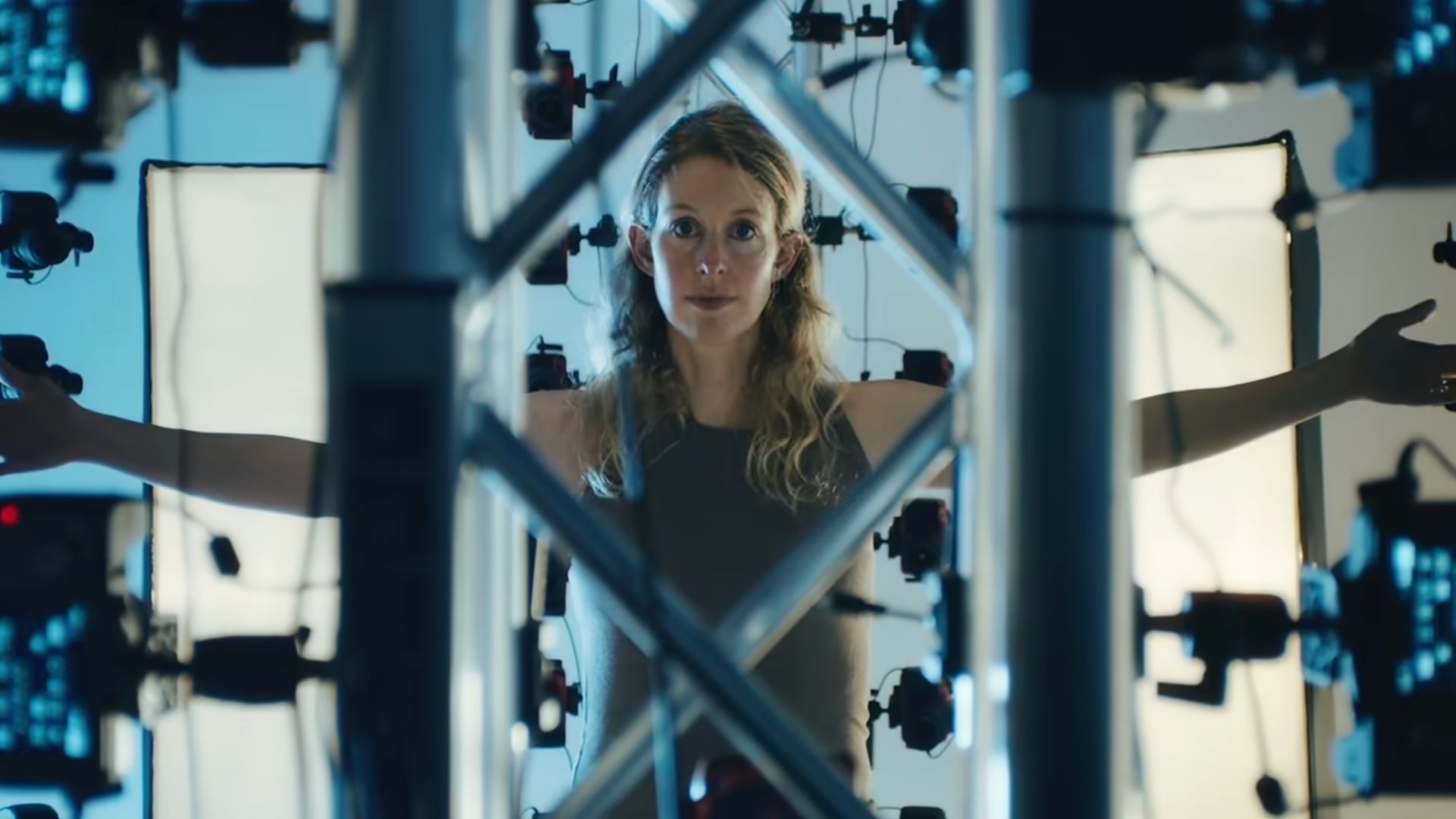
So, You Can See Everything, huh? A few of us here at Kotaku saw Nathan Fielder’s documentary about Elizabeth Holmes, the founder of Theranos, a health tech company that was shut down after Holmes was convicted of defrauding investors in 2018. The basis of the accusations was that the company’s signature device, which Theranos claimed could accurately conduct a vast assortment of blood tests on a single drop of blood, didn’t work as investors were led to believe. The film documents her final weeks with her partner and children before having to surrender herself into federal custody in Bryan, Texas. Kenneth Shepard: And that’s only half of the Everything we See in this movie. So Ash, before we get into all there is to unpack, tell me, what was your knowledge of both Holmes and of Fielder’s work leading up to seeing this movie? Ash Parrish: So most of my initial exposure to Nathan Fielder had been against my will. My first run-in with his work was the first season of his HBO show The Rehearsal where I felt for him both kinship and revulsion. I was fascinated and amused by the Inception-like depth to which he would pursue a subject and the results that would produce in his human guinea pigs. I’ve been hooked ever since. Less so, though, with Nathan for You which I have only seen bits and pieces of because my husband thinks it’s fucking hilarious. That show makes me want to crawl out of my flesh. Far less endearing than The Rehearsal. As for Elizabeth Holmes, I think I saw some of the initial documentaries that had come out about her after her legal convictions but that was it. I didn’t see and didn’t care about The Dropout. But I knew her in broad strokes. © A24 I think what lit my brain on fire with You Can See Everything is I know Fielder can get weird, and that the weirder he gets, the more human a story emerges, either from his subjects or himself (I’m thinking of the time he got a pilot’s license in the purest distillation of commitment to the bit). I wanted to see him work his eldritch neurodivergent truth powers on her to see what shakes out and HO BOY. KS: I have avoided a lot of Fielder’s work because secondhand embarrassment makes me viscerally uncomfortable in a way that my therapist and I have had many conversations about. I watched the first episode of The Rehearsal and was like, “Oh, if it’s only going to get worse from here I have to tap out.” For Holmes, I had only vague recollections of what happened with her and Theranos when the trailers came out because that was absolutely something outside of my orbit. I think I saw those stories coming out and kind of thought, “Ah, an American medical company being deceitful. For me, it was Tuesday.” Never watched The Dropout or really thought much about her again, to the point where when I first saw the You Can See Everything trailer I didn’t immediately recognize her. However, that trailer with Nathan and Elizabeth being inches away from each other’s face and he’s straight up asking her if she’s being deceitful sent chills down my spine. I think anyone who has ever dealt with a narcissist or pathological liar has had a conversation like that, where they’re looking someone in the eye who, whether they truly internally believe it or not, is so committed to the “truth” they’re trying to put out that it’s almost unnerving. I was immediately brought back to a conversation I had in a coffee shop with an ex of mine in college who was very obviously lying to me, and he had to have known that I knew he was lying because I had literally laid out the facts of a situation in a way he could not feasibly debunk, and yet he dug his heels in, and I had that same expression Fielder has in the trailer of just pure annoyed disbelief, and I straight up just said “Why are you doing this?” Like, why are you committing so hard to this when the facts of the matter are laid out here. And so from this scene alone of two people where the dynamic seemed to be one person caught in dishonesty and another person just looking at them and trying to read why they’re acting like this, I felt like I had to see this movie almost as a form of catharsis for a nearly decade-old event. I don’t think I necessarily got that, and obviously after seeing it in the context of the movie, that initial scene is a bit more layered than it originally seemed. But it got me to watch something I would have probably skipped otherwise. AP: How do you feel about Holmes now after seeing the full film? I’m honestly less concerned about her flavor of narcissistic pathology because she, for better or worse, is serving her court-mandated restitution for that. Meanwhile Billy Fucking Evans is a free man breathing free air. KS: That is kinda the big question of the movie, right? Like, ultimately, yeah, Holmes is doing her time, I don’t frankly feel any sympathy for the people she may or may not have ripped off (motherfucking Assassin’s Creed villain Henry Kissinger was on the Theranos board?), so the fraud of it all doesn’t get me. I do think, and obviously all of this is couched as “the movie presents this in a particular way, and that is what we have to cast judgments about,” You Can See Everything does make her a sympathetic figure, and simultaneously makes a whole show of acknowledging the folly of doing so. Because I did genuinely feel for Elizabeth Holmes “the character” as she is portrayed on film. Fielder goes out of his way to show how the slightest gap in what someone says and how it is perceived can lead to a communication shit storm, and whether or not I believe that Holmes actually doesn’t understand those nuances is immaterial to how much I have seen that bullshit manifest every day as a person who works with words on the internet. A headline that people react to because of what they think it means rather than what it actually means is something we see every day in this line of work. So I think the movie showing things like the famous “Who’s on First?” comedy routine is effective in communicating this hypothetical disconnect. But then yeah, is it all an act? Is the way she and Evans basically say the exact same things to him when he’s interviewing them independently a sign that these two are ironclad con artists and Fielder maybe got too close to see it all objectively? Again, those are questions the movie asks and is at least upfront about. I think if Holmes was being honest with Fielder during his prison visit about her knowledge of all the various insane things Evans has been doing both before and during her sentence, then who am I to tell her not to date and have children with a red-pilled Silicon Valley fuckboy when she seems happy doing so? If she didn’t know about all those things, she most certainly will now, and if she chooses to raise a family and a business with him and is truly not in any distress about it, then is this just a rich person’s version of “girl who stays with her shitty boyfriend and makes excuses for him”? © A24 And even that kneejerk reaction feels dismissive because anyone who’s been in an abusive relationship will tell you that you will romanticize it until you can’t anymore. A man putting an AI mock-up of his partner on the internet and just shrugging at the idea of it being used for nefarious reasons? Immediate breakup. That man has no respect for you. The movie outright asks the Stockholm Syndrome question and just kinda feels like it’s hit a wall. Which, you know, ending a movie on “We don’t have a satisfactory answer to all these questions” is as valid a conclusion as any. You can see everything, but you’ll never truly know everything. AP: Yeah I was going to ask: Do you think she’s aware enough to know she should be in distress? My alarm bells as a person with experience with narcissistic / abusive people were ringing off the whole scene with the eggs. But even then I question it because that’s a weird way for someone to whisk eggs. Does Elizabeth know that? Was that scene constructed to reinforce the narrative that she’s just too naive, too neurodivergent, and needs someone like Evans to steer her directly? And her poor children, she had them just before she was sent away. In an interview with Fielder in WIRED, he shared that she patently did not think she was going to jail. And I can’t help but wonder if the sympathy having two little kids running around encouraged was part of a grander scheme. “You can’t send me to jail, look I have babies. Think of them.” KS: Same. I was at the Alamo Drafthouse watching it so I wasn’t about to so much as whisper to my friends sitting next to me during the eggs scene lest their snipers take me out, but I immediately sat straight up in my chair and looked at them like “what the fuck?” And that wasn’t even remotely close to the most fucked-up thing Evans would do during the whole movie. The more charitable read that this is just their dynamic and they’re both content with it is a valid one, but from a filmmaking perspective You Can See Everything does seem to lean into the narrative that something is amiss here from the outset. They both were supposedly okay with this entire documentary project, but she is remarkably open about it, whereas he’s the one who gets cagey about answering questions or Fielder talking to her family for too long. There’s also the added layer of, which I didn’t know going in, her father bringing up that she was raped at Stanford, which is the kind of world-shattering thing that can completely skew your relationships with other people. So again, I feel like the movie wants me to at least consider the charitable and sympathetic angle that maybe she wasn’t deceitful, but instead was someone who has been traumatized by her lived experience and now sees the world through a more neurodivergent lens. The human part of me wants to see it that way, but everything else that’s happening around it makes me hesitant to do so. Like even shit where she’s like “I never let people see me cry” and then seems to just start crying on command. Could Elizabeth Holmes be a neurodivergent woman who has dealt with a lot of trauma, is naive, got in over her head, and is also possibly a pathological liar? Does the founder of Theranos contain multitudes like Walt Whitman once said? © A24 AP: I don’t think those two things are at odds with each other. And this is a way to help one reinforce the other. I believe, like any ND person, myself included, that effective communication is fraught. I don’t, can’t, believe that it could be SO impenetrable to her that she doesn’t grasp why people interpreted the “can” in “This machine can run all kinds of tests” as meaning what Fielder said it meant. If that kind of miscommunication gaffe is the hill you’re choosing to die on… And it’s made more sinister by Evans in that moment being like “See the kind of whimsical spirit she is!” in this gross paternalistic kind of way. KS: It is the weird game Fielder has to play here that he does, to some extent, have to at the very least interrogate those claims and ideas in good faith, no matter how absurd they might sound. Yet even when the movie is connecting these dots of how language can be interpreted in various ways and that she simply sees the world differently and your facts and logic are just trying to diminish her shine, the shadow of a New York Times article that claims Holmes called her public-facing persona a “character” she created looms over everything, and the quote’s validity never debunked in this movie despite Holmes disputing that she said it. So regardless of whatever earnest beliefs she claims to hold, the entire thing is suspect and everyone, Fielder and the viewers, has to live with the constant uncertainty. Then yeah, you have Evans propping all this up while also being more forthright in being a fucking con artist so when any of those aspects of her alleged personality show up I’m like, “how deep does this charade go?” AP: Fielder himself has some suspicion hanging over him too. There was more than one moment in the film where I’m clawing at my husband like “HE BETTER NOT KISS HER.” Then there’s the whole moment about “breaking his rule” to never go in the cold water. And that winds up being the final shot of the film. KS: That thread is interesting because it’s one of the points in the movie where it kind of moves away from typical documentary-style storytelling and into a more traditional, non-documentary narrative. Because the first time we see that is when he goes back to the beach house years later and is looking out to the beach almost wistfully, like he’s distracted. This is when Dropout actor Amanda Seyfried has shown up after being roped into all this, and the movie starts to become more like an overtly authored thing, and Fielder comes into this place with the intention of illustrating his own thought process. Which, you know, Seyfried even asks him at the end if he might have hidden something, kept something out of the movie that would have made Holmes look bad, if he’d grown to care for her, which yeah, the shot of them swimming together seems to communicate that yes, he did grow to care for her and could have obscured something about her, whether intentionally or subconsciously. Whether that means he omitted something groundbreaking or not, he may have, at some point in the project, grown to sympathize with her, which is, in my interpretation, why we get the cut of the film that we do. Which I can imagine is going to get on some people’s nerves because I do think if you’re coming into this movie in the hopes of finding out what “really” happened with Theranos and who Elizabeth Holmes really is, you’re probably not going to get that. To me, a lot of the movie’s underlying thesis is that the pursuit of trying to truly know someone, even someone who claims to be an open book, is a losing game. Everything we know about a person is experienced through a distorted lens, whether that be a projection of how they want to be perceived, our own lived experience informing how we interpret something (like someone’s romantic relationship), or, in this case, a documentary by someone who seems to worry he has become compromised from the objective truth of a person. Even if someone is completely honest with you on just like, a factual level, experiences with people who are less forthright mean we will likely always view them with some level of suspicion. And in some cases that’s healthy, I suppose. It keeps us vigilant and protects us from being overly trusting. AP: I don’t think people are approaching You Can See Everything with the intent to have answered for good and all the question of whether Elizabeth Holmes is lying. I really do think the appeal is to watch two master manipulators have a manipulate-off and to see the depths to which Fielder goes trying to untangle his own feelings about that. In which case, mission pretty well accomplished. © Hulu KS: I think there’s going to be at least some fraction of the audience who might be unaware of Fielder’s work but remember Holmes’ case and are hoping to get some sort of real insight into it all that will not be found here. Because yes, even though the first half is largely presented as a documentary, it’s not until the second half, the half that they deliberately obfuscated from promotional materials, that the Fielder of it all really comes out. Which, we have actually somehow gotten this deep into this conversation and not really touched on. While the first half of the movie documents Holmes’ final days before turning herself in, the second half, which picks up years after the fact, is where Fielder miraculously works through limitations that would have been documentary-ending roadblocks by bringing in Amanda Seyfried, who portrayed Holmes in The Dropout, to perform reenactments of some segments Fielder wasn’t able to film, while also becoming very invested in figuring out the truth herself in a way that was also really fascinating to watch unfold. Now, I was kind of bracing myself for something like this, as she had been a bit cagey about whether she was in the documentary when asked in interviews, and I’d seen theories long before the movie was out that Seyfried would be involved in some way, though they were a little off-base in some ways. How did you react when Seyfried showed up in the flesh? AP: I had no idea she was involved in the movie, but I knew the moment she popped up he’d have her engage in some kind of recreation. “This is The Rehearsal season three.” And it honestly felt good to watch her watch what we’d seen and see her fall into the same trap I did. At the beginning you feel for that woman, you see her, Seyfried, recognize in real time the kind of bastard Evans looks like. Then we all get to go on the same emotional trip together when Fielder reveals the money aspect to her and subsequently us, that Evans had approached A24 executives about getting paid for their participation and convinced them to agree to it!! and how Holmes may not have known about that. The back half of the movie unteasing that aspect was a wild ride. I’m grasping and clawing at my partner, desperate for Fielder’s phone to ring because I wanted him to have a conversation without Evans present to direct (or pretending to direct). And I think that’s when, through Seyfried’s parroting of Holmes’ words in elaborate pantomime, the phrase “building monuments to love” comes up and that’s where it all falls apart for me. That’s such an odd, specific thing to say. And the fact that both Holmes and Evans said it in such different situations, tells me they really did have a fucking script. KS: In some ways Seyfried felt like the audience stand-in because Fielder’s not gonna be like “fuck this man, actually,” so thanks to her for her service. And to have someone on camera for Fielder to talk to more candidly was nice because the first half of the movie does have to exist in this specific setup where he can say or do whatever he wants but he’s trying not to interfere too much with the day to day. So Seyfried’s segment of just talking about what he’s seen and what he suspects could be happening feels like the first time the movie really breaks out of that reality. It felt like that was where the movie was pivoting into a sort of “oh, so here’s the actual story here” phase, and that story is that Evans is a bastard who is controlling this woman, owning and manipulating her image while she’s in prison, and Fielder may have stumbled into something that he needs Seyfried’s help to communicate on film. It was cathartic to see her just kind of lay Evans out for the kind of person he was by, I guess, being a woman with opinions he didn’t like in the room, and kudos to her for not jumping across that kitchen table and beating his ass. But also, as much as she was ready to fight on behalf of another woman, she also kind of has to deal with the fallout of her own part in all of this in that her show, even if she believed herself to have some safe distance by not having interacted with Holmes directly, had some impact on how Holmes was perceived. She gets defensive and says “we were making TV,” but the average person doesn’t grasp that biopics and the like are “based on” reality. Again, sort of another example of what is said and what is perceived having consequences, even if what’s being communicated is misunderstood or interpreted in ways the ones doing the communicating didn’t intend. Is Holmes actually experiencing the harassment she mentions? Nobody knows, because everything she says feels suspect, especially as, like you said, it really feels like she and Evans have some kind script memorized about how they will talk about and present their lives to anyone outside of them. © A24 One last thing I do want to bring up, because I’m sure we could go on forever extrapolating everything in this movie, but to kinda wrap up things, something I did want to talk about was the title: You Can See Everything. On its face, that’s almost like a quote from Holmes, inviting everyone into her home to see who she actually is, but I do think the movie itself completely recontextualizes the title when Holmes and Fielder have a whole conversation about the meaning of the word “can.” You hypothetically can do anything, but that doesn’t mean you actually will. Then, I saw someone point out that in a lot of the movie’s promotional material like trailers and posters, the world Everything is positioned to the left of the You Can See, so it could be read as “Everything You Can See” instead. And I just want to point out that if either of those things were intended that way, that’s some damn fine wordplay and the kind of shit that makes someone whisper “fuck” to themself when they think of it. Because it sums up the whole movie. It presents itself pretty straightforwardly but there’s all this other context that means you can’t quite trust it. Ultimately, I’m glad I saw it, and maybe it is my lack of Fielder experience that made me read it as something other than a sort of manipulation-off. I left feeling less like I understood either Fielder or Holmes, and more like I’d just been made to think a lot about the futility of trying to actually know who anyone truly is, and the degrees of discomfort inherent in living with that. And, ultimately, I think I did see enough to know that I don’t need to know any more about Elizabeth Holmes and her shitty-ass red-pilled boyfriend. AP: Oh I definitely don’t need to see anymore of her or her baby daddy. And that’s a great point with the “can” that I didn’t put that together, considering a big moment in the film hinges on that flimsy little word. Good catch. You, too, can see everything by seeing You Can See Everything in theaters now.
So What Are We Supposed To Take Away From You Can See Everything?
Full Article
Original Source
Read the full article at Kotaku →KhanList aggregates and links to publicly available news content. We do not host full articles from third-party sources. Always verify important information with original sources.