
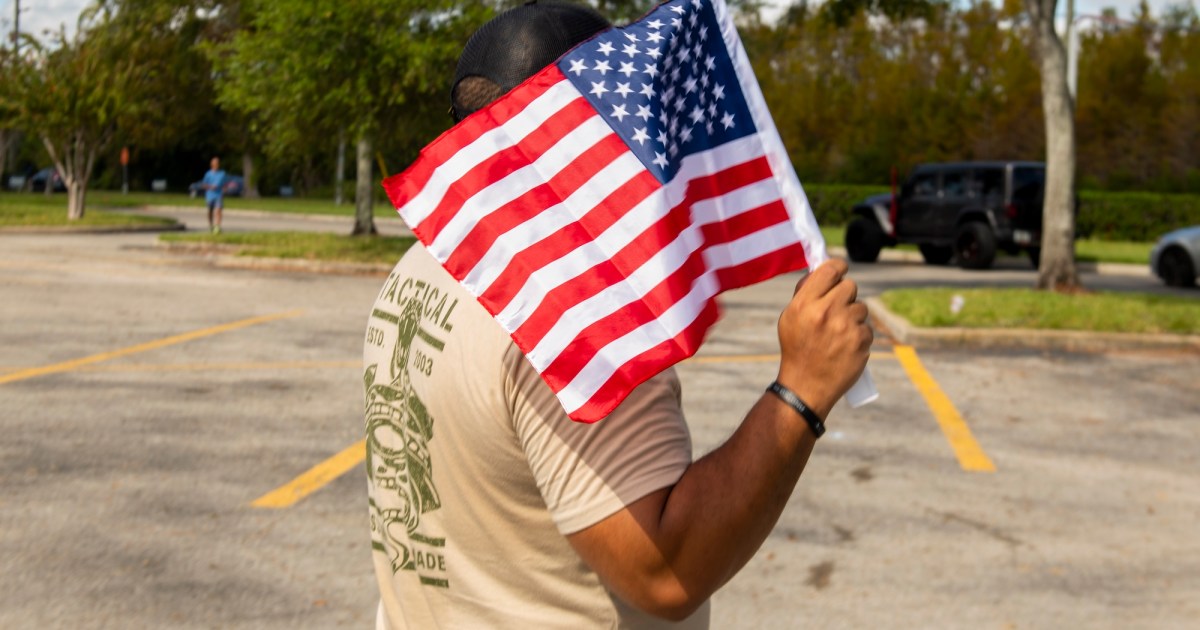
A voter carries a flag in central Florida. Dominic Gwinn/Zuma Get your news from a source that’s not owned and controlled by oligarchs. Sign up for the free Mother Jones Daily. When Trump won in 2024, members of the Republican Party theorized that MAGA’s conservative platform resonated more with Latinos, in particular Latino men’s values, and that they had rejected Democrats’ focus on social issues that election cycle, including expanding immigrant rights, gender, and reproductive rights. The Hill even argued that the reason Latino men had favored Trump was that they didn’t want a woman president. Clearly, there was more to the story, as many policy analysts countered last election. Latinos just elected Texas’ first Latina governor – a Democrat and a woman. Seventy percent of the state’s population voted Democrat, a 42 percent increase from the 2024 election. Majority-Latino counties and districts across the Southern United States in Texas, New Mexico and Florida shifted overwhelmingly blue and saw some of the largest Senate shifts, according to a New York Times analysis. Trump’s gerrymandering efforts in the Rio Grande Valley aimed to use the Latino vote that had elected him in 2024 to win additional House seats during the midterms. But these efforts backfired when voters voted blue– and Tejano singer and democratic candidate Bobby Pulido even flipped a previously red congressional seat. It’s easy to think Trump’s immigration crackdown pushed Latinos to the left. And this anger, definitely, played a role in mobilizing voters. But the real story is more nuanced, and it has to do with the fact that, for years now, many Latinos haven’t felt listened to. Nearly 80 percent of Latinos are part of the country’s working class, and the group is particularly sensitive to the country’s rising food and gas prices caused by Trump’s policies. This election, those two key issues – the economy and ICE crackdowns – worked in tandem to propel a record number of 14.5 million Latino voters to the polls and contribute to the currents of a blue tsunami. “Very plainly, we’re scared of ICE, and we can’t afford to live,” Aylin Rodríguez, the 27-year-old president of the Harris County Young Democrats, told me on Thursday. In Houston, she noted, the July shooting of Lorenzo Salgado Araujo by an ICE agent infuriated the community. Then-gubernatorial candidate Gina Hinojosa quickly denounced the shooting and called for an independent investigation. Her opponent Greg Abbott, who has long supported aggressive enforcement, meanwhile, was silent for a week before saying he backed the investigation too. Rodríguez said Hinojosa’s response, as well as her identity, Rodríguez said, made people feel understood. Rodríguez says she has uncles and cousins who voted for Trump last election and voted blue this cycle, upset at how Trump’s immigration crackdown has gone beyond targeting criminals. “They didn’t realize that they would go and raid their job sites, that they would deport their friends, that they would affect their businesses, or that it would affect their practice.” Gabriel Sanchez, professor of Political Science at the University of New Mexico, said that the top issues Latinos care about are the cost of living, job availability, and affordable housing and healthcare, the same concerns that have driven the votes of working-class Americans from other ethnicities, across party lines. And for at least six years now, these voters have felt a disconnect between how the party in power describes the economy and what they experience in their day-to-day lives. “I’ve been tracking the last three election cycles. The economy has been the top issue for Latinos through this whole period,” Sanchez said. To Sergio Garcia-Rios, a politics professor at the University of Texas, Austin, it’s important to understand that the Latino vote is often pragmatic. Latino voters are not a monolith, and the group has multiple issues that they care about– economic pressures, Catholic values, and immigration enforcement among them– that don’t often fall neatly along party lines. This time, Democrats’ affordability message resonated with the group. But they could very easily swing back. “In my reading of the data, Talarico and Hinojosa owe the Latino vote the win,” said Garcia-Rios, who is also the Director of Polling and Data for Univision News. Preliminary data, he noted, shows that a large part of the voter base that helped turn Texas blue was first-time voters– that is, Latino youth. Part of this new generation came into the labor market after COVID, while the rest is currently facing one of the most difficult entry-level job markets in decades – and how elected officials choose to address the economy really matters, especially going forward. While Garcia-Rios, Rodríguez and Sanchez all expected Democratic gains in the Latino voter bloc, nobody foresaw just how big of a blue shift the country would have – not just at the state level but in local races. And now, these leaders have to make sure they keep their promises. “Republicans read their victories in 2024 as a broad mandate when these voters got them into power because of the economy,” Garcia Rios said. “If I was talking to Democrats, I’d be warning them: don’t take any of this for granted. This is potentially one of the most powerful swing voters in the making.”
So Much for the “Latinos Are Republicans Now” Hot Takes
Full Article
Original Source
Read the full article at Motherjones →KhanList aggregates and links to publicly available news content. We do not host full articles from third-party sources. Always verify important information with original sources.