
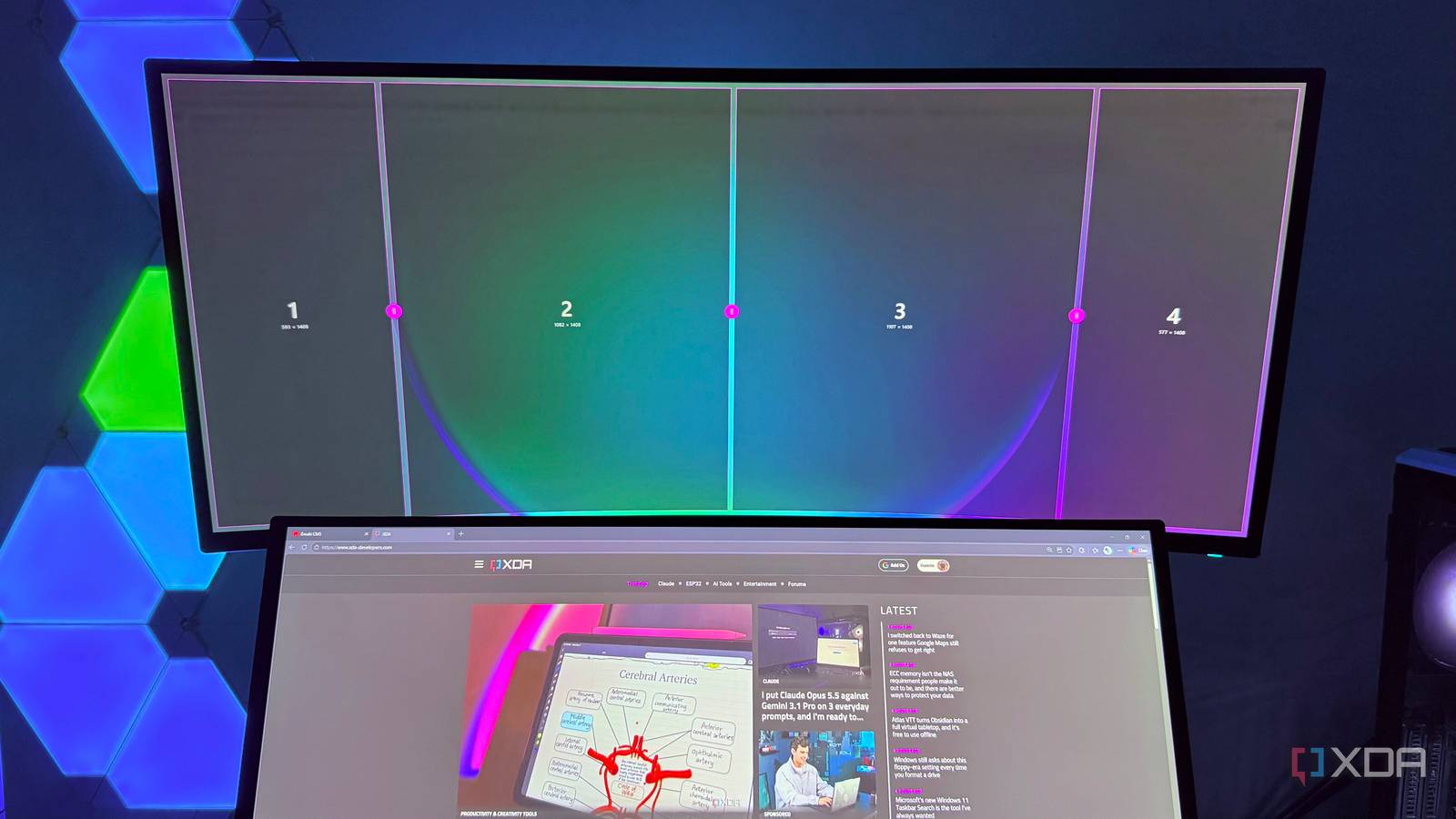
Published Oct 8, 2026, 8:00 PM EDT Hamlin has been in the tech field for over nine years. Since 2017, his work has appeared on MakeUseOf, Android Police, OSXDaily, Beebom, and more. He served as the Senior Editor at Valnet's MakeUseOf for over two years before joining XDA. He uses a high-end gaming rig for desktop use and a MacBook for traveling, but dislikes some of the quirks of macOS. You're more likely to catch him at the gym or on a flight than anywhere else. I've used the Alienware AW3423DW OLED for the last four years, and though I bought it for gaming, I now mostly use it as a secondary monitor that gives me plenty of room to multitask. That 21:9 aspect ratio gives me extra width to keep multiple windows open side by side without making any of them feel too cramped. And since I'm usually juggling Discord, Chrome, and TradingView, even while gaming, Snap Layouts were a no-brainer for quickly organizing everything. Now, as much as I've enjoyed using Snap Layouts since Windows 11 first launched, I've always found the preset layouts a little too restrictive for an ultrawide monitor. Even though Microsoft says the layouts you see may depend on display size, my ultrawide doesn't get anything particularly special compared to my other two 16:9 monitors. That's what convinced me to try out FancyZones in Microsoft PowerToys when I first read about it, and after seeing how much more customizable it is, I haven't looked back. FancyZones lets me build the layout I want And I can have a different layout for each of my three monitors If you just use FancyZones as it is after installing PowerToys, you're going to be disappointed because you only have like five preset layouts to choose from. Snap Layouts, on the other hand, gives me eight on each monitor. So, to take full advantage of it, you need to create a custom layout by going to PowerToys Settings -> FancyZones -> Open layout editor. Since my main issue with Snap Layouts was that it didn't give me a layout to arrange four windows horizontally, that's exactly what I created. I split my ultrawide into four equal zones, and now I can fit four windows side by side without having to manually resize each one afterward. You can go crazy with the layouts, but I just wanted something practical. My favorite part about FancyZones is that it remembers which layout I've assigned to each monitor. For my 4K monitor, I created the same four-window grid that I'm used to with Snap Layouts, and for my other standard 1440p one, I created a simple two-column layout. This way, each of my three monitors has a layout that actually suits how I use it. FancyZones gets the snapping part right I don't have to drag windows all the way to the edges For a feature called "Snap Layouts," you'd expect the actual snapping process to be its biggest strength. Except it's only straightforward when you're snapping windows to the edges or corners of your screen. To see more layout options, you need to drag a window all the way to the top edge of your monitor. And then you still have to drop the window into the zone you want. Of course, you can hover over the maximize button instead, but even that's near the top-right corner, so you're still mostly moving your cursor across the screen just to bring up the layouts. With FancyZones, I just hold Shift while dragging a window, and my custom zones immediately show up. Then I can drop the window into whichever zone I want without dragging it to the top edge of my screen first. This might not seem like a big deal, but on a 34-inch ultrawide, it saves me a lot of mouse movement when I'm constantly rearranging windows. And since I already know where each zone is, I don't have to stop and think about where I want to put the window every time. Snap Layouts has simplicity going for it, though But FancyZones is mostly a one-time setup that only takes a few minutes If there's one thing Snap Layouts gets right, it's that you don't have to set anything up. If you like the predefined layouts, you don't need to mess around with anything else. And if you just want a simple split-screen or four windows arranged in a grid, you don't even need to bring up the layouts in the first place. The layout you want to use can change depending on what you're doing, too, and Snap Layouts makes it easy to switch between them on the fly. With FancyZones, it's not nearly as straightforward until you set it up properly. But you only need to set it up the way you like once. For instance, you can create multiple custom layouts and assign a number to each of them. After that, you can switch between them any time by pressing Win + Ctrl + Alt + [number]. The keybind is kind of ridiculous, but I've rarely found myself needing to switch layouts on my ultrawide anyway. And I can still use Snap Layouts when I want a different arrangement. So I can basically use whichever one makes more sense at the time, depending on whether I'm holding that Shift key when I drag a window around. Snap Layouts needs more customization to win me back I don't think it should be hard for Microsoft to add a few more layout options to Snap Layouts. Even something as simple as letting me arrange four windows horizontally would solve my biggest problem with it on an ultrawide. But ideally, I'd like to see Microsoft go a step further and let me create my own layouts. And the whole snapping process could use some work, too. After using FancyZones, I now prefer holding another key to have my zones appear while dragging a window. Maybe one day we'll get that flexibility in Snap Layouts, but until then, I'm keeping FancyZones enabled alongside the other PowerToys utilities I now use every day. Microsoft PowerToys is a collection of free, open-source tools that can improve Windows productivity.
Snap Layouts wasn't built for ultrawide monitors, so I built my own with PowerToys
Full Article
Original Source
Read the full article at Xda-developers →KhanList aggregates and links to publicly available news content. We do not host full articles from third-party sources. Always verify important information with original sources.