
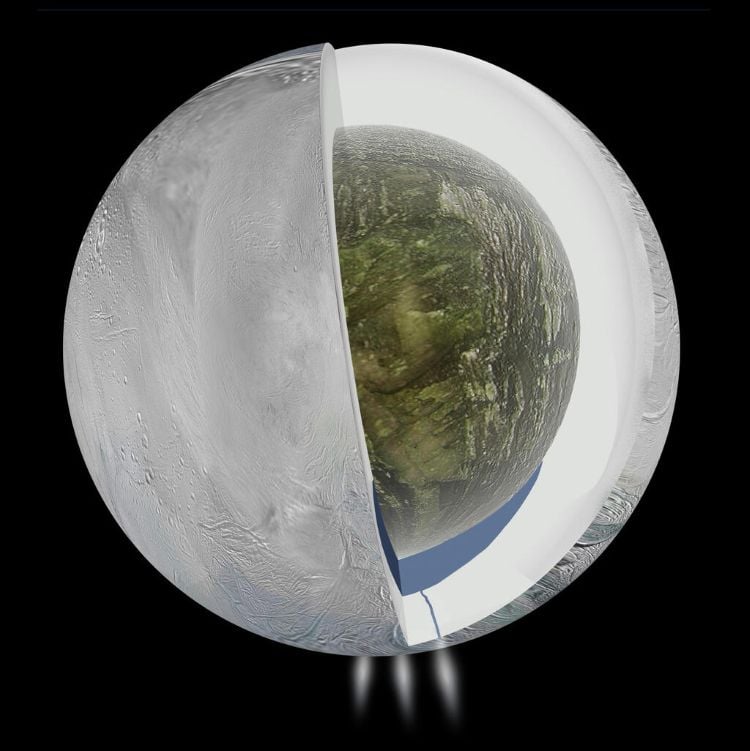
There are more than 450 confirmed moons orbiting the eight major planets, but only a handful of them provide unique scientific value to pique the interests of the scientific community, specifically their potential for hosting life as we know it. This is due to the subsurface oceans that exist beneath icy crusts, including Jupiter’s Europa and Ganymede, and Saturn’s Enceladus. But what processes are responsible for producing these subsurface oceans, or potentially preventing them from forming in the first place? Now, an international team of scientists from NASA, the Southwest Research Institute (SwRI), and the Weizmann Institute of Science in Israel might be one step closer to solving this conundrum. In findings recently published in Nature Astronomy, the researchers used computer models to address a longstanding knowledge gap regarding how large impacts influence the formation and evolution of subsurface oceans on icy moons throughout the solar system. The researchers focused on the smaller moons of Saturn and Uranus, with Saturn hosting Enceladus, Titan, and Dione, and their potentially active subsurface oceans, while Uranus hosts Titania, Oberon, Ariel, Umbriel, and Miranda. All these Uranian moons are still being debated for either having active subsurface oceans or oceans that existed long and have since frozen over. The primary motivation behind the study was to ascertain whether these smaller moons orbiting Saturn and Uranus are the original moons or if they formed from the chunks of a giant impact on a larger body. Collisions and Ocean…Stagnation? In the end, the researchers found that large impacts don’t influence the formation of new ocean worlds and only influence the size of an active ocean and its lifespan. The reason new ocean worlds aren’t formed from large impacts is from the large mixture of ice and rock, with the latter sinking to the bottom shortly after the ice melts into water. This sinking rock prevents the ocean from growing, resulting in the ocean freezing over. Credit: NASA/JPL-Caltech/Southwest Research Institute “Imagine a moon that is small and frozen and isn’t doing anything very interesting,” said Dr. Alyssa Rhoden, who is a principal scientist at SwRI and a co-author on the study. “If you throw something at it and cause a big collision, would that impart enough energy to cause an ocean to form? Our models indicated that is actually incredibly difficult. Most of the time a small moon experiencing a disruption may lose its ocean or prevent an ocean from forming in the first place.” Why Ocean Worlds? Liquid water is the very reason life thrives on Earth, as it is the driving force behind life’s cellular functions, metabolism, and survival. While water comprises about 60 percent of an adult human body, this percentage is higher for many life forms, including jellyfish (about 95 percent water), herbaceous plants (about 90 to 95 percent water). But some life forms have lower water percentages, including marine mammals (50 to 60 percent water) and insects (50 to 75 percent water). While this paper focused on the moons of Saturn and Uranus, specifically Saturn’s Enceladus and Dione, there are several other potential ocean worlds scattered throughout the solar system. These include Jupiter’s Europa, Ganymede, and Callisto, Saturn’s largest moon, Titan, and a smaller moon, Mimas, dwarf planet Pluto and Ceres, and Neptune’s Triton. While the Uranian moons discussed in this study are debated for being past or present ocean worlds, the only mission to visit Uranus is Voyager 2, which conducted its famous flyby in January 1986, and no missions are currently planned to visit Uranus anytime soon. In contrast, two missions, one active and one planned, will be exploring two ocean worlds within the next few years, which are NASA’s Europa Clipper and NASA’s Dragonfly. Europa Clipper is currently cruising to Europa, it is slated to arrive at Jupiter in April 2030, and its primary mission objective will be to ascertain the potential habitability of Europa. NASA’s Dragonfly is a quadcopter whose primary mission will be to “hop” around Titan’s surface searching for chemical signatures of life or water, and is slated to launch in July 2028 with an estimated arrival time at Titan in 2034. What new insights into how large impacts influence icy moon oceans will researchers make in the coming years and decades? Only time will tell, and this is why we science! As always, keep doing science & keep looking up!
Smashed Icy Moons Cool Too Rapidly to Retain Oceans
Full Article
Original Source
Read the full article at Universetoday →KhanList aggregates and links to publicly available news content. We do not host full articles from third-party sources. Always verify important information with original sources.