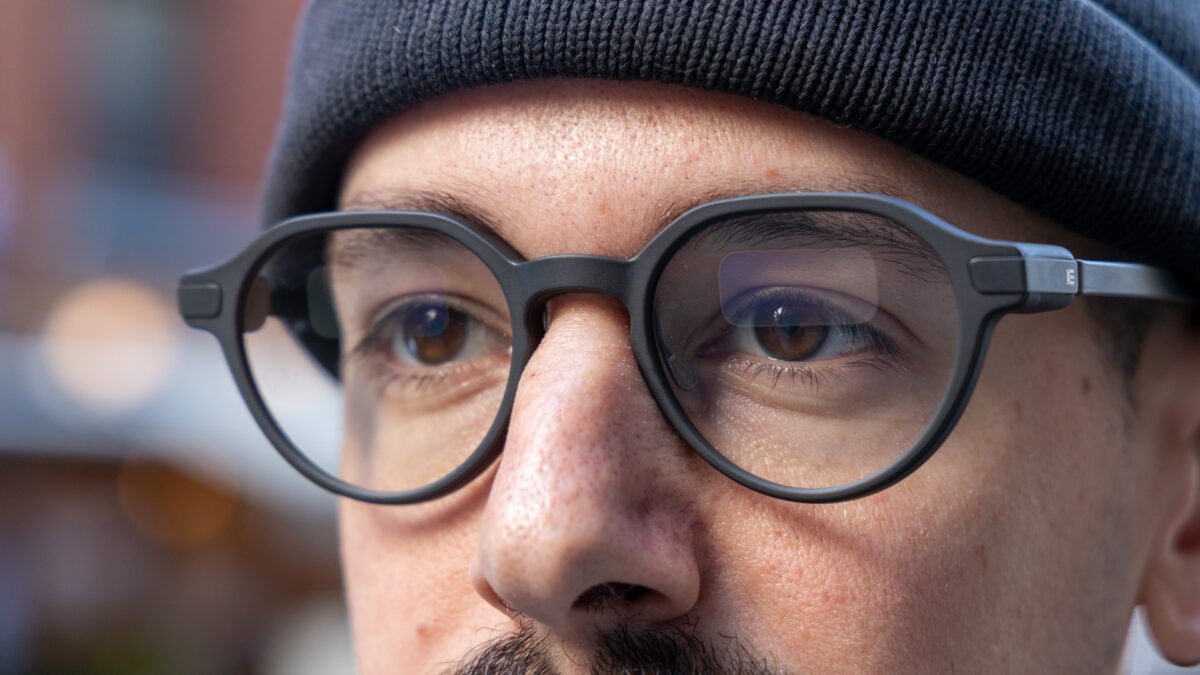
Even if Apple is one of the only major consumer tech companies without a pair of smart glasses officially in the pipeline, there are strong signs pointing to a future where its face-worn computer exists. The biggest sign is reporting from Bloomberg’s Mark Gurman, who recently detailed a behind-the-scenes debate on what exactly Apple will offer the world of smart glasses. Unsurprisingly, that internal discussion is around the biggest hot-button issue: privacy. Specifically, Gurman’s reporting suggests that Apple is working to address the camera on smart glasses, which is arguably the most fraught feature on any pair. Unlike Meta and its AI glasses, Apple seems to be intent on ensuring the camera on its smart glasses doesn’t wind up earning the company a reputation as a tool for spying or otherwise encroaching on user privacy. To do that, it’s reportedly considering a couple of non-Meta approaches to hardware. In one iteration, Apple is reportedly prototyping camera-less glasses that would avoid the privacy pitfalls of most smart glasses entirely. This would position Apple’s offering as something closer to smart glasses made by companies like Even Realities, which focus more on AI features like transcription and translation as well as other more productivity-focused use cases like notifications for emails, calendars, and text messages. © Raymond Wong / Gizmodo Alternatively, Apple is also considering including a camera but not allowing it to take photos or videos. That approach would address problems with people using smart glasses to secretly record others but still allow for people to use smart glasses for computer vision-based features—translating text on a page, identifying objects in your environment, vision-based navigation, etc. While both of those are valid approaches to smart glasses and even have precedent in today’s spectrum of hardware you can buy, there’s one big issue—there’s a solid chance they’re a death sentence for the company’s public reputation. As useful as AI can be in smart glasses, it’s not quite the killer feature yet. Having used Meta AI at length, it can still be hit or miss. Don’t get me wrong, Meta’s Muse Spark model is a massive improvement over previous generations in terms of accuracy and in how natural responses feel, but the use cases aren’t always obvious. Most people—myself included—still have to work to figure out how and when to incorporate computer vision, which can take away from the intended magic of it all. The problem gets worse when you look at the competition. Meta, of course, sells smart glasses with cameras on them capable of taking high-resolution photos and videos, but so do Samsung’s and Google’s glasses. The reason for that is that—based on my own use of smart glasses and monitoring how other people are using them—it’s still the most marketable feature. Sure, photo and video capture appeals to glassholes who want to discreetly record other people without their knowledge, but they also appeal to normal people who want to record action sports and other kinds of non-icky videos hands-free. In order to make smart glasses that appeal to the masses, Apple has an impossible choice: it can make its hardware privacy-friendly, or it can make a pair that sells. That’s a tough ultimatum for most tech companies (aside from maybe Meta, which doesn’t seem to care as much about the privacy side of things), but for Apple, it’s even tougher. Apple has long staked much of its brand on caring about privacy, so any deviation from that ethos is a big deal—one that could jeopardize the brand’s entire reputation. It’s hard to count Apple out in any capacity when it comes to consumer tech, but smart glasses are an entirely new gadget with totally different constraints. When it comes to smart glasses, it looks like Apple is going to have to risk a glasshole reputation or die trying.
Smart Glasses Are the One Privacy Nightmare Apple Can’t Solve
Full Article
Original Source
Read the full article at Gizmodo →KhanList aggregates and links to publicly available news content. We do not host full articles from third-party sources. Always verify important information with original sources.