
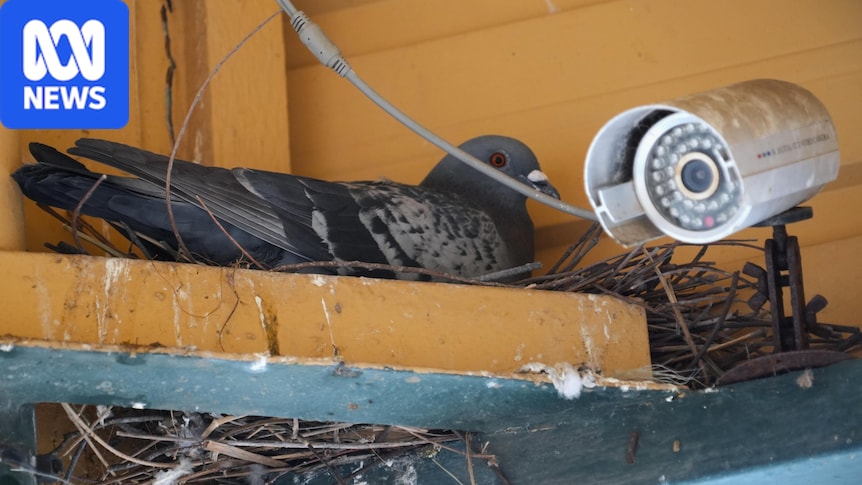
Walking down the main street of Pinnaroo in South Australia's Murray Mallee, you may have to watch where you step.With distant coos of pigeons perched on the ledges of the town's historic buildings, you can see the streets have a few unwelcome guests.Pigeon excrement has been one of the town's biggest concerns due to safety and hygiene. (ABC Riverland: Amelia Walters)From birds creating drinking water issues at the local primary school to local businesses spending hundreds of dollars a week cleaning their machinery, many say more needs to be done to address the problem.Hundreds spent on cleaningFor third-generation business owner Roydn Bailey, the pigeon problem is not new, but now it is getting "out of control".Roydn Bailey says the pigeons have been a problem for 15 to 20 years. (ABC Riverland: Amelia Walters)He estimated his business spent hundreds of dollars a week washing pigeon excrement off his company's machinery."We try and park our machines between the rafters to limit the amount of droppings onto our machines because it damages the paint," he said.Roydn Bailey's machinery shed is filled with pigeon feathers and excrement. (ABC Riverland: Amelia Walters)"[The droppings] block our gutters up, which then creates a big problem when we get downpours with water coming in through the roof."Mr Bailey believed having two grain silos at either end of the township made it the ideal food source for the birds.Todd Dooley has lived in the area for four years and recalls it being an issue from day one. (ABC Riverland: Amelia Walters)A few metres down the road, Todd Dooley runs the local post office and said you can "hear and see them all the time".Mr Dooley's child also attends the local primary school and said the pigeons have gotten so bad in recent years that the education department had to step in.Pigeons congregate on powerlines near the local primary school. (ABC Riverland: Amelia Walters)"I know they were shipping in drinking water for the kids for the last couple of years because of the damage done to the tanks, pipes and drinking fountains," he said.An education department spokesperson confirmed the school relied on rainwater tanks for drinking water and had supplied drinking water to the school on two occasions."[Water was supplied] last year while the tanks were temporarily disconnected from the rainwater system as a precaution to ensure they were not affected by contamination from impacted gutters," the department said."The department has been working with the school to address issues associated with pigeons and ensure its drinking water supply remains safe and available."Bird-proofing and pressure cleaning were undertaken at the school in April 2025, while water tanks were replaced this year. (ABC Riverland: Amelia Walters)The department said there was no ongoing weekly pressure washing of the school grounds and the school was "not currently" having drinking water trucked in.Pest explainedFeral pigeons are descendants of domestic homing pigeons that were introduced to Australia from Europe, making them creatures of habit.Adelaide Pigeon Control owner John Rohal said the species bred extremely fast."It may start with just two pigeons on the roof that you don't seem to mind, but they can breed up to nine times a year, and before you know it, you've got 12 up there," he said.John Rohal says shooting and trapping are the most effective ways to control pest populations. (ABC Riverland: Amelia Walters)"The amount of damage 12 birds in six months can ruin a house."Mr Rohal said eradication was the most effective way to address pest populations."I would say your two most effective methods would be shooting and trapping as deterrents don't really work," he said.John Rohal says feral pigeons form generational habits, meaning they return to the same locations. (ABC Riverland: Amelia Walters)"I've gone to places where I've only eradicated five out of 20, and the other 15 have bailed and never returned."Eradication effortsSouthern Mallee Council chief executive Jason Beaton has been organising eradication efforts via a contractor for the past 18 months.With harvest around the corner, he said the council was prioritising culling to get on top of the issue."It's very effective to start with … but then they do come back, so it's going to be a real ongoing process for us," Mr Beaton saidResidents and the local council say the birds have been a major issue, including damaging solar panels. (ABC Riverland: Amelia Walters)"It's the public amenity we're worried about; there's real pride in this community, so to have pigeons hanging around and defecating on your public parks and buildings, that is our biggest impact."When asked whether the state government has been notified about the ongoing issue, he said it was a council problem they would fix on their own.Jason Beaton says the eradication efforts will be an ongoing process. (ABC Riverland: Amelia Walters)"This has been a localised issue that, as the Southern Mallee people do, we solve our own problems," he said.
Small SA town's 'out of control' pigeon population
Full Article
Original Source
Read the full article at Abc →KhanList aggregates and links to publicly available news content. We do not host full articles from third-party sources. Always verify important information with original sources.