
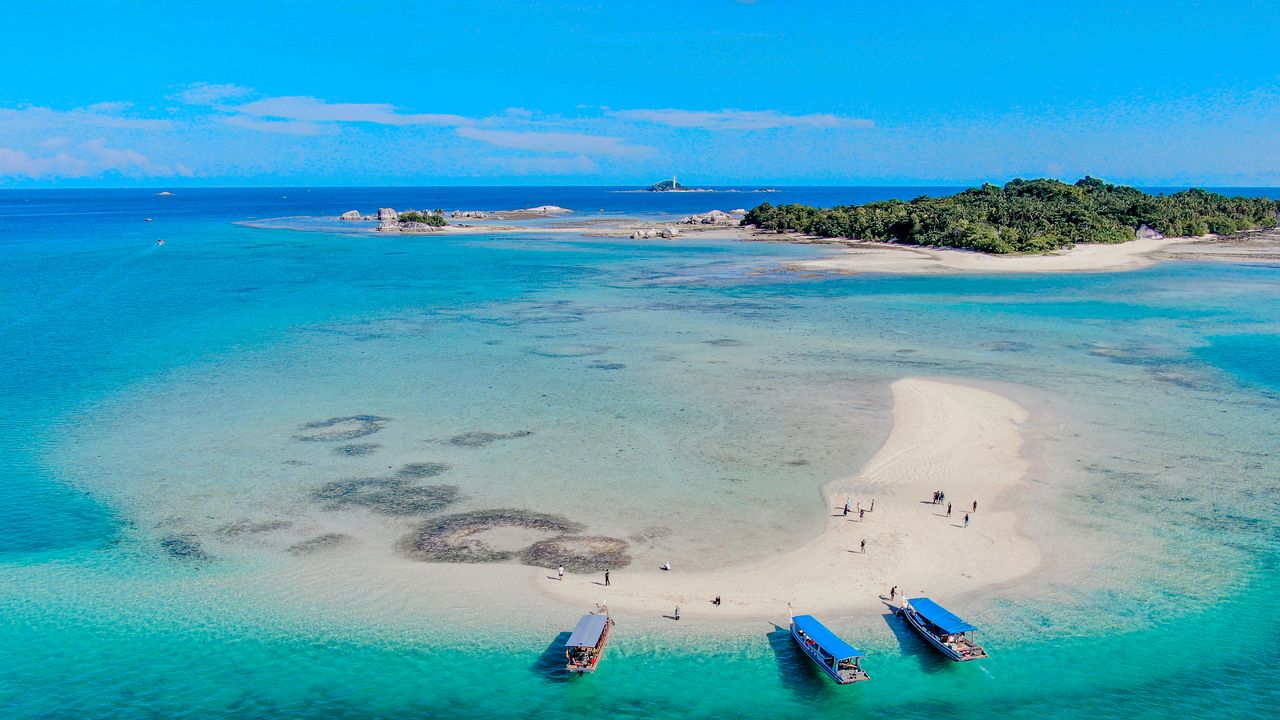
A thin ribbon of tarmac winds its way through leafy villages that hug Belitung’s coast. Very occasionally, a scooter—piled high with passengers—hums past. It feels as if I have this Indonesian island almost to myself.The boot-shaped island off the coast of Sumatra is often labeled the “Maldives of Indonesia” thanks to its pristine reefs, turquoise sea, Triassic granite formations, and last year's confirmation of its UNESCO Global Geopark status, a designation that aims to protect the natural environment and to encourage holistic and sustainable development.Snorkeling with Bluemind Experience Courtesy Tanjung Kelayang ReserveKelayang Island's Triassic rocks Courtesy Tanjung Kelayang ReserveSo far, Belitung remains off the tourist trail, but thanks to UNESCO's recognition, a new direct flight from Singapore, and green-thinking hotels launching on its shores, it won’t be for long. As excited as they are to welcome new guests, locals are also determined to create a blueprint for sustainable tourism.There are 17 geosites dotted around the island. The first one I visit is Bukit Peramun, a park 30 minutes' drive inland from the coast. Local guide Jimie Afrian leads me through a forest of ironwood and wild fig trees, aiming to reach the summit at sunset. As he guides me along the leaf-strewn trail, he points out the ginseng roots turned into herbal medicine and the Batu Kember (Twin Rocks), which were once used to confirm whether a person was ready for marriage. In times gone by, teenagers from the surrounding five villages would hike through the forest and stand between the oversized granite rocks, arms outstretched. If they could touch the twin rocks with both hands, it was deemed that they had reached adulthood.There was a time when visitors could wander these trails alone; now everyone needs a guide to accompany them through this community-managed forest, which is home to pangolins, hornbills, and mousedeer. As we stand on a wooden viewing platform overlooking a patchwork landscape dotted with farms, palm-oil plantations, and forest, Afrian seems acutely aware of his responsibility. “It may only be 60 hectares, but we will protect it,” he says, looking into the distance.The sun is about to set, so we push on to the highest point in the park, where locals have created a pop-up restaurant. Here, visitors enjoy the panoramic views of the countryside while sipping cups of tea and dipping strips of fresh cassava into local honey.The sky over the park puts any smartphone filter to shame. It turns shades of ochre and lilac as the sun lowers behind the hills on the horizon. It's a wonder, but the sunset isn’t the main event. For that, we needed to return to the forest.Endangered Belitung tarsier in the Tanjung Kelayang Reserve Courtesy Tanjung Kelayang ReserveA climbing pangolin Courtesy Tanjung Kelayang ReserveThe rangers had already been walking ahead of us with infrared lights to find the true star of the park—the endangered Belitung tarsier. The shy, nocturnal creatures seem to be staying high in the canopy rather than coming down to feed, but then one of the rangers asks us to follow them as quickly and quietly as possible. Six feet above me, I catch sight of a long, thin pink tail dangling down from a branch, and when I look up, I see what looks like a real-life Labubu. Its large olive-colored eyes nervously study the newcomers as it carefully wraps and unwraps its long pink toes around the branch. While the guides are happy to show us what makes the park special, they are determined our time with the tarsier remains fleeting. “You are using up their time to get food,” says Afrian, gently.But this isn’t the only park that’s showing what regenerative tourism can look like. Within the 350-hectare Tanjung Kelayang Reserve, which lines the coast, two green-thinking hotels have been built within its grounds. Both are thoughtful in their execution. The Sheraton Belitung is built with handmade clay bricks and renggadai wood, and uses rainwater and solar energy. Instead of lush lawns, the grounds feature ecoponds cleaned naturally with a lining of kaolin clay. Further along the coast, the Billiton Ekobeach Retreat offers beach villas made from dolken logs and nipa palm leaf roofs.After hiking through the forest and visiting a stingless bee farm where I sip fresh honey straight from the hive, a tour of the coastline feels long overdue. Tour company Blue Mind Experience takes guests on boat trips through the reserve and sometimes lets them experience what it is like to be a castaway, which is what I am about to do today.Sheraton Belitung Resort Courtesy Tanjung Kelayang ReserveWhen I step onto the beach in front of the Sheraton, once again it feels as if I have the place to myself. The only people I see are my tour guide Ali and the captain, Rio, who will be piloting the boat.My guide Alif Faozin, 18, has just returned to his parents’ home in Belitung, eager to help with the influx of new visitors. He says his parents, who work for palm oil companies, are delighted with his new role and pleased that he gets to meet people from different countries and share stories of their home. After setting sail, the boat zigzags between tropical islands covered in coconut palms and Jenga-like rock formations. Between the waves, locals can be seen taking lungfuls of air before diving under the surface to search for sea cucumbers or perhaps another haul of 9th-century Tang treasure like the one found in 1998.The captain lowers the anchor by a sandbank so we can spy the hot pink starfish dotted around its edges, then takes us further to Kelayang Island, where locals sit in the shade of bamboo huts and lift their heads now and then to see if any hungry travelers need feeding before their boats depart. Visitors can also follow a small leafy trail to Kelayang Cave, where hanging bats doze after a night of feasting.The Dutch lighthouse on Lengkuas Island Courtesy Tanjung Kelayang ReserveLengkuas Island, with its 19th-century Dutch lighthouse, also attracts picnickers, but beneath the waves, the view is even better. The captain drops the anchor near a reef where fan-like corals in shades of purple and gold overlap, creating what looks like an underwater metropolis. Clownfish dance over sea anemones, while pastel-colored parrotfish glide across the pristine reef.But the new UNESCO Global Geopark is designed to protect more than just the Triassic granite rocks that stand like sails in the water; it also protects Belitung’s Satam stone. This rare, jet-black tektite is believed to have formed when a meteorite struck the tin-rich land over 700,000 years ago.In times gone by, the glossy pitted stone would be cut and polished for jewellery, then handed down through the generations as an heirloom. Islanders believe the stone brings luck and wards off evil. Now the stone itself is protected, and Indonesians want visitors to leave with a replica, which the community-led BICA Ceramic recreates using Belitung clay.Other local creatives are shaping sustainable souvenirs. Ex-pharmacist-turned-designer Bella Kartika Aprilia launched the batik brand Sepiak Belitung. Belitung motifs such as white pepper, wooden fishing boats, and the tiered candle umbrella are all showcased in her designs.“I wanted to create something that didn’t just sell clothing but also carried Belitung’s identity,” says Aprilia. “For me, batik is one way to tell the story of a place: its nature, its culture, its people, and the hopes it holds.”Aprilia works with over 20 local artisans to create the resortwear pieces sold at her store and at hotel boutiques. She says that Belitung is the perfect place for travelers who want to slow down and truly experience a destination: “It’s not just about seeing the sights but about meeting the people, understanding the culture.”As my stay draws to a close, the captain of the Blue Mind Experience pilots the boat to a private island so I can experience what it is like to be a castaway. Large rocks form a half-moon around a small beach and tranquil bay. Onshore, a Pinterest-worthy scene awaits with a calico tent fringed with palm leaves, colourful beanbags, a stack of novels, and a small campfire. He jokes that he will collect me tomorrow, but as I sink into a beanbag with a fresh coconut in my hand, tomorrow feels far too soon.
Slow-Traveling Through Belitung, the Indonesian Island Now Designated as a UNESCO Geopark
Full Article
Original Source
Read the full article at Cntraveler →KhanList aggregates and links to publicly available news content. We do not host full articles from third-party sources. Always verify important information with original sources.