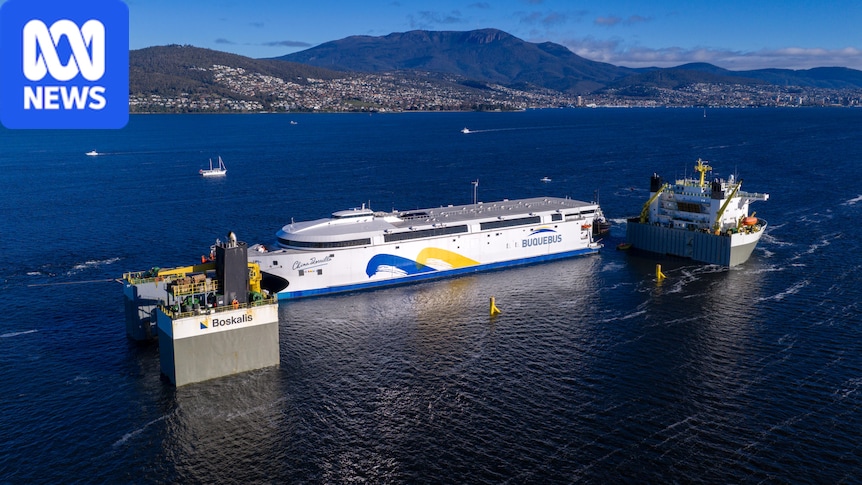
Peering through binoculars and nestled on camp chairs, onlookers have encircled the River Derwent to behold one of the most complex marine undertakings in Tasmania's history.The world's largest battery-equipped, electric-powered ferry, the Hull 096, was successfully loaded onto the heavy-lift transporter ship MV Black Marlin on Friday, completing a multi-day operation.Mick Boxall's photo of the China Zorrilla being manoeuvred into place over the submerged deck of MV Black Marlin. (Supplied: Mick Boxall)Glenorchy resident Mitchell Needham was among those who had ventured out to the waterfront suburb of Tranmere to watch the "unreal" spectacle."The Black Marlin travelling all the way from South Africa to come here and semi-submerge, just to carry a ship — that's the coolest thing I've ever seen," he said."Seeing the tugs slowly inch [the ferry] towards the cradle in the centre of the ship and just trying to guess what's going on has been the highlight of my day, honestly."Mitchell Needham (left) watches the event take place, alongside Mike Kwon. (ABC News: Monty Jacka)Lindisfarne local Mike Kwon described the process as "really interesting" to watch, while Lauderdale resident David Long said it was "something you don't see every day".The operation took several hours. (TasPorts: Rob Burnett)David Long and Nolan Cardno watched the loading unfold. (ABC News: Monty Jacka)David Bryan, who lives in Sanford, said it was the most impressive sight he had witnessed in the River Derwent since the nuclear-powered aircraft carrier USS Enterprise visited the city in 1976."I'm just in awe of how modern technology is, how you can transport massive items around the world — it's just been an excellent experience," he said.Robert Hardy and David Bryan enjoy the spectacle. (ABC News: Monty Jacka)What did it involve?The Hull 096, which will soon be officially named China Zorilla, was built by Hobart shipbuilders Incat on behalf of South American ferry company Buquebus.It is the largest battery-equipped, electric-powered ferry in the world, and is set to service the Rio de la Plata route between Colonia del Sacramento in Uruguay and Buenos Aires in Argentina.However, as it was only designed for short journeys, trying to sail it from Hobart to South America would result in it running out of power after about 30 minutes — likely somewhere near Bruny Island.The MV Black Marlin, operated by Netherlands company Boskalis, was called in to carry the vessel across the Pacific Ocean, arriving in Tasmania on Tuesday.The loading process officially began on Friday morning, when the heavy-lift ship filled its ballast systems with water, causing its cargo deck to slowly sink into the river over several hours.The Hull 096 was taken out to meet the Black Marlin in the centre of the River Derwent.A network of tugboats were used to position the Hull 096 above the submerged cargo deck, before it was mounted onto a cradle attached to the Black Marlin.That concluded around midday, and the next stage of the project will be refloating the heavy-lift vessel, which was expected to take about 10 to 12 hours.Isabel Gordon's photo of the loading operation. (Supplied: Isabel Gordon)Incat's Tom Cooper said the operation was unlike anything that had ever taken place in Tasmanian waters."There was a bit of fiddling around this morning with the tow lines and things like that, but everything seemed to go really smoothly," he said."The trickiest part from the crew's point of view was … getting it right in place so that it lined up exactly where they needed it to be … thankfully it all went to plan."The operation involved more than 30 people, including crews from Boskalis, Incat and Tasports, with an exclusion zone of 500 metres in place.What happens now?The Black Marlin is expected to depart on Monday for a 40-day voyage, which will see it pass the northern tip of New Zealand, cross the Pacific Ocean and round Cape Horn.It will then arrive at Buenos Aires, where the loading process will be reversed, and about a month of commissioning work is expected before it begins operations."They've got a big plan. No doubt there'll be some champagne bottles broken on the bow of the ship," Mr Cooper said.Incat is building three other, slightly smaller battery-powered electric ferries that will go into operation in Denmark; however, these will be equipped with diesel generators."So this may well have been the first and last time we'll ever see a heavy-lift ship in the River Derwent needing to transport a ship like Hull 096," Mr Cooper said.Tracy Hobbs's photo of the operation. (Supplied: Tracy Hobbs)The superstructure of Hull 096 during construction in Hobart. (Supplied: Incat)Turbines waiting to be fitted to Hull 096 during the construction phase. (Supplied: Incat)The wheelhouse of Hull 096, before the ship's completion. (Supplied: Incat Tasmania)What does it mean for Tasmania?Incat project manager Sean Lowrie worked on the Hull 096 for more than two years and said it was a proud but bittersweet moment for staff."There's been a lot of pride, a lot of excitement, and now we look to the next project and going forward," Mr Lowrie said."That will be our next opportunity to show the world what we can do at Incat."Among those spread across the waterfront, there was a common sentiment that the loading was a proud moment for Tasmania, putting a small island on the world stage."It's just a wonderful thing for Tasmania, to be able to produce a bit of machinery like that for the world stage," Mr Kwon said.Mr Long said it would help put the state "on the map", while Mr Bryan said it was great to see one of the "best ferries in the world" coming out of Tasmania."It makes you proud of what a small little island can achieve," Mr Bryan said.
Slow-motion big ship lift operation thrills spectators in Hobart
Full Article
Original Source
Read the full article at Abc →KhanList aggregates and links to publicly available news content. We do not host full articles from third-party sources. Always verify important information with original sources.