
Equity is the last part of a pay package that most companies still administer by email. Salaries run through payroll software, benefits run through a platform, then stock options run through a spreadsheet and a chain of local lawyers billing by the hour. That held while startups hired in one country. It stopped holding the moment they hired everywhere. Ninety-seven per cent of multinationals that offer equity now grant it outside their headquarters country, according to the NASPP and Deloitte Tax equity incentives survey, which turns a domestic instrument into a fifty-jurisdiction tax problem for finance teams who never planned to be multinational. Every jurisdiction taxes the grant at a different moment, treats vesting differently, applies its own withholding rules, then changes them without telling anybody. Slice's own CEO and Co-Founder, Maor Levran, has put the cost of getting it wrong at individual fines running well past $200,000.The rules are not converging either. Ravio's 2026 data shows European tech markets pulling apart. Fifty-eight per cent of UK companies now grant equity to all employees, up 16 per cent in a year, with the Netherlands moving 19 per cent the same way. France fell 6.5 per cent over the same period, Sweden 8.1 per cent, on tax treatment alone. The category built to fix this is growing fast enough that nobody agrees on its size, with five research firms landing their forecasts 5.6 times apart. Against that backdrop, a quiet architectural question is gaining force: what happens when compliance stops being advice bought after the fact and becomes infrastructure enforced at the point of the grant? Slice, founded in 2022, raised a $25 million Series A led by Insight Partners in January 2026 to build exactly that, taking total funding to $32 million. Its customers include Wiz, Cyera, Wayve, DevRev, Alianza, Coralogix, LiquidAI and Pebble. To unpack whether compliance-first infrastructure genuinely changes the job or simply relocates the risk, I sat down with Maor Levran, Slice's Co-Founder and CEO, who spent thirteen years as a corporate lawyer watching companies get this wrong before he left to go and build the fix. Ishan Pandey: Hi Maor, it's a pleasure to welcome you to our "Behind the Startup" series. Please tell us about yourself and the journey that led you to build Slice? Maor Levran: I spent thirteen years as a corporate attorney, working on fundraises, M&A and IPOs. Equity was in every one of those deals, and it was always the same story: the thing everybody cared about most and nobody actually owned. Founders cared, because equity is how you close talent. Employees cared, because it was their upside on paper. And the actual administration of it lived in a spreadsheet somebody built three years earlier that no one wanted to touch.What changed my mind was watching the same problem repeat at a completely different scale. My clients became global companies expanding to many countries: engineers in Poland, sales in the UK, a controller in Canada, an EOR arrangement in Brazil. They kept issuing equity the way they always had, because equity is how you win the hire. But equity does not travel. A grant that is perfectly clean in Delaware can be a taxable event on day one somewhere else. I was being paid by the hour to discover those problems after the fact, usually inside a diligence process, when they were most expensive and least fixable.At some point the honest conclusion was that this is not a legal problem you solve with more lawyers. It is an infrastructure problem. So in December 2022 I left the law firm and started Slice with Yoel Amir and Samuel Amar, to build the system that should have existed a decade ago: one platform where the cap table, the workflows, the local law and the tax treatment are the same object, instead of four teams reconciling by email. We are backed by Insight Partners, we work with more than hundreds of companies and over 300,000 stakeholders, and the mission has not changed since day one. Make the world flat for equity.Ishan Pandey: You spent thirteen years in tech law, ranked by Legal 500 as a top tech attorney four years running, advising startups through fundraises, M&A and IPOs. Partners do not usually leave to build software. What was the specific client conversation that made you decide this was worth walking away from the partnership for?Maor Levran: There was not one dramatic phone call. There was a pattern that became impossible to unsee, and it always sounded the same: a founder or a CFO calling me after something had already gone wrong, asking me to fix it retroactively. The one I keep coming back to was a company that had been granting options to employees in a country where those grants had been disqualified from favourable tax treatment for close to two years. Nobody had done anything reckless. They had a cap table platform, they had counsel, they had a competent finance team. The information simply lived in three places that never met.What made that conversation different for me was realising what I was actually selling as a lawyer. I could write a beautiful memo explaining exactly how it broke. I could not stop it from breaking. My product arrived after the damage. And the fee for that memo, multiplied across every jurisdiction a company operates in, is precisely why most companies never ask the question in the first place. The advice is priced so that you only buy it once you already suspect there is a fire.The thing partners do not tell you is that leaving is not really about leaving law. It is about moving from the end of the process to the beginning of it. Everything I know as a lawyer is still the product. It is just encoded in an AI-native rules engine and an agent that runs before the grant, instead of a memo that runs after it. That felt worth trading a partnership for.Ishan Pandey: You have said individual fines from equity mistakes can run well past $200,000. Walk us through where the chain actually breaks. Is the failure usually at the grant, at vesting, at exercise or in the reporting afterward? How long does a company typically go before it finds out?Maor Levran: It breaks at the grant far more often than people expect, and that is the expensive one, because everything downstream inherits the defect. The grant is the moment where jurisdiction, employment classification, plan type and approval sequencing all have to line up at once. Approve a US grant a day before the employee’s official start date and you have quietly destroyed the ISO treatment. Grant to someone employed through an EOR and you may have disqualified them from a local deduction they were counting on. Grant in Israel without the trustee structure in place and the whole Section 102 benefit is gone. None of these produce an error message. The grant looks perfect on the cap table.The second failure point is mobility, and it is the one almost nobody models. An employee who relocates mid-vesting fractures the tax treatment of their unvested shares across two jurisdictions simultaneously. That change starts in the HR system, and in most companies the HR system does not tell the equity system anything meaningful. Exercise and reporting are where the damage surfaces, in withholding that should have been calculated, a filing window that closed, a country report that does not reconcile. By then you are remediating, not preventing.As for how long: typically eighteen months to three years, and almost never through internal discovery. It surfaces at an event. A funding round’s diligence, an acquisition, an IPO readiness review, or an employee who tries to exercise and finds their tax bill is double what they were told. There are public versions of exactly this. One company suspended an IPO for six months over unwithheld taxes on option exercises that had been accumulating for two years. Another is in litigation because employees were told they had ten years to exercise when the real window was ninety days. That is the pattern. Silent for years, then all at once, at the worst possible moment.Ishan Pandey: Ninety-seven per cent of multinationals already grant equity outside their headquarters country, so this is not an emerging problem. It is a universal one that stayed unsolved. Why do you think the infrastructure never got built? What changed recently that made it buildable?Maor Levran: Two reasons, and neither of them is that the problem was too small. The first is that until recently it genuinely was not universal. Cap table software was built in and for the United States, for companies whose employees were in the United States, at a time when hiring globally was the exception. Those platforms were architected as systems of record: store what happened, render a screen. That was the correct architecture for the world they were built for, and you cannot retrofit cross-border reasoning onto it. The gap is not a missing feature. The data model was never designed to know that employee, country and plan type interact.The second reason is that the knowledge itself was not software-shaped. The rules for equity in sixty-six countries did not exist in any structured form. They lived in the heads of partners at law firms, priced by the hour and deliberately bespoke. Building this meant doing something no software company wanted to do: spend years with top law and accounting firms producing genuine country-by-country legal research, roughly seventy pages of analysis per jurisdiction in our case, and then encoding it as a rules engine. That is a legal project before it is an engineering project, which is why it took a team of lawyers and accountants to start it.What changed is that both blockers fell at the same time. Global hiring stopped being exotic, so the problem became universal rather than niche. And AI became good enough to reason over a structured legal corpus rather than simply retrieve from it. That combination is the whole thesis. Our SliceAI agent is not a chatbot sitting on top of a cap table. It is a legal, finance and HR expert operating inside a proprietary knowledge base, with the data never leaving the platform. Neither half of that was possible five years ago.Ishan Pandey: Five research firms size this category and land 5.6 times apart on the forecast, mostly because they draw the boundary differently. How do you define the market Slice is actually in? What does that definition include that the cap table category leaves out?Maor Levran: The forecasts land 5.6 times apart because most of them are sizing software licences for cap table management. That is the smallest and least interesting number in this market. Define the category as seats for a share registry and you get one answer. Define it the way a CFO actually experiences it and you get a very different one. We define our market as global equity operations and compliance: the total cost a company incurs to issue and maintain equity across borders. That includes the cap table platform, but it also includes outside counsel spend on cross-border equity questions, local tax advisers, the accounting firm’s stock-based compensation work, trustee fees, the internal finance and HR hours spent reconciling three systems by hand, and the remediation cost when something breaks. For a global growth-stage company the software licence is usually the smallest line in that stack by an order of magnitude. The advisory spend is the market.That is the line the cap table category draws in the wrong place. It counts the filing cabinet and ignores the reason you need the filing cabinet. When a customer moves to Slice they do not simply cancel a subscription. They stop calling a law firm in every jurisdiction, because the answer is already in the platform. That is why we describe Slice as replacing the cap table tool, outside counsel and the spreadsheets at the same time, and it is why the honest question for a buyer is not what a seat costs but what their equity actually costs them in a year. One of our clients reported that they cut the finance team's equity workload by 60 per cent after moving to Slice.Ishan Pandey: Ravio's 2026 data shows Europe splitting rather than converging on employee equity, with sharp gains in the UK and the Netherlands against declines in France and Sweden driven by tax treatment. For a company selling compliance infrastructure, is that divergence your best tailwind or your hardest engineering problem?Maor Levran: Both. The divergence is the tailwind, and managing it is the engineering challenge. If the rules converged, this would become a much simpler problem and eventually a cheap feature inside a payroll product. The divergence is what makes the work valuable. The UK moving toward broader employee equity while France and Sweden pull back on tax treatment is not noise in our model. It is exactly why a CFO cannot answer these questions on their own.The harder engineering problem is actually time, not breadth. Countries are a finite list. Change is not. And when a rule changes, it does not necessarily affect only new grants. It can change the correct treatment of grants issued years ago that are still vesting. So the real requirement is knowing, when a jurisdiction changes its rules, which of your existing grants, employees and filings are affected - and telling you before your auditor does.'That is the difference between compliance infrastructure and a database of rules. We maintain that knowledge with leading law and accounting firms and run it through three layers: a deterministic rules engine, an AI agent layer, and human equity experts who are lawyers and CPAs. None of those layers is trustworthy enough on its own when the stakes are this high.The commercial tailwind is simple. Every time a country changes its treatment, a finance team discovers that they had no way of knowing. That creates demand for us - and it is not going away.Ishan Pandey: You wrote in July that equity platforms were built to remember while Slice is built to act. Give us the concrete version. Where does the model sit relative to your rules engine, what does it decide on its own, then what still requires a human to sign off? Maor Levran: The layering matters, so let me be precise. The rules engine is deterministic and it is the authority. Country rules, plan types, tax treatments, approval sequencing, filing windows: those are encoded, versioned and sourced from our legal and regulatory knowledge base. They are not generated. The model does not get to invent a tax rule. What the model does is the part software was never able to do before. It reads the messy real world, an HRIS record, an uploaded SPA, a fifteen-year-old spreadsheet from a legacy platform, a board consent PDF, turns it into structured facts, and then reasons across finance, legal and HR at once to work out what those facts mean and what should happen next.So the split is simple: the model interprets and orchestrates, the engine adjudicates. Ask SliceAI whether your Australian grants since 2020 are compliance-ready and the agent assembles the population, applies the encoded Australian rules and returns a sourced answer with the exceptions listed. Ask who is due for a refresh under your policy and it builds the list from live HR and equity data. It will draft the grants to each country’s rules, prepare the award letters, assemble the board approval package and stage the filings. It will onboard an entire financing round from raw documents with a full audit trail.What it does not do is sign. Board approval is a human act and it stays one. So is anything that creates a legal obligation to an employee or a regulator: the executed letter, the filing submission, the withholding instruction. And on a genuinely ambiguous jurisdictional question, the agent’s job is to say so and route it, not to pick an answer. That line is deliberate. The value is not autonomy for its own sake. It is that the work which used to require a human is done and evidenced by the time a human looks at it.Ishan Pandey: Here is the uncomfortable question. I want to give you room to answer it properly. Tax and securities law across dozens of countries is not merely complex, it is frequently ambiguous, with reasonable advisers reaching different conclusions. When your system produces an answer a tax authority later challenges, who carries that risk? How do you keep a CFO confident enough to rely on software instead of a legal opinion?Maor Levran: Let me answer that directly. The company carries the legal risk, the way it always has, because the company is the one granting the equity. Slice is not a law firm and we do not sell a legal opinion. Anyone in this category who implies otherwise is either misunderstanding their own product or setting a customer up badly. What we change is not who is liable. It is how much of the surface area is genuinely uncertain, and what you can show when somebody asks.The premise of your question is that this field is ambiguous, and it is, but not uniformly. In my experience the large majority of what goes wrong is not the hard, arguable edge case where two good advisers disagree. It is the settled question nobody asked: the approval that ran a day early, the trustee structure that was never opened, the withholding nobody calculated, the filing window that closed. That part is not ambiguous at all. It is simply invisible in the systems most companies run on today. Removing it is most of the risk reduction available, and it is exactly the part software should own.For the genuinely contested minority we do three things, and we are explicit about all of them. We show our work: answers are cited back to Slice’s underlying country analysis, produced with top law and accounting firms, so a CFO or a general counsel can see the basis rather than trust a black box. We keep humans in the loop: our customers have access to our equity experts, lawyers and CPAs, and where a question needs a formal opinion we route it into our partner network rather than guessing. And we produce the audit trail: who approved what, on what date, against which version of which rule. That last part is what actually keeps a CFO comfortable. Confidence does not come from software promising certainty. It comes from being able to demonstrate, years later, that you asked the right question at the right moment and acted on the best available answer, which is precisely what most companies cannot do today.Ishan Pandey: Finally, for founders granting equity across borders right now, without the infrastructure and without a budget for advisers in every market, what is the most practical thing they can do this quarter to reduce their exposure?Maor Levran: Three things, and all of them are free this quarter. First, build the list. One sheet: every equity holder, their country of tax residence, their employment classification, whether employee, contractor or EOR, their grant date, their plan type and their exercise window. If you cannot produce that list quickly, that is a finding in itself. You cannot manage exposure that you cannot enumerate.Second, look backwards before you look forwards. Take the three or four countries where you have the most people and check two things that are frequently missed: was board approval properly in place before each grant date, and does the structure required in each country actually exist, the Israeli trustee, the UK filing, the local plan registration. Historical mistakes get harder and more expensive to fix the longer they go unnoticed. This is the highest-return hour a founder can spend on equity.Third, make relocation a trigger event. One line in your process: nobody changes country without finance and legal being told. Mobility is one of the most under-managed risks in global equity and it costs nothing to catch. It only requires that somebody be told. And if I can add a fourth, stop treating equity as a task that runs after the hire. It is a regulated instrument in every country you operate in. The companies that get burned are almost never the careless ones. They are the fast ones who assumed the tool they bought in year one was still telling them the truth in year four.Don’t forget to like and share the story! Vested Interest Disclosure: HackerNoon has reviewed the report for quality, but the claims herein belong to the author. #DYOR.
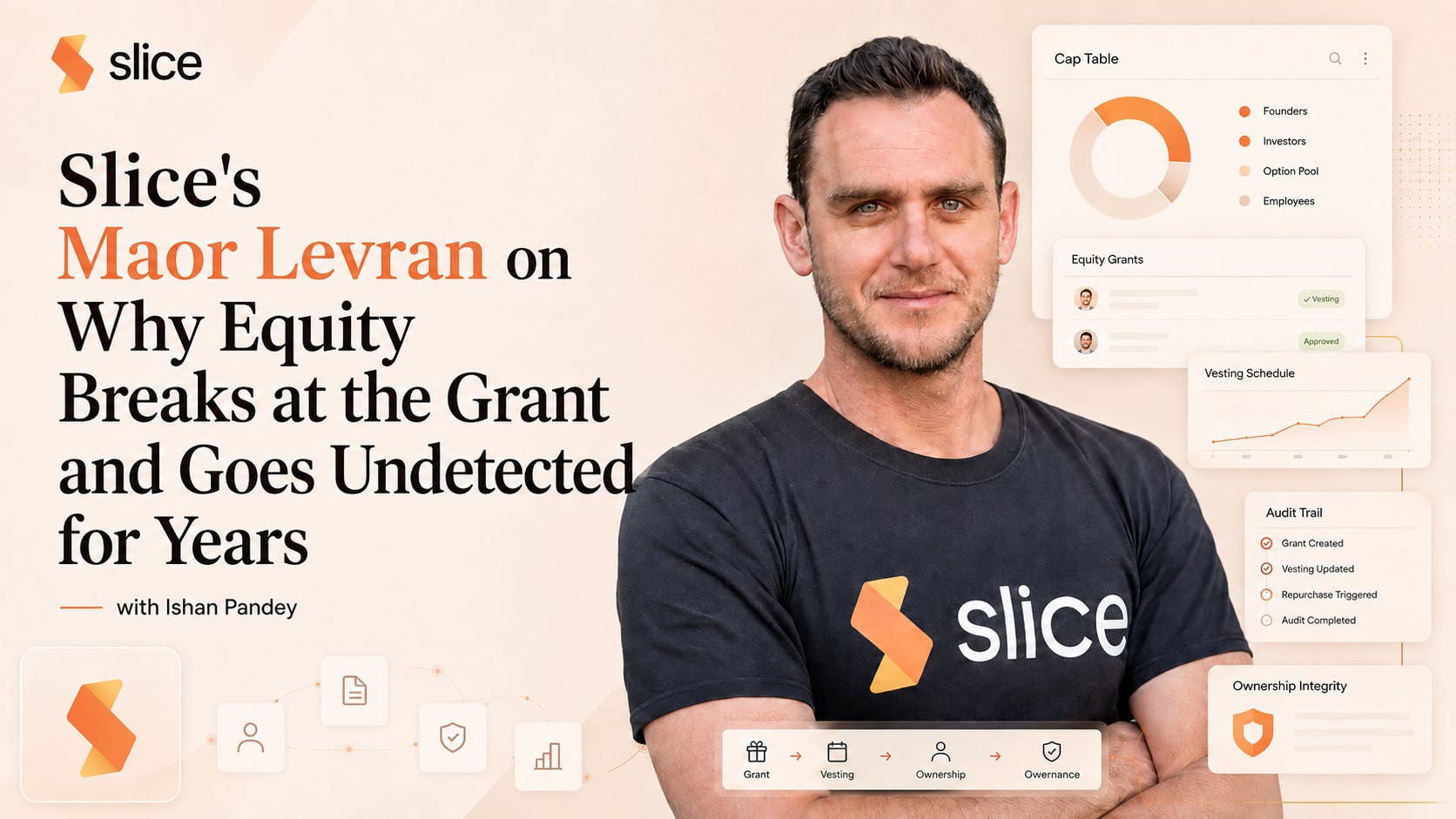
Slice's Maor Levran on Why Equity Breaks at the Grant and Goes Undetected for Years
Full Article
Original Source
Read the full article at Hackernoon →KhanList aggregates and links to publicly available news content. We do not host full articles from third-party sources. Always verify important information with original sources.