
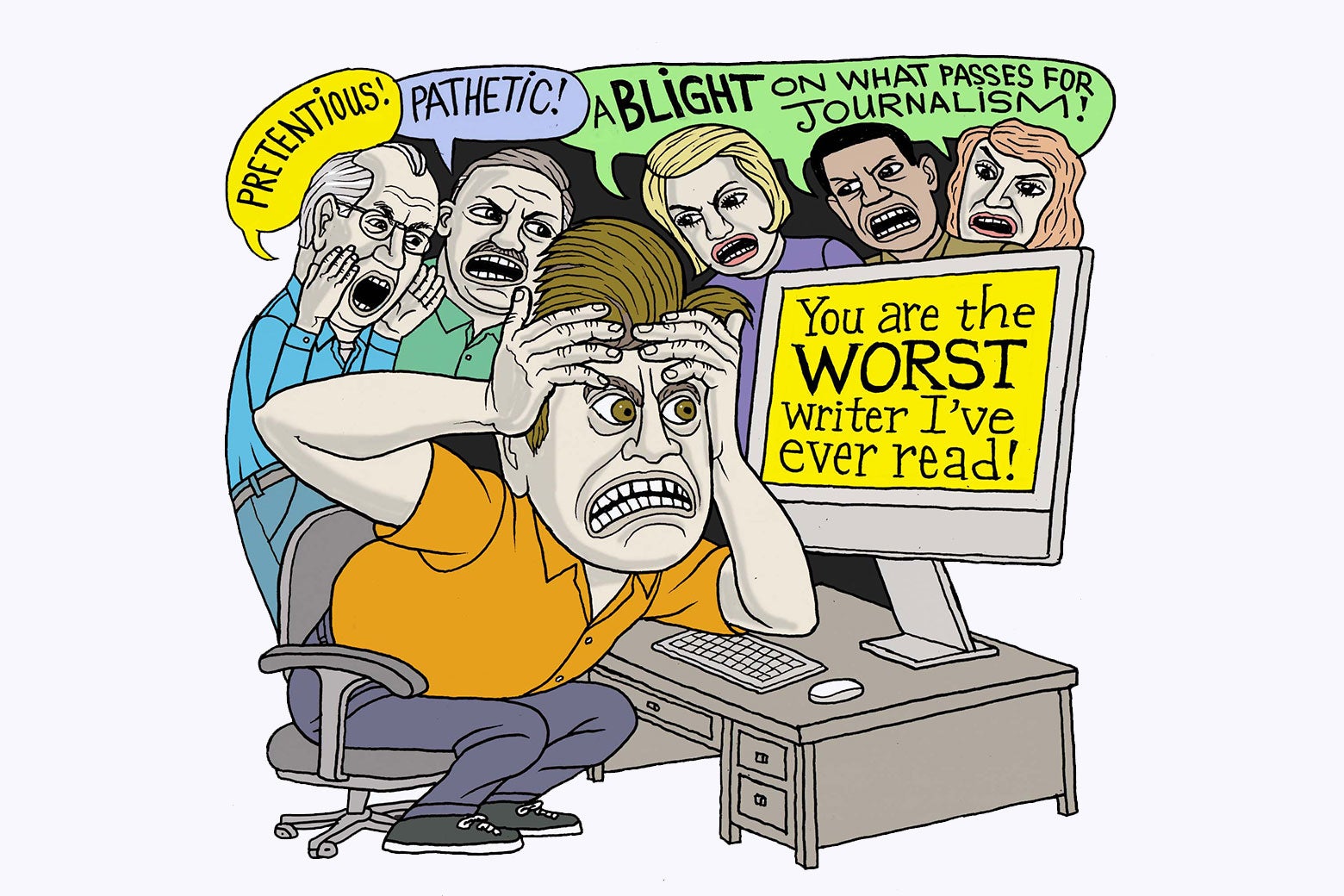
Life I thought Slate’s hostile commenters were out to get me. I decided to ask them why. They could not have surprised me more. By Enter your email to receive alerts for this author. Sign in or create an account to better manage your email preferences. Unsubscribe from email alerts Are you sure you want to unsubscribe from email alerts for Luke Winkie? Sept 23, 20265:35 AM Illustration by Mark Alan Stamaty Sign up for the Slatest to get the most insightful analysis, criticism, and advice out there, delivered to your inbox daily. I’ve been a journalist for long enough to be familiar with most of the job’s occupational hazards. I’ve angered powerful people without a legal canopy to protect me. My cursor has hesitated over the Send buttons of emails containing invasive questions. I know what it’s like to be chewed out, to have your confidence flattened, to junk entire drafts and start over from scratch. And yet, for most of my career, I never did attract a personal troll. In this line of work, having a troll is the opposite of having a fan. It’s someone out there—across the astral span of the internet—who has decided to keep tabs on what you publish with the singular intent of mocking everything you write. Since I never had one, I wondered if people like this had gone extinct alongside the rest of the web I used to know. After all, digital media, and its trademark pugnacious tone, is basically defunct. The linear rapport necessary for a blogger to become someone’s nemesis simply no longer applies; the written word is on life support. At least, that’s what I thought—until I discovered the Slate comments section. At last, I had finally found my haters. Slate’s comments section is not prominently advertised on the homepage, and when I was hired as a staff writer in the spring of 2023, I didn’t know it existed. But, sure enough, all of the articles on the website are studded with a button shaped like a speech bubble. Click on it, and a discussion thread quietly materializes at the bottom of the screen, revealing one of the last few remaining active commenting communities hosted by a magazine. The section possesses a distinctly Web 1.0 architecture: There are no reaction GIFs or YouTube embeds, and posters tend to distinguish themselves with multisyllabic usernames. Trawling through the comments feels a little bit like exploring the sediment of cyberspace. As such, the core clientele—about 200 strong—is composed of people who have been visiting Slate for a very, very long time. They are some of our most dedicated readers. They’ve also despised pretty much everything I’ve ever written. Comments sections are, by nature, snarky. The format was devised to be a digital version of the newspaper’s good old-fashioned Letters to the Editor page—itself a receptacle for readers to loudly hector the opinion columnists they found annoying. Once considered default features, many of those sections disappeared as digital media matured, mostly because editors determined them to be hotbeds of inanity and harassment. (Recently they’ve made something of a comeback—earlier this year, the Atlantic reintroduced a comments board after abolishing it in 2018.) But Slate’s comments section has survived, and it has retained its characteristically adversarial register to this day. The threads bloom with treatise-length complaints, exasperating grammatical pedantry, and the usual flame-war material. Anyone who has ever written professionally has contended with some version of this, but what surprised me about Slate’s community was just how closely read the taunts in the comments section tended to be—particularly when they were channeled in my direction. Sure, I’ve been hit with plenty of run-of-the-mill drive-bys—“I really hope my Slate Plus dollars aren’t paying this guy,” reads one comment to my 2024 story about men wearing chains—but other insults reveal a profound metatextual fluency in my entire oeuvre. It’s as if the commenters are reading my work voraciously with the specific intention of obliterating me. In the autumn of 2023, as part of Slate’s long-running Human Guinea Pig column, I was tasked with donning a Mario costume and busking for change in Manhattan. I think the story turned out pretty well, but the incident has been cited, derisively, in the comments section of dozens of articles I’ve written since. “You’ve never forgiven him for putting on that Super Mario costume in Times Square,” read one, left by user Muffin the Mule, about a story published almost three years after the Mario adventure. When I checked the comments on a story I wrote in the spring about Tucker Carlson’s gonzo ballcaps, one read, “Do you think Winkie wears the hat with his gold chain?” In another, about plastic surgery, I wrote that I left the house dressed in a chambray shirt and salmon shorts. This fairly normal outfit offended one user so much that he has made sardonic references to it on multiple occasions in the comment box. You get the idea. It is not just that I get roasted relentlessly—it is that the roasts are meticulously tailored, leading one to believe that making fun of Slate writers is, for the commenters, among the prime incentives for visiting the website. And I am far from the only person here to get that treatment. Slate contributors far and wide have endured their own bespoke wisecracks, and that has nurtured a, let’s say, complicated relationship with the magazine’s comment box among the staff. One colleague told me that her mother has occasionally taken up in the comments herself, slinging zingers back at the trolls on behalf of her daughter. (My mom has done this too—I imagine it’s among the main reasons she pays for a Slate Plus subscription.) Another co-worker told me that she ventures into the comments on extremely rare occasions, often as a self-loathing exercise. (“The last time I checked on them was two years ago when I wrote a piece I was convinced was terrible,” she said. “I knew someone in there would agree.”) But the person on staff who possesses, by far, the most comments-related trauma is Slate Jurisprudence editor Jeremy Stahl. In his early days at the magazine, Stahl was made a community moderator of the Fray—the venerated message board that Slate operated in the 2000s. Even in those days, Stahl remembers, the tenor of the comments was largely the same as it is now. “It was, for a while, a very hostile, troll-y commenting community,” Stahl said. “They said some of the meanest things anyone has ever said to me. It was a bummer.” This all brings me back to my personal troll. Unlike some of my fellow Slatesters, I’ve never felt especially victimized by the comments section. I have thick skin, and I’ll happily admit that I have a perverse fondness for the backlash that results from an incendiary blog. (I’m also white and male, which excludes me from some of the gnarlier flavors of trolldom.) But if I’m being honest, there is one user who has a unique talent for vexing me. He posts under the username Flexo, and he is the person who has picked on me the most during my time at the magazine. I’ve gotten to know his rancorous countenance well over the months and years, as my byline has become flush with essays. In fact, when I take my ambling scrolls into the comments section, my eyes instinctively seek out his name. I think I’m morbidly curious to see if I’ve finally won Flexo over. The answer—eternally—is no. “This guy is far and away the worst writer I’ve ever read. I feel like I need to have a lime bath to disinfect myself after using the word ‘writer,’ ” wrote Flexo beneath the aforementioned Tucker Carlson piece. “Don’t post here, it only encourages him,” he commented on a story I wrote about a viral dieting trend. “Winkie is a blight on what still passes for journalism,” he added. “Never heard of him. Winkie is the worst.” This is Flexo one more time, offering his assessment on a profile I wrote about the right-wing comedian Tony Hinchcliffe. Someone responded to him saying that I “like the obscure” in my writing subjects and enjoy “being on the edge of a movement.” To which Flexo countered: “A bowel movement?” It goes without saying that Flexo and I have not met, nor have we ever spoken to each other. This is how it always is between a writer and their commenters, and as such, I’ve never been quite sure how to interpret the flavor of his smarm. Is my dear Flexo just an ordinary jerk? Is he trying to offer me some tough love? Did one thing gradually transform into the other? Really, all of those questions led me to another question: How much does Flexo hate me, really? The only thing I knew for sure is that, for better or worse, the people at the bottom of my articles—the ones responsible for the thousands of comments tapering off into an infinite scroll—are, beyond a shadow of a doubt, the most dedicated readers I’ve ever had, in a moment in media history when “having readers” is harder than ever. Despite all the negativity, a clear kinship exists between us. With Slate’s 30th anniversary around the corner, I wanted to get a better sense of their relationship with me—and the magazine as a whole. That meant I needed to give Flexo a call. In order for this project to work, I needed to create a dossier of my biggest haters. Evan Urquhart, Slate’s veteran community manager, agreed to help. I gave him 30 usernames to help me track down. Urquhart seemed to do this out of love for the community he has helped steward for more than a decade. He struck a considerably different tone than Stahl did. I think he knew what I was up to. “Our commenters are really funny, and really smart. Some of the meanness is more like their love language,” he told me. “Our community is made up of lovable, crotchety grumps. God bless them.” And so, armed with my dossier, I fanned out dozens of emails to the denizens of the Slate comments section. This presented another challenge: Was I crossing some sacred line? Especially when the commenters in question have said so many nasty things about your work? I worried that seeing my name pop up in the commenters’ inboxes might come off a little intrusive, or perhaps even narclike—a fracturing of a trust. And seriously, I wasn’t here to settle scores. Instead, I told these commenters that I was working on a story about Slate’s longevity, and that I wanted to know what has kept them around the magazine across so many different eras. That was basically true, as far as I was concerned. Flexo replied in less than 15 minutes. “You sometimes drive me crazy, but I do love our community, and none of it would be possible without the writers,” wrote Flexo, striking a much more conciliatory tone than I had grown accustomed to. “We have a great community and it’s nice you recognize that. This was a very nice email to send.” One week later, I jumped on the phone with him. After years orbiting around the exterior of the comment box—peering inside with macabre curiosity to witness the ways I’ve annoyed the regulars most recently—it felt a bit like making first contact. Flexo, as it turns out, is a 62-year-old guy named Ron who lives in the Pacific Northwest. I learned that he holds a degree in physics from the University of Oregon, and that he worked as a professional musician for decades. He told me that he loves jazz, and onetime Slate staff writer Jamelle Bouie, and that he hated my longform feature about the Creed cruise. (It wasn’t about the writing, Flexo told me. He just can’t stand the band’s music.) Most importantly, I learned that he isn’t active on any forms of social media. Facebook bores him, and he doesn’t have accounts on Twitter or Bluesky. No, the only place that Flexo posts is the Slate comments, which he visits almost every day. There is a long history of people, adrift in the frigid expanses of cyberspace, finding close fellowship in unexpected places—be it a niche subreddit, or a lonely Discord outpost, or the stately vestibules of World of Warcraft. The saga of Flexo, and the underbelly of Slate as a whole, is proof that the same dynamic can be replicated in a venue that exists primarily for readers to gripe about Dear Prudence letters. That makes it a testament to the tenacity of digital communion. For instance: Flexo has an Instagram account, but it is set to private, and he follows only 13 people—all of whom are fellow Slate commenters. They hang out sometimes, offline. (“I’m friends with several regulars,” he said.) Together, they work around the limited social features of our commenting interface—no direct messaging—by ferreting over burner emails to each other. (“It’s like a Slate-only email address,” Flexo said.) Failing that, Flexo is happy to treat Slate the same way you or I might treat Nextdoor. A few months ago, Flexo offered up a characteristically off-topic comment on a random Slate story complaining that one of his amps was on the fritz. Another user, who lived in Flexo’s area and had some mechanical know-how, replied, right there in the comments, offering his help. “He wrote, ‘Swing the amp by my house, I can fix it,’ ” Flexo said. “I’m like, ‘Are you serious?’ ” He was, and he took care of it. All of this is to say that Flexo is not some nihilistic troll. His participation in Slate’s discourse isn’t driven by the arbitrary destructiveness of, say, the average Twitter shitposter. Flexo has an investment in Slate, mostly because without Slate, its comments section would cease to exist. This is the symbiosis that defines the community, and it’s also why former Slate staff writer Dan Kois always thought that the comments section might as well exist in a “different universe” from Slate proper. I get what he means: While the community relies on Slate’s infrastructure and is fluent in the magazine’s tone, the section also possesses its own hermetic culture—one replete with idiosyncratic norms and insulated memes, like a Petri dish embedded in the HTML of one of the few publications to survive the wipeout of digital media. As for why these folks have stuck around despite their occasionally acrimonious attitude toward Slate itself, Kois just thinks that’s an immutable reality of the internet. If you build it—if you provide a blinking text box and the chance to pester an author—they will come. “It’s like that scene in Jurassic Park with Jeff Goldblum,” Kois said. “Life finds a way. Wherever there’s a little crack, they will flourish.” Nobody embodies this relationship better than a commenter named Wintermute, another one of my recurring trolls, and someone who has remarked on—no joke—nearly every article I’ve ever written for Slate. (He’s the one who had an issue with the chambray shirt.) Wintermute told me that he is happily retired and spends most of his days consuming a truly gargantuan amount of news. Wintermute starts on CNN, before pivoting to Le Figaro, El País, the Times of India, and a bevy of other international periodicals. Accompanying him on that daily binge is the Slate homepage, which remains open in a tab on his desktop at all times. “I hit the comments a couple of times an hour,” he told me. Wintermute started participating in the Slate town hall shortly after he began reading the website, back in 2009. Compared to the sweating morass of, say, the New York Times feedback section, he found that posting on Slate didn’t feel like “shouting into the void.” When Wintermute wrote a comment on the site, there was a good chance it would be read by a like-minded person, provoking a pithy retort or providing a flash of virtual chumminess that could be replicated, over and over again, in more articles down the line. This has always been the golden promise of networked communication, but ironically, the intimacy that Wintermute speaks of is possible on Slate only because, in 2026, the number of people enthusiastic about leaving comments on digital magazines is vanishingly small. In that sense, Slate’s community became tight-knit through the power of sparsity alone. Here is a band of wonks and nerds—the final standard-bearers of a more erudite era of the internet—gathered under torchlight in the enveloping darkness. “The Slate long-timers know each other, and we can give each other some chaff without the counterparty being offended,” Wintermute said. (Wintermute added that he does find the bulk of the stories we publish to be “informative and entertaining,” despite his propensity to “dump on them in the comments.”) It ought to be mentioned that readers like Wintermute—verbose, opinionated, more than a little cranky—were always the ones that Slate hoped to court. Back in the mists of time, the early 2000s to be exact, our robust commenting infrastructure was a crucial feature of the magazine’s brand identity. Slate used to compile the most salient comments it could find in a weekly roundup, showing off to the rest of the web all the smart people who read the website. (Here are some long-desiccated Slate comments scrutinizing Dahlia Lithwick’s coverage of the Michael Jackson trial.) But strategies shift and priorities change. Today it is often understood to be imprudent for a website to invest heavily in the health of its comments page when more pressing concerns, like YouTube views, beckon. Yet the deeper I delved into the lives of our commenters, the more I was moved by what this section was capable of—what it is still capable of, even now. Did you know, for example, that love has recently blossomed in the Slate comments? It’s the talk of the town down there. A user who goes by Betsy told me that she had been “aggressively flirting” with a user named Frank for months. “It became a running joke in the community,” Betsy said when I spoke to her by phone. Before long, the pair found themselves in a secluded comment thread—beyond the “Read More” partition—dashing off suggestive little missives back and forth in rapid fire. “Once it was clear that people weren’t observing us, we started talking pretty personally,” Betsy continued. She had set up a burner email address to receive his correspondence. Its prefix read: “BetsyLovesFrank.” “We eventually started calling and texting. It’s still a long-distance thing, but I’ve since been to Chicago, where he lives, a couple of times,” Betsy said. “He’s very cute, sweet, and charming.” Betsy told me another story, this one much heavier. During her years in the comments section, Betsy became close with a user named Minxie. She was a regular interlocutor in Slate’s politics coverage and had kicked around the site since the days of the Fray. So when Minxie disappeared in 2025, Slate’s commentariat grew worried. Betsy was on texting terms with Minxie, and those messages would later be discovered by Minxie’s husband, who informed her that she had died after a brief illness. “I told him that I knew Minxie from Slate, and that a lot of us were concerned about her, and if he minded if I shared the news,” Betsy said. He granted permission, and a few days later, pinned to the top of Slate’s daily open thread, was a death announcement—alongside a link to a GoFundMe page for Minxie’s memorial. Anyone who had gotten to know her in the comment box was invited to attend. “I’m grateful this was somehow discovered,” responded one commenter. “So much better than just wondering where Slaters go when they stop posting.” Kois was right. A whole civilization had flowered in the empty space beneath Slate’s articles. And as I got to know it better—as I witnessed how they loved, and how they mourned—I could begin to feel some semblance of the warmth bleeding through the snideness, in the same way that the commenters did. Still, toward the end of my conversation with Flexo, I needed to address the elephant in the room. Why had he been so mean about my writing? He laughed and laughed. An unspoken tension on the line finally snapped. “You’re so nice to ask me this,” Flexo said. “I couldn’t believe you wrote to me. When I saw your name pop up, I was like, ‘Oh, fuck, does he realize?’ ” In truth, I already knew what Flexo was going to say. For 30 years now, Slate has been a remote fiefdom in the media ecosystem. Its editorial demeanor remains offbeat, whimsical, and belligerent, a pure expression of “Slate-iness,” a term that everyone understands but nobody can strictly define. The magazine has seldom made an ovation to the general public—instead, it trusts that, now and forever, a type of person that can best be described as a “Slate reader” will exist, and that they will carry us through an industry buffeted by eternal headwinds. That is exactly why such intimacy has bloomed between the commenters, and also why, in this twisted, photonegative way, it is refracted onto the writers themselves. Whether I like it or not—whether he likes it or not—few human beings on earth have read more of my words than Flexo. “I may have been unfair at times. You guys get the feedback, whether it’s what you want to hear or not. But even though we’re idiots a lot of the time, we do fucking pay attention. We read what you guys write, and we think about it, and we care about it,” Flexo said. “The comments section is why that relationship exists. If I leave a comment on the New York Times, Paul Krugman isn’t going to call me up for an interview.” But I had. A curious thing happened while I was working on this story. After I had conducted my first few interviews, word spread through the comments section that I was writing something about Slate’s community. The commenters—in their archetypally cheeky way—breathlessly demanded updates in otherwise unrelated threads. (“This is the weirdest story about commenters I’ve ever read,” proclaimed one of the first notes left on a piece I wrote about alligators.) It made sense. There are few things a commenter craves more than attention from an author. What was more surprising is how the community’s overarching attitude toward my byline would change as well. The trolls I’ve gotten to know so well have tempered themselves—Flexo especially, who since our interview hasn’t had one bad thing to say about my work. Perhaps the commenters simply wanted to be on their best behavior, knowing that the microphone was turned around to them. Or maybe I’ve just been around Slate for long enough now to be fully melded within the site’s culture. Whatever the case, I seem to have crossed some sort of Rubicon. I guess the commenters and I have finally gotten to know each other. “It’s fun seeing writers get better as they work for Slate,” wrote a poster named QRedux—who can now be categorized as a former troll of mine—on a profile I wrote about Mike Love, published just a few months ago. “Luke Winkie definitely falls into that camp for me. When he first started writing here everything he did made me roll my eyes so hard I was afraid I’d injure myself. Now he can write an article on a subject I have zero interest in and make it compelling.” One theme that kept coming up throughout my reporting is how those who comment on Slate have been commenters for life. So many have arrived here out of the great diaspora that followed the shuttering of the great discussion hubs of yesteryear: Salon, or Gawker, or the countless other debris bobbing around the wastewater that has been made of digital media. For years, this was all anyone could hope to get out of the internet. The web was still small, the world still somewhat literate, the entire enterprise reduced to a blinking cursor underneath a blog post. That alone had the power to shape a world. Betsy told me that she has spent more time with her fellow commenters than with some of her best friends. “None of us intended for that to happen, but here we are,” she said. And in the future, when the 200 or so users who make up Slate’s coterie go their separate ways, I wonder if the comments section will go dark as well. I suppose that makes all of us, the authors and the posters alike, the last of a dying breed. Let every troll be a reminder that, once upon a time—and hopefully for a little while longer—people liked to read articles on the internet. Internet Culture Journalism Media Relationships Social Media Memes Slate's 30th Anniversary
Slate Commenters Have Been Trolling Me for Years. I Decided to Confront Them—and Was Startled by What I Found.
Full Article
Original Source
Read the full article at Slate →KhanList aggregates and links to publicly available news content. We do not host full articles from third-party sources. Always verify important information with original sources.