
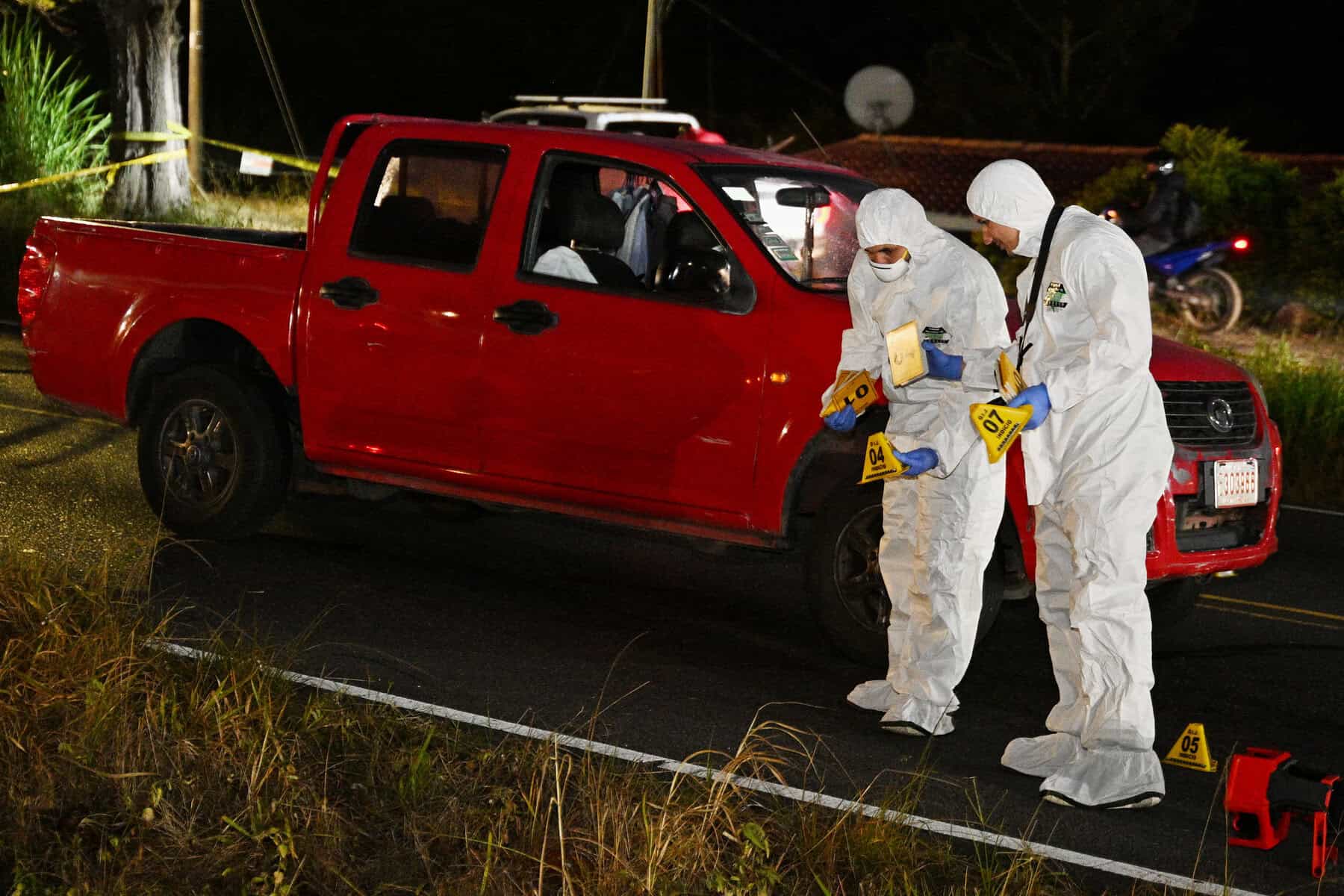
Camilo Rodríguez Chaverri, the journalist shot dead yesterday afternoon on Route 32 in Heredia, had filed about 10 complaints over threats to his safety in the past two years, according to Vladimir Muñoz, acting deputy director of the Judicial Investigation Agency (OIJ). Investigators are now examining whether those threats are connected to his killing. Rodríguez, 50, was driving a red pickup toward San José near San Miguel de Santo Domingo when, according to the OIJ’s preliminary account, two men dressed in black on a white motorcycle pulled alongside and opened fire. Muñoz said the attackers first shot at the driver’s side, then circled the vehicle and fired through the passenger window before fleeing toward the capital. Muñoz said agents recovered nine to 10 shell casings outside the vehicle and that the number of shots could prove higher. An earlier account attributed to the OIJ on Monday evening cited seven to eight casings. Agents are reviewing security camera footage to trace the escape route and are checking whether the suspects had been following Rodríguez before the attack. The case has been assigned to an interdisciplinary team from the OIJ’s San José Homicide Section, which is looking to identify both the gunmen and anyone who may have ordered the attack. No arrests had been announced as of this morning, and authorities have not established a motive. Attorney General Carlo Díaz said Monday that the scene resembled a contract killing, according to international wire reports. Díaz also said Rodríguez had declined to enter the Public Ministry’s victim and witness protection program despite the threats, a point the OIJ confirmed, meaning he had no police protection. The public complaints Rodríguez made on social media, in which he named alleged drug traffickers, are one line of inquiry, which Muñoz described as broad. Further details are in our first report on the Route 32 shooting. President Laura Fernández condemned the killing late last night, calling it a cowardly murder and a stain on freedom of expression regardless of the content of his statements. She said she had instructed all police forces to support the investigation so that those responsible are punished. Fernández had sued Rodríguez for defamation during the 2025 campaign over a video in which he alleged her home was built with money from a drug trafficker, according to wire reports. The shooting came on the same day the president said jailed gang members had ordered her own killing. Former president Luis Guillermo Solís condemned the crime and called for a thorough investigation with no impunity for the gunmen or whoever planned the attack. In the Legislative Assembly, the 47 lawmakers present unanimously approved a motion for a minute of silence and a call for investigation, according to legislative reports. National Liberation Party caucus leader Álvaro Ramírez said insecurity in the country had spiraled out of control, while Social Christian Unity Party lawmaker Abril Gordienko called the attack an alarming sign of the level of insecurity. Broad Front lawmaker José María Villalta said Rodríguez was killed for practicing journalism and urged investigators to pursue whoever ordered the crime. Press organizations both here and around the world joined the condemnation. Yanancy Noguera, president of the Costa Rican Association of Journalists (Colper), said that the evidence so far points to the silencing of a dissenting voice, and the association demanded a swift investigation. The Press and Freedom of Expression Institute (IPLEX) called for a prompt, independent, rigorous and exhaustive inquiry into both the perpetrators and anyone who ordered or financed the killing, while cautioning against drawing early conclusions about the motive. The Central American Journalists Network also condemned the attack and urged prosecutors and the OIJ to act quickly. Rodríguez worked in radio, print and television before turning to social media, where he posted allegations about drug trafficking and alleged links between criminal groups and political and business figures. He said he had shared information on those links with the US Drug Enforcement Administration, a claim that has not been independently verified. He also sought public office, pursuing the Costa Rican Renewal Party’s presidential nomination in 2022 and heading the Aquí Costa Rica Manda party’s San José legislative list for the 2026 elections. According to the attorney general, Rodríguez is the third journalist murdered in Costa Rica, after radio host Parmenio Medina in 2001 and Ivannia Mora in 2003. The case lands as Costa Rica posts drug seizures the US Embassy calls historic, in a country that ranked first in the Americas in this year’s World Press Freedom Index. Costa Rica has long counted press freedom among its democratic strengths, yet a recent survey found that four in ten Costa Ricans hold back their opinions on social media out of fear. How quickly investigators identify those responsible, and whether they reach anyone who ordered the attack, is likely to shape how safe people feel speaking out.
Slain Costa Rica Journalist Filed 10 Threat Complaints Before His Killing
Full Article
Original Source
Read the full article at Ticotimes →KhanList aggregates and links to publicly available news content. We do not host full articles from third-party sources. Always verify important information with original sources.