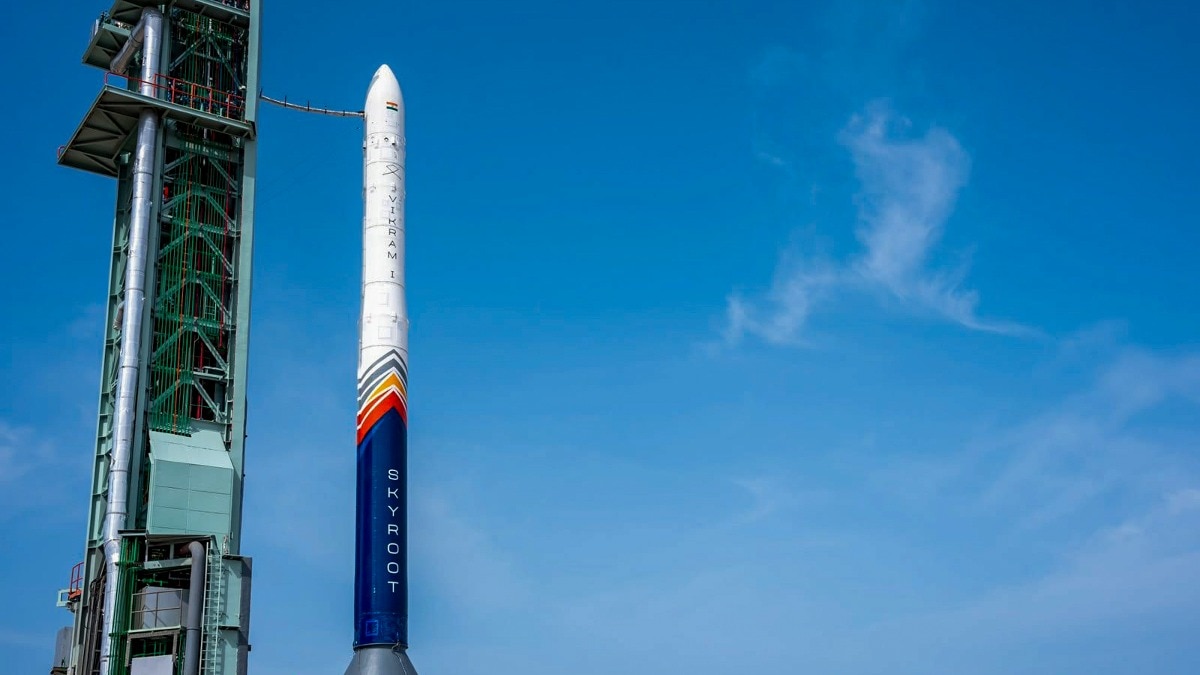
With Vikram-1 success, Skyroot became the first private company to design, build and fly an Indian rocket to orbit, placing it among a select group of private space firms globally to achieve the feat.Vikram-1 rocket lifted off from the First Launch Pad at the Satish Dhawan Space Centre in Sriharikota as part of Mission Aagaman. Skyroot Aerospace on Saturday scripted history by becoming the first private Indian company to successfully launch an Indian-built rocket into orbit on its maiden flight, marking a major milestone for the country's growing private space industry.The company's Vikram-1 rocket lifted off from the First Launch Pad at the Satish Dhawan Space Centre in Sriharikota as part of Mission Aagaman. The launch vehicle reached its planned low-Earth orbit at an altitude of around 450 km and successfully deployed multiple payloads, including Skyroot's own SCOPE satellite, Grahaa Space's Solaras satellite and other in-orbit experiments.The successful mission makes Skyroot the first private company to design, build and fly an Indian rocket to orbit, placing it among a select group of private space firms globally to achieve the feat.According to the company, Prime Minister Narendra Modi personally called the Skyroot team to congratulate them after the successful mission. The Prime Minister had also sent a handwritten postcard inscribed with "Vande Mataram", which was carried aboard Vikram-1. Congratulating the team, ISRO Chairman Dr V Narayanan said, "I extend my heartfelt congratulations to Team Skyroot on the successful accomplishment of the Vikram-1 mission. This achievement is the outcome of years of innovation, perseverance and engineering excellence, and reflects the growing maturity of India's private space sector. It is encouraging to see Indian industry translating technological capability into launch capability, complementing our national space programme."He added, "ISRO and IN-SPACe remains committed to working closely with industry partners to build a vibrant, globally competitive space ecosystem that advances India's space ambitions." IN-SPACe Chairman Dr Pawan Goenka described the launch as a landmark achievement for the country."This is a proud day, not just for Skyroot but for the whole country. Only a handful of nations can reach space on their own, and today a private Indian company joined that exclusive club," he said.Skyroot co-founder and CEO Pawan Kumar Chandana said the mission marked only the beginning of the company's ambitions."We are immensely proud to stand here today. Vikram-1 reached its designated orbit and deployed our own SCOPE satellite, Grahaa Space's Solaras satellite, and other in orbit experiments making Skyroot the first private company to take a rocket to orbit on its very first flight," Chandana said."Our mission has always been to open space for all. Today we opened that door a little wider. This is not the destination. It is the beginning. From here, we leap," he added.During the mission, Vikram-1 completed all its key flight milestones, validating the performance of its propulsion, avionics, and guidance, navigation and control systems under actual flight conditions. The company said the mission also generated valuable flight data that will help improve future launches in the Vikram series.Skyroot co-founder and COO Naga Bharath Daka said, "Mission Aagaman is the culmination of years of engineering, rigorous testing and an unwavering commitment to solving some of the hardest problems in Space."He added that the company was "already applying today's learnings to the next chapter of the Vikram series and to building a world-class launch capability from India, for the world."Vikram-1 is a multi-stage launch vehicle designed to carry satellites weighing up to 350 kg to low-Earth orbit. Built with an all-carbon composite structure, it uses in-house developed propulsion systems, including 3D-printed engines and solid-fuel motors.The company said the success of Vikram-1 lays the foundation for its commercial launch programme. Its next launch vehicle, Vikram-2, capable of carrying payloads of up to 1,000 kg to low-Earth orbit, is targeted for its maiden flight in 2027, while Skyroot is also developing a fully reusable launch vehicle aimed at reducing the cost of access to space.- EndsPublished On: Jul 18, 2026 18:36 IST
Skyroot's Vikram-1 enters orbit on maiden flight, a first for private sector
Full Article
📰 Original Source
Read full article at Indiatoday →KhanList aggregates and links to publicly available news content. We do not host full articles from third-party sources. Always verify important information with original sources.