
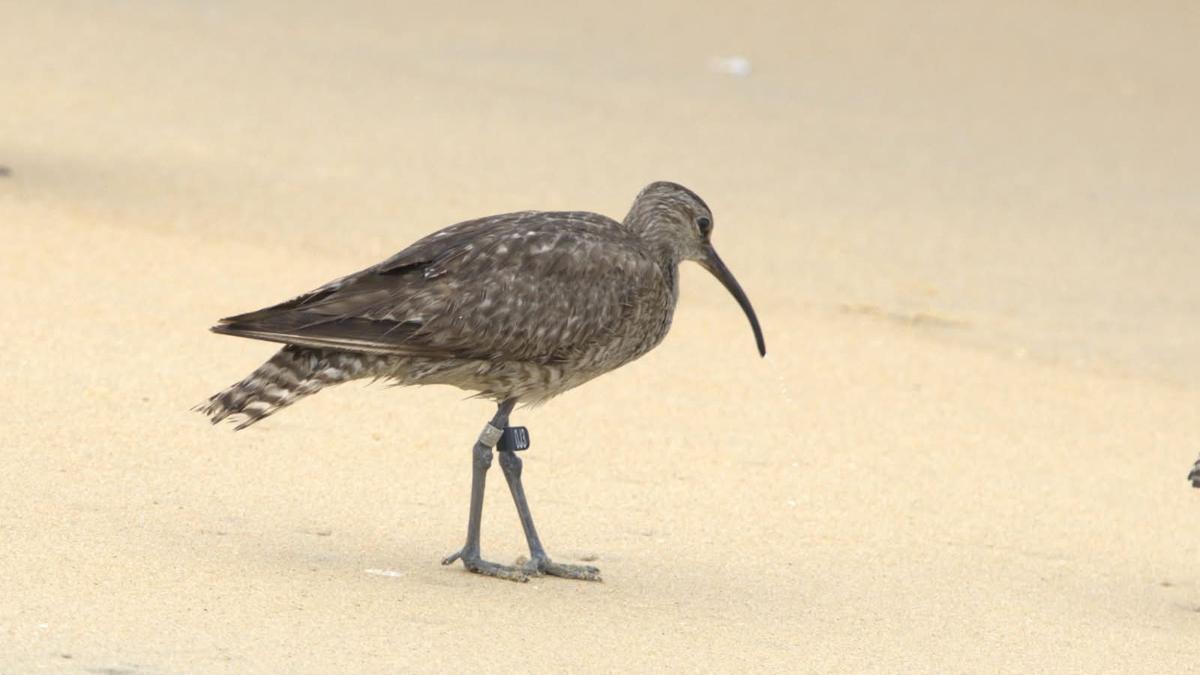
Eurasian whimbrel spotted on the Elathur beach in Kozhikode earlier this month. | Photo Credit: Special Arrangement With the winter migratory bird season under way, two marked shorebirds recorded along the Keralam coast earlier this month offer clues to migration routes, stop-over sites, links between breeding and wintering grounds, and the movements of individual birds.A Eurasian whimbrel (Numenius phaeopus) ringed at Kadalundi-Vallikkunnu Community Reserve more than six years ago has been resighted on the Elathur beach, about 20 km from the reserve, in Kozhikode, while a Tibetan sand-plover (Anarhynchus atrifrons) spotted on the Chavakkad beach had been banded in Mumbai in 2025.Black flag and ringAbdulla Paleri, a Kozhikode-based ornithologist and Assistant Professor at Dignity College of Arts and Science, Perambra, photographed a Eurasian whimbrel on the Elathur beach on September 19. According to him, the bird had a ‘black flag’ bearing the alphanumeric code ‘0J3’ on its left leg and a metal ring on its right leg. The black flag on its upper leg indicated that the bird had been marked in south India under a bird-banding programme of the Bombay Natural History Society (BNHS). A single black flag with a unique alphanumeric code is used to mark waders in the five southern States. According to the BNHS, this was the first resighting of this particular Eurasian whimbrel.On September 12, a Tibetan sand-plover was seen on the Chavakkad beach in Thrissur with two ‘white flags’ on its right leg, one above the other, bearing the code ‘HZN’, and a metal ring on its left leg. The bird was photographed by birdwatcher P.P. Sreenivasan from Guruvayur in Thrissur. The use of two white flags, according to him, is associated with the bird-marking programmes conducted by the BNHS in rest of India.Photographs of both the birds were sent to the BNHS to obtain further information about their ringing and banding history.Mr. Paleri said, according to information provided by the BNHS, the Eurasian whimbrel had been ringed on January 29, 2020, at the Kadalundi reserve by S. Sivakumar, a scientist at the BNHS.“The observation is noteworthy as it documents an individually marked Eurasian whimbrel returning to the Keralam coast more than six years after it was ringed. The bird may have returned to its breeding grounds in Europe or Central Asia after being ringed in 2020 and subsequently migrated back to the Kozhikode coast,” said Mr. Paleri.In MumbaiAccording to information provided by the BNHS, the Tibetan sand-plover was banded on March 27, 2025 in Mumbai by researcher Kiran Dalvi. Tibetan sand-plover spotted at Chavakkad in Thrissur earlier this month. | Photo Credit: Special Arrangement “One possibility is that, during its migration from the Himalayas or Tibet, the bird first reached Mumbai, where it was banded, and subsequently travelled approximately 1,000 km to reach the coast of Thrissur. Another possibility is that after visiting Mumbai, it returned to its Himalayan or Tibetan breeding grounds and subsequently migrated to Keralam for the winter,” said Mr. Sreenivasan.A second sighting of a marked shorebird can tell a larger story about its migration.“Individual bird sightings recorded at different locations can reveal much more than the presence of a species. When a marked shorebird is sighted again, it provides a glimpse into the bird’s journey — where it travels, its stopover site, and how different parts of its migratory range are connected. Such records are crucial for piecing together migration patterns and understanding the journeys shorebirds undertake between their breeding and wintering grounds across seasons,” P.O. Nameer, Dean of the College of Climate Change and Environmental Science at Kerala Agricultural University, told The Hindu. Published - September 27, 2026 07:00 am IST
Six years on, ringed Eurasian whimbrel resighted on Keralam coast; marked Tibetan sand-plover also recorded
Full Article
Original Source
Read the full article at Thehindu →KhanList aggregates and links to publicly available news content. We do not host full articles from third-party sources. Always verify important information with original sources.