
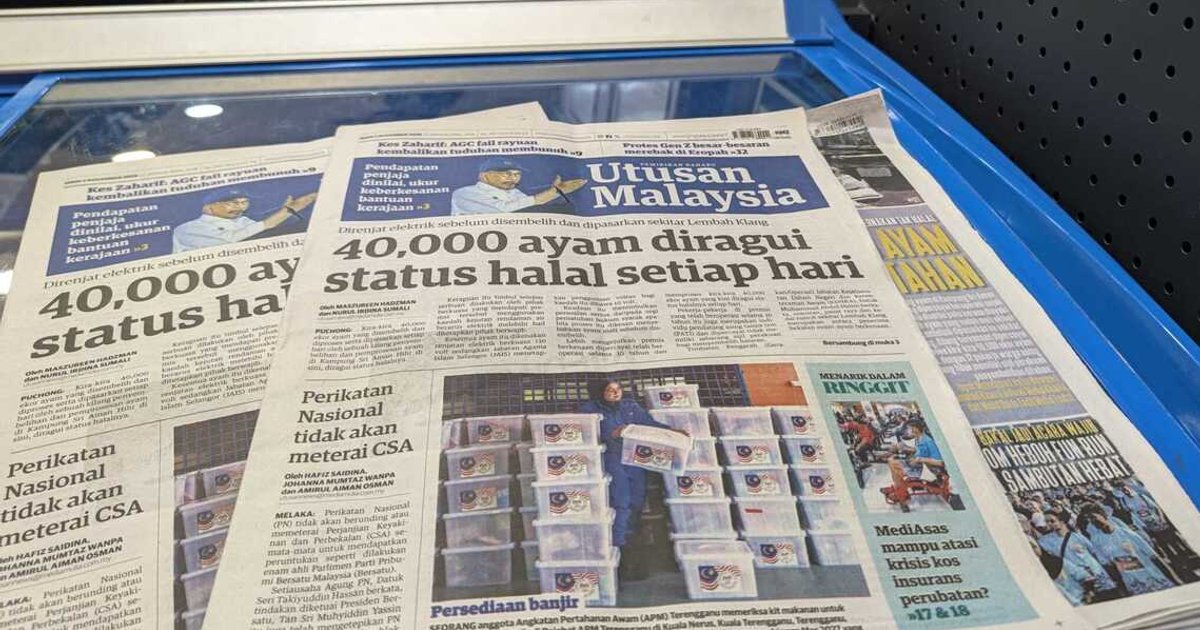
KUALA LUMPUR – Journalists at Malaysia’s oldest Malay-language newspaper, Utusan Malaysia, have expressed dismay and fears for their future as the publication faces another crisis just six years after its revival from financial collapse.Its publisher, Media Mulia, announced on Nov 1 plans to place nearly half of its roughly 200 employees on paid leave as it weighs restructuring options, reviving painful memories of the newspaper’s abrupt closure in October 2019 after years of financial losses.“We should have learnt from the collapse of the original Utusan so that the same mistakes would not be repeated,” said one journalist at the company, who asked not to be identified as it may affect their job security.“But history is repeating itself, marking another dark chapter for Utusan Malaysia and affecting its employees.”An internal memo seen by The Straits Times cited business and cost pressures as reasons for the paid leave scheme, with the names of the nearly 100 affected employees expected to be revealed on Nov 4.ST also understands that a town hall meeting is scheduled for Nov 3, where the company will give details of the scheme, and steps that it will take to ensure its business continuity.The uncertainty has left reporters anxious about their future, with many caught off guard by the announcement and without alternative employment plans.Media Mulia director and chief financial officer Abd Wahid Idris said in a statement on Nov 2 that the rationalisation exercise was undertaken to ensure that its business will continue and be sustainable.He also said the company remained committed to continuing the publication of its print edition for loyal readers.History repeats itself for staffFirst published in Singapore in 1939, the newspaper was founded by Malay journalism pioneer Abdul Rahim Kajai and Yusof Ishak, who later became Singapore’s first president.The collapse of the original publisher, Utusan Melayu (Malaysia) Berhad, in 2019 followed years of poor cash flow, mounting debts and declining sales. This eventually prompted its board of directors to declare the company insolvent and initiate liquidation proceedings.It had returned to publication in July 2020 under Media Mulia, a company linked to Malaysian tycoon Syed Mokhtar Al-Bukhary, promising a fresh start for one of the country’s most storied news organisations.Describing a sombre mood in the newsroom on Nov 2, the journalist said media practitioners deserved greater recognition and appreciation, arguing that the rise and fall of political leaders are often shaped by what journalists write.“The role of the media is not to be kicked aside when no longer needed,” the journalist added. They said employees had been left wondering how long the leave would last and whether they would be permitted to take up other work during the period.Employees who had initially been told that their employment would continue until the end of October were instead instructed to pack their belongings and leave the office as early as 1pm on Oct 9.Journalist welfare advocate Radzi Razak commented that while restructuring may be necessary for a company’s survival, employees should not be left in the dark about their future.Speaking to ST, Radzi questioned what would happen to the affected journalists once their paid leave ended and what assurances the company could offer them.“What happens to journalists, photographers, editors and production workers who have spent decades building these newsrooms? How much experience and institutional memory can the industry afford to lose?” he asked.“The concerns among employees are real. They deserve clarity, fair treatment and honest answers.”Broader industry decline in MalaysiaThe crisis comes amid a sustained decline in Malaysia’s newspaper industry, with the combined print circulation of Malay-language newspapers plunging 55% from two million copies in 2013 to just 905,000 in 2018, according to the Audit Bureau of Circulations.Utusan Malaysia itself saw its circulation plunge 43% between 2014 and 2018, from about 172,000 copies to fewer than 100,000, before its original publisher collapsed the following year.The developments come just days after Communications Minister Fahmi Fadzil urged financially troubled media organisations to seek assistance from his ministry before resorting to layoffs.Speaking at a press conference on Oct 31, Fahmi said he wanted to prevent media workers from losing their livelihoods as the industry struggled with mounting financial pressures.Fahmi said that the government had added another RM30 million to assist media companies under the Media Innovation Fund. Previously, 72 Malaysian media companies have benefited from the fund to support their digital transformation, modernisation, and sustainability.“If possible, we don’t want even one person to lose their job,” he said. “Please approach me, we will try and help as best we can.”Furthermore, media advocacy group Gerakan Media Merdeka (Geramm) reminded Media Mulia of Fahmi’s call, and urged against a repeat of the 2019 experience.“We urge Media Mulia to prioritise consultations with its employees, provide a transparent explanation regarding their future, and explore all available options before any layoffs are decided upon,” Geramm said in a Nov 2 statement.“The legacy of a media organisation lies not merely in its brand, but also in the employees who have built its credibility.”Sign up for our weekly Asian Insider Malaysia Edition newsletter to make sense of the big stories in Malaysia.
Six years after revival, Malaysia’s oldest Malay newspaper faces another crisis. What’s next?
Full Article
Original Source
Read the full article at Straitstimes →KhanList aggregates and links to publicly available news content. We do not host full articles from third-party sources. Always verify important information with original sources.