
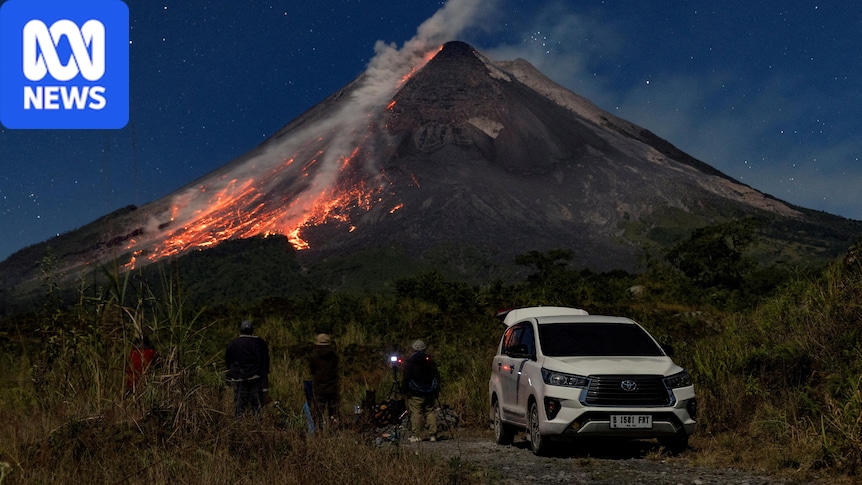
Read the story in Bahasa IndonesiaCendy Rahmat never imagined he would experience volcanic ash while living in Jakarta.Growing up in Yogyakarta near Mount Merapi, one of Indonesia's most active volcanoes, he was familiar with volcanic activity and had experienced major eruptions.But after moving to the Indonesian capital in 2019 he believed he was far enough away from the country's volcanoes to not have to worry about them.Cendy Rahmat has experienced the impacts of eruptions from three different volcanoes. (Supplied: Cendy Rahmat)"I thought I wouldn't be affected by a volcano-related disaster in Jakarta," he said."I was surprised it could reach us."His surprise came after the Jakarta government confirmed earlier this month that volcanic ash from Anak Krakatau, about 150 kilometres away, had reached parts of the city.The ash polluting the air in Jakarta and elsewhere across Indonesia was the result of six volcanoes erupting in a very short space of time, a "rare" event despite the region being one of the world's most volcanically active countries and home to 500 volcanoes.The ash has spread across parts of Java and Sumatra, disrupting thousands of flights and affecting more than 340,000 passengers including Australians.Anak Krakatau remains at Level III, or "Alert" level, with a 3-kilometre exclusion zone in place.As of Thursday, Indonesia's Meteorology, Climatology and Geophysics Agency (BMKG) was also detecting ash from at least four other volcanoes: mounts Lewotolo, Ibu, Dukono and Semeru.A house in Central Java is covered in ash after Mount Merapi erupted in 2010. (Reuters: Dwi Oblo)It was not Mr Rahmat's first encounter with volcanic ash.In 2010, while still in high school, he experienced Mount Merapi's biggest eruption in more than a century, which killed more than 300 people.Four years later he was being covered in ash by East Java's Mount Kelud."The ash was incredibly thick," he said.Ash from Mount Kelud's 2014 eruption travelled hundreds of kilometres across Java. (Reuters: Dwi Oblo)The eruption in 2014 spread ash as far as 500 kilometres away, forcing tens of thousands to evacuate and closing at least seven airports across Java.Mr Rahmat said that he remembered the February eruption as a "grey Valentine's Day".'Rare' event as six volcanoes eruptIndonesia is home to 127 active volcanoes and sits along the Pacific Ring of Fire. (Supplied: Indonesia's Ministry of Energy and Mineral Resources)The US-funded Smithsonian research institution records 55 Indonesian volcanoes that have erupted since 1960, more than any other country.In recent weeks Anak Krakatau in the Sunda Strait, Semeru in East Java, Ile Lewotolok and Lewotobi Laki-laki in East Nusa Tenggara, Mount Ibu in North Maluku and Mount Sinabung in North Sumatra have all erupted.Dr Indranova Suhendro, an assistant professor at Gadjah Mada University's Faculty of Geography, said two or three volcanoes "quite often" erupted at the same time in Indonesia."But having six volcanoes erupt at once is rare, even over a period of decades or centuries," he said.Dr Indranova Suhendro says each volcano has its own characteristics. (Supplied: Indranova Suhendro)Each volcano has its own magma system and eruption cycle, he said.Some, such as Semeru and Anak Krakatau, erupt relatively frequently, while others can remain quiet for years. This time, those independent cycles happened to overlap, Dr Suhendro said.External events such as earthquakes can sometimes influence an individual volcanic system, but one volcano would not trigger another because they have separate systems and are located far apart."In terms of timing I think it really was a coincidence," he said.'Merapi is like a playground'Abid Rahmatullah says he sometimes does his university assignments while overlooking Mount Merapi. (Supplied: Abid Rahmatullah)Abid Rahmatullah, who is from Ngemplak district in Yogyakarta, about 18 kilometres from the summit of Mount Merapi, said living with volcanic activity was part of everyday life.He said living near Merapi had its benefits, including good quality water, fresh air and nice views."For me, Merapi is like a playground," Mr Rahmatullah said."During the day, you can't really see the lava avalanches. Just thin smoke and rocks coming down. But at night they look like natural fireworks coming down the slopes."During Merapi's 2010 eruption Abid Rahmatullah and his family evacuated to another city. (Supplied: Abid Rahmatullah)Despite being accustomed to Merapi's activity, Mr Rahmatullah said there was still concern about the possibility of a sudden explosive eruption without warning.He said residents monitored updates and followed officials' guidance through a WhatsApp group.Indonesia's disaster preparednessThe recent eruptions have also sparked questions about how Indonesia funds disaster preparedness.The Indonesian National Disaster Management Agency (BNPB) was allocated Rp1,43 trillion ($113 million) in Indonesia's 2025 state budget, while the 2026 state budget allocated about Rp491 billion ($39 million) to the agency.Dr Suhendro said reducing funding for disaster preparedness was "very unwise", arguing that Indonesia's exposure to natural disasters meant funding should at least be maintained, if not increased.Economists have also raised concerns about the disparity between disaster-management funding and spending on government priority programs such as the Free Nutritious Meals (MBG) program.Civil groups have launched a challenge to the 2026 state budget in Indonesia's Constitutional Court.In a statement to the ABC, the Government Communication Agency said disaster resilience and public nutrition were both "important national priorities" with "distinct objectives and funding structures".It said a change in BNPB's allocation "should not automatically be interpreted as a reduction in overall disaster funding or a direct transfer to the Free Nutritious Meals program"."BNPB's institutional allocation is only one component of the wider national disaster-financing framework which also includes funding across ministries and agencies, regional budgets, contingency and emergency-ready funds, and the Disaster Pooling Fund."The Indonesian government has proposed increasing BNPB's budget to about Rp1 trillion ($79 million) in the draft 2027 state budget.
Six volcanoes erupt within days in Indonesia in 'rare' event
Full Article
Original Source
Read the full article at Abc →KhanList aggregates and links to publicly available news content. We do not host full articles from third-party sources. Always verify important information with original sources.