
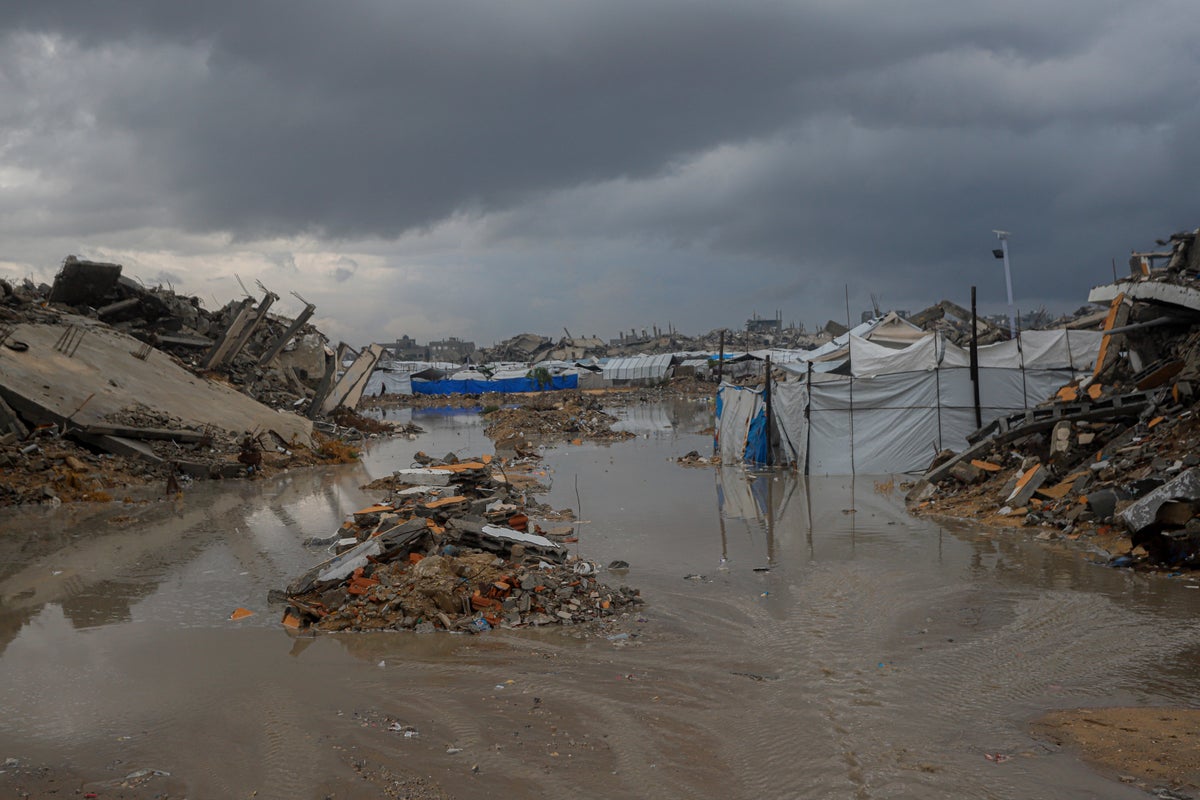
At least six people have been killed and tens of thousands have had their tents flooded after torrential downpours hit Gaza. Among the dead were a woman, her two children aged eight and six and three other children from the same family, all killed when a sand embankment collapsed onto tents in Deir al-Balah. “They had been sheltering among forcibly displaced families in the central Gaza Strip,” Wassem Mushtaha, Oxfam’s Response Lead in Gaza said.“The number of fatalities is expected to rise. The conditions in Gaza are abhorrent. Severe flooding has displaced around 100,000 people. People have no safe place to go.”Eyad Amawi, a representative of the Gaza relief committee, saw a woman’s distress after losing her loved ones in the floods.Floodwater surrounds makeshift tents beside the ruins of destroyed buildings in Jabalia refugee camp, northern Gaza Strip (AFP/Getty)“I cried watching her,” he told The Independent. “As a father it is extremely difficult.”Amawi said his own home in the Nuseirat Camp was surrounded by sewage water and that his children, one girl and three boys aged between 15 and four, have had to wade through the dirty pools to get around. Since Israel’s war on Gaza began in October 2023, 1.7 million people have been displaced with the vast majority living in makeshift tents of varying quality and sturdiness. Many of the worst affected are children and the vulnerable with aid agencies on the ground telling The Independent that the storm has created a climate highly fertile for infectious diseases. At least 70,000 tents were flooded overnight in an area that was already one of the most densely populated places on the planet before the war. Displaced Palestinian children use buckets to remove floodwater around their belongings outside a tent at a displacement camp in Gaza City (AFP/Getty)Now, there are around 21,000 people per square kilometre, according to Amawi, with over 65 to 70 per cent of Gaza rendered off-limits by Israel. Images from the flooding shows children particularly badly affected by the storm, walking around in water mixed with mud and sewage up to their abdomen. “We’re expecting to see an increase in respiratory infections, especially among children in the upcoming days,” says Mai Elawawda, a communications officer for Medical Aid for Palestinians based in Dar Al-Balah. “We’re expecting infectious diseases, and God forbid, hypothermia.”She says that Palestinians living in tents are turning up to medical clinics in wet clothes that they are unable to change or dry. With crossings into Gaza tightly-controlled by Israel, getting replacement materials and medical equipment to deal with the crisis caused by the flooding in a timely manner is near impossible. It has caused the prices of material to skyrocket, making recovery and rebuilding difficult. Israel’s COGAT (Coordinator of Government Activities in the Territories) told The Independent that “the humanitarian situation in the Gaza Strip is currently the best it has been since the beginning of the war in terms of food availability, living conditions, and water and sanitation infrastructure.”A woman removes rainwater from a displacement tent in Gaza City (AFP/Getty)It added: “The entire population has access to tents or other shelter solutions, and Israel continues to take measures to mitigate the impact of adverse weather conditions on the population.” It pointed to the provision of 91,000 tents, 8,200 trucks carrying tarpaulins, blankets winter clothing and additional supplies including sewage vacuum trucks since the ceasefire agreement was implemented last year. But experts say it is not enough. Dr Goher Rahbour, a British consultant colorectal and general surgeon from Suffolk who is volunteering at Nasser Hospital in Gaza with the group IDEALS, says that the situation on the ground is dire. “Outside of the hospital there are thousands upon thousands of tents of a fairly poor quality plastic material,” he tells The Independent. He explains that the tent cities have been pitched in basin-like areas that are slightly lower than ground level meaning that floodwater pools there. “The tents are downhill, as as soon as there’s the slightest bit of water it goes down into these basins. They’re all flooded and it’s game over.”With no drains, electricity or infrastructure, the water collects soil, mud and dirt leaving Palestinians with little to do but try to dry their tents out and move on to the streets or abandon them completely. Hundreds and thousands of Palestinians live in tents after the war (AFP/Getty)Hospital workers turning up to work with Dr Rahbour at Al Nasser are also unwell with coughs and colds. “Once they finish work, it doesn’t matter how senior you are in a hospital, you are going back to live in a tent.” It also creates a difficult climate for patients. One woman who Dr Rahbour treated for appendicitis also suffered from scabies on her back. What would be a common condition requiring straightforward care back in Britain is complicated in such an environment and he is concerned about the woman’s risk of infection when she returns to her tent. “They don’t have topical ointments, or soap and water. There is overcrowding. She was already suffering from some kind of upper respiratory ailment such as a cough.”According to Dr Rahbour and his colleagues, 70,000 tents, around 500,000 pieces of tarpaulin and 57,000 emergency shelter kits are needed immediately. But despite the crisis he says it is the everyday misery that makes everything especially unbearable. The vast majority of people are living without any light, electricity, adequate food or nutrition. Hundreds of thousands are unemployed and the price of almost everything is prohibitively expensive. “You see it more in their face,” he explains. “They don’t want to show their despair. With delays getting to hospital and the stench of sewage, it’s another thing for their life which is hard.”For Elawawda, who is on the ground supporting those who are suffering, she says that the guilt of having a roof over her heard can be unbearable. “Many children we are receiving at our clinics and medical points were literally born in these tents,” she says. “It breaks my heart to know it’s raining outside and in a couple of hours I’m going to see families all the way on the road. My colleagues and I are going to see children who are completely cold. They will just be sent back to these shelters.”
Six killed in Gaza flooding as tents collapse during downpours with 10,000 more displaced
Full Article
Original Source
Read the full article at Independent →KhanList aggregates and links to publicly available news content. We do not host full articles from third-party sources. Always verify important information with original sources.