
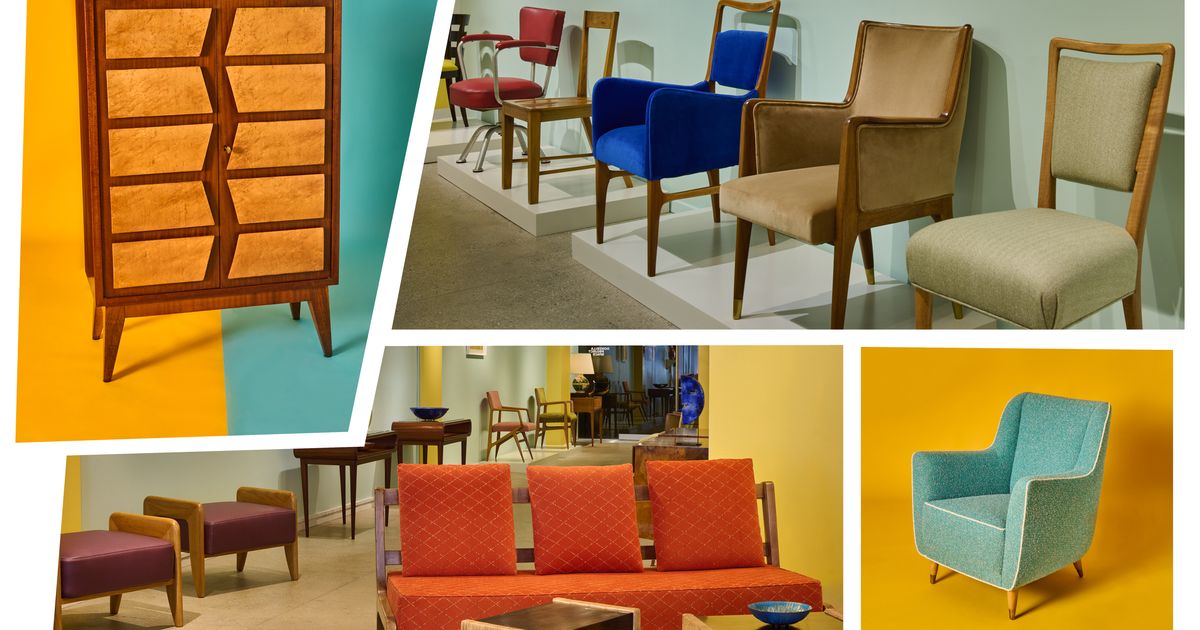
Six Decades of Gio Ponti, All At Once A retrospective at Donzella reveals rare works by the Italian designer not seen in 20 years. Photo-Illustration: Curbed; Photos: Michael Mundy Photo-Illustration: Curbed; Photos: Michael Mundy Photo-Illustration: Curbed; Photos: Michael Mundy While his 20th-century contemporaries struggled to shake off the dogma of the Bauhaus, the dominant design ideology in Europe from the 1920s through the end of World War II, Gio Ponti remained blissfully agnostic to any single idea of utopia. Over six decades, the seminal architect, designer, and editor mined the layers of Mediterranean history to conjure up futuristic concepts — a looking back in order to look forward. It rarely yielded a uniform look; he would develop a utilitarian shelf for the austere years after World War II and, decades later, go on to design a pair of ornate lounge chairs for a luxury hotel. And despite, or perhaps because of, his refusal to stick to one style or trend, many of his furnishings made it into production. That spirit of relentless experimentation is an inescapable theme of “Designing Optimism,” a sweeping retrospective at New York’s Donzella Project Space. Culled through years of boots-on-the-ground sourcing by gallerist Paul Donzella and historian Brian Kish — who has lived and breathed Ponti artifacts, drawings, and papers for three decades, co-authoring a massive Taschen monograph along the way — the show captures six remarkably fertile decades of Ponti’s furniture design, from the late 1920s onward. In the last three years of developing the show, Donzella leaned on auctions and a buying partner who accessed private collections, while Kish tapped into more offbeat channels, including an elderly French nobleman with ins at Vatican-adjacent charities. Many of the exhibited works haven’t been seen publicly in decades. The selection of nearly 80 pieces isn’t exhaustive. “I knew no matter how big the collection we could gather, there would always be key pieces that were left out just because there’s so much,” says Donzella. “Regardless, there’s a good mix between pieces that are minimal and those that show his more decorative leanings.” The newest piece in the exhibition debuted over half a century ago, and the last comprehensive Ponti retrospective was in 2001. For Donzella and Kish, this show is a chance to bring the influential 20th-century polymath into focus for a new generation. Rare console table, rare table lamp, Pavoncella peacock sculpture by Gio Ponti and Paolo De Poli. Trumeau from Casa Ceccato by Gio Ponti and Piero Fornasetti (1950). On the right: Model 811 lounge chair by Gio Ponti for Cassina (1957). Photographs by Michael Mundy Born into a prominent Milanese family, Ponti was pushed toward engineering but allowed to pursue architecture. “He always wanted to be a painter, and that fine-art sensibility never left,” says Kish. Operating with an astonishing velocity fueled by a mere five hours of sleep a night — much to the lament of his wife, who banished his late-night sketching to a desk down the hall — his mind churned out ideas for all scales of objects, from diamond-faceted cutlery to architectural monoliths (including Milan’s emblematic Torre Branca) and towering street lamps eventually retooled for the home. Across a landscape of shifting tastes, the importance of decoration was a nonnegotiable in all of Ponti’s output. While his peers, such as Ornament and Crime’s Adolf Loos and high modernist Le Corbusier, looked down on nonfunctional flourish, he viewed it as essential for emotional engagement. That perspective aligned with the enduring Italian belief that objects should delight, particularly during periods of collective hardship. Even amid post–World War II belt-tightening, a seemingly simple two-door cabinet (1946) could be trimmed into a zigzag pattern, perhaps signaling hope in a prosperity to come. For a 1954 telephone side table prototype, he incorporated his quintessential curved edge but also harnessed the advanced manufacturing of the industrial boom that would eventually become the standard. The show loosely groups Ponti’s furniture according to different time periods. But as with most of design history, his career is not easily packaged into neat boxes. He pulled from both Art Deco and International Style modernism while going in his own direction. The somewhat chronological organization of the show reveals formal and aesthetic through lines that emerged and were refined over time. In the 1920s and ’30s, he worked with neoclassical motifs but played with unlikely material pairings and began perfecting his paradigmatic curved edge — what started out as Deco-esque geometry became more organic over time. In the 1940s and ’50s, he embraced Italy’s postwar economic miracle and his work became more industrially viable. In the 1960s and ’70s, one-off commissions allowed him to create artistic pieces that fully demonstrate the breadth of his experience; these are among the most innovative, hyperfunctional yet still ornate. From left: Zig-Zag cabinet Photo: Michael MundyRare bookcase Photo: Michael Mundy From top: Zig-Zag cabinet Photo: Michael MundyRare bookcase Photo: Michael Mundy Rare and early side chairs, by Gio Ponti. Photo: Michael Mundy Ponti always rejected rigid hierarchies between high and low. He integrated Formica with burled walnut — seen at Donzella in a rare 1950 display cabinet featuring lithograph-transferred Fornasetti prints of Venice. He paired bamboo caning (then perceived as cheap) with rare African padauk wood in his 1940 Diavolo tables. He moved easily between fulfilling multimillion-dollar commissions and developing accessible furnishings for returning World War II veterans, all while editing influential magazines — and using these platforms perhaps to covertly inform his own research. Along the way, Kish notes, “Ponti moved toward weightlessness.” The 1964 insectlike lounge chairs designed for the Parco dei Principi Hotels in Rome and Sorrento feature ultrathin legs that make their curved seat shells appear to float. “There might be an avan- garde tension that makes them difficult to live with domestically,” says Donzella. “But they reveal that he was still pushing formal boundaries in his 70s.” Though the curators thought it might be too obvious to include Ponti’s final design of his iconic 3.75-pound, 699 Superleggera chair, they’re presenting a 1950 prototype, created using a combination of intricately carved wood and brass hardware that proved too complex to manufacture en masse. It serves as a reminder that Ponti’s restless, constant exploration of new techniques, forms, and materials did occasionally hit some limits. For Kish, Ponti’s willingness to make mistakes, learn from them, try again, and ultimately push the field forward demonstrates a generosity that is hard to find in today’s highly risk-averse design landscape, where any small stylistic divergence is scrutinized as a major slip-up. Endlessly reworked, the cost-effective 699 Superleggera became so popular that producer Cassina had to put an ad in Domus, the magazine Ponti had established three decades earlier, warning about the legal ramifications of copyright infringement. The New York show is the first among several retrospectives opening in the next few years, along with a permanent home for Ponti’s archives in Milan. There might not be as many Ponti imitators today, but “Designing Optimism” makes a strong case for borrowing something essential from the designer’s ethos: how to refuse conformity. “Designing Optimism” is on view through December 22 at Donzella. From left: Rare ottoman Photo: Michael MundyUnique armchair Photo: Michael Mundy From left: Rare ottoman Photo: Michael MundyUnique armchair Photo: Michael Mundy Rare dining table Photo: Michael Mundy A Diavolo console table, Diavolo side tables, a rare vase by Gio Ponti for Richard Ginori, a Arlecchino cocktail table, Colombian bird sculptures by Gio Ponti and Paolo De Poli, Model 811 lounge chairs by Gio Ponti for Cassina, star wall lights, Gato metal sculpture by Gio Ponti and Paolo De Poli, a rare table lamp by Gio Ponti for Venini. Photo: Michael Mundy A rare custom console by Gio Ponti for Arredoluce, Finestra wall lights by Max Ingrand for FontanaArte, Dahlia floor lamp by Paolo De Poli, Enameled Square Bowl No. 2, rare wire sculpture attributed to Gio Ponti, Enameled Bowl No. 2 by Paolo De Poli. Photo: Michael Mundy A Roaming Art Fair Finds a Home in Robert Wilson’s Southampton Retreat The Independent Art Fair’s Massive New Home on the Lower East Side Marble Dominated Milan Design Week See All Six Decades of Gio Ponti, All at Once Your product is saved! You’ll receive emails when your saved products go on sale. Manage preferences.
Six Decades of Gio Ponti, All at Once
Full Article
Original Source
Read the full article at Curbed →KhanList aggregates and links to publicly available news content. We do not host full articles from third-party sources. Always verify important information with original sources.