
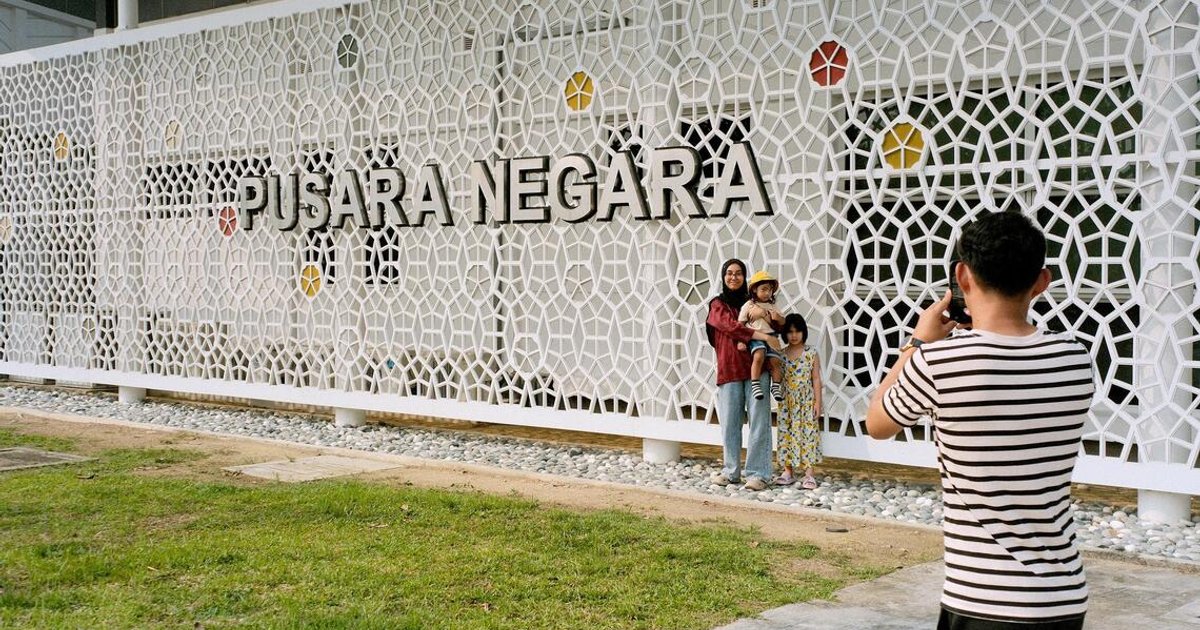
PUTRAJAYA – The grave of Siti Hasmah Mohamad Ali, wife of former Malaysian prime minister Mahathir Mohamad, has become a pilgrimage site for visitors and well-wishers from across the country, mourning the passing of the much-loved “mother of the nation”. She died on Sept 28.Located at the southernmost end of Putrajaya, Malaysia’s administrative capital, the site has been surrounded by temporary hoardings, with canopies and chairs set up for the comfort of visitors, including Mahathir himself, who has been visiting almost daily.Their daughter Marina Mahathir expressed her gratitude for the steady stream of visitors, saying the family was “truly grateful for their prayers and visits”.“Every time I visit the grave, I see many people coming,” Marina said at a memorial service for Siti Hasmah on Oct 13. “We are all deeply touched and thankful for their prayers.”Siti Hasmah, who died at the age of 100, had been expected by some to be buried at the Makam Pahlawan, or Heroes’ Mausoleum, at the National Mosque in Kuala Lumpur. Two of her predecessors, the wives of former prime ministers Abdul Razak Hussein and Hussein Onn, were buried there after their deaths in 2020 and 2014 respectively, near their husbands.Grand vision, abandonedSo when it was announced that she would be buried at Pusara Negara, or the National Cemetery, in Putrajaya, the reaction was a mix of confusion and curiosity. Some wondered why she was not laid to rest at the Heroes’ Mausoleum. Others had a more basic question: What exactly is Pusara Negara?The story of Pusara Negara reveals a grand national vision that was never realised. First proposed more than five decades ago as a tribute to Malaysians who had served their country, Pusara Negara was originally planned for Bukit Kiara, before the land was earmarked for a golf course.The cemetery that eventually emerged in Putrajaya was a far more modest undertaking.The original site was Bukit Kiara, then a hilly rubber plantation.Visitors congregating for a quiet prayer and reflection by the grave of Siti Hasmah Mohamad Ali. ST PHOTO: HADI AZMIThe 1982 Pusara Negara masterplan described it as “much different than the design for a traditional cemetery or graveyard”, envisioning “a cemetery within a park” that made full use of Bukit Kiara’s terrain.The 89ha complex was to have a grand entrance, a ceremonial boulevard and a plaza where final tributes to national heroes would be made.The cemeteries themselves were to occupy seven hills, with separate burial grounds for Muslims, Buddhists, Christians, Hindus and Sikhs, as well as land set aside for future expansion.The planners envisioned enough space to bury the nation’s distinguished dead for more than 200 years.Scans from the 1982 masterplan for the original Pusara Negara (National Cemetery). PHOTO: KUALA LUMPUR LIBRARYThe scale of that ambition becomes clearer when compared with the existing Heroes’ Mausoleum at Masjid Negara in Kuala Lumpur.Inaugurated in 1965, it saw its first burial in 1973 with the death of deputy prime minister Ismail Abdul Rahman. Since then, five of the seven plots beneath its main pavilion, reserved for former prime ministers and deputy prime ministers, have been filled, while the open-air burial ground beside it has become increasingly crowded.The grave of former prime minister Abdullah Ahmad Badawi at the Heroes' Mausoleum at the National Mosque in Kuala Lumpur in May. ST PHOTO: HADI AZMIAt the time, the proposed national cemetery attracted support in Parliament. Then Batu Pahat MP Abdul Jalal Abu Bakar suggested in Parliament that national heroes already buried elsewhere be reinterred there.“The aim is to ensure that when visitors arrive, they can see those who have rendered distinguished service; we will inscribe the life stories of the deceased on each grave, whether they passed away long ago, such as during the Second World War, or were figures like Mat Kilau and others, so that they may serve as a lasting legacy for future generations,” Abdul Jalal said in 1977.But the grand plan was not to be. In 1988, the government decided to use the Bukit Kiara land for a different purpose: a golf course.The land was sold to Solarvest in 1992 to be developed as the Kuala Lumpur Golf & Country Club, as part of a privatisation drive “for the benefit of the country with the arrival of foreign tourists into the country”.Explaining the decision in Parliament in November 1992, deputy speaker Ong Tee Keat said Pusara Negara could still be built on a much smaller scale.“The existence of this golf course does not mean that the national mausoleum can no longer be established,” Ong said.A modest realityThe name Pusara Negara disappeared from public discourse for more than two decades, resurfacing in 2013 when work began on a dedicated burial ground for national figures within an existing cemetery complex in Putrajaya’s Presint 20.Unlike the grand ceremonial plaza and hilltop burials envisioned in the original plan, the present-day Pusara Negara is modest, with Siti Hasmah’s grave lying beside the main thoroughfare, just steps from the carpark.The administration building bearing the cemetery’s name, meanwhile, remains empty and cordoned off with tape.Yet the modest setting makes the cemetery a more accessible and welcoming place for ordinary Malaysians.S. Murali, who travelled from Kapar, Klang, about 60km or an hour by road, said it made it easier for Malaysians from all walks of life to visit the much-loved Siti Hasmah.“If it was in Masjid Negara, it feels a bit awkward for us non-Muslims to come and visit,” the 39-year-old electrician told ST during his visit on Oct 3. “Here, anyone can come.”For others, where Siti Hasmah was laid to rest mattered little.“The love and appreciation is with her as a person,” said Maznah Idris, who lives in Gombak, Kuala Lumpur. The 68-year-old homemaker spent half an hour by the grave, reading the Quran and offering prayers for Siti Hasmah.“We will visit her regardless of where she is laid to rest.”Sign up for our weekly Asian Insider Malaysia Edition newsletter to make sense of the big stories in Malaysia.
Siti Hasmah’s burial shines a light on Pusara Negara, Malaysia’s forgotten national cemetery
Full Article
Original Source
Read the full article at Straitstimes →KhanList aggregates and links to publicly available news content. We do not host full articles from third-party sources. Always verify important information with original sources.