
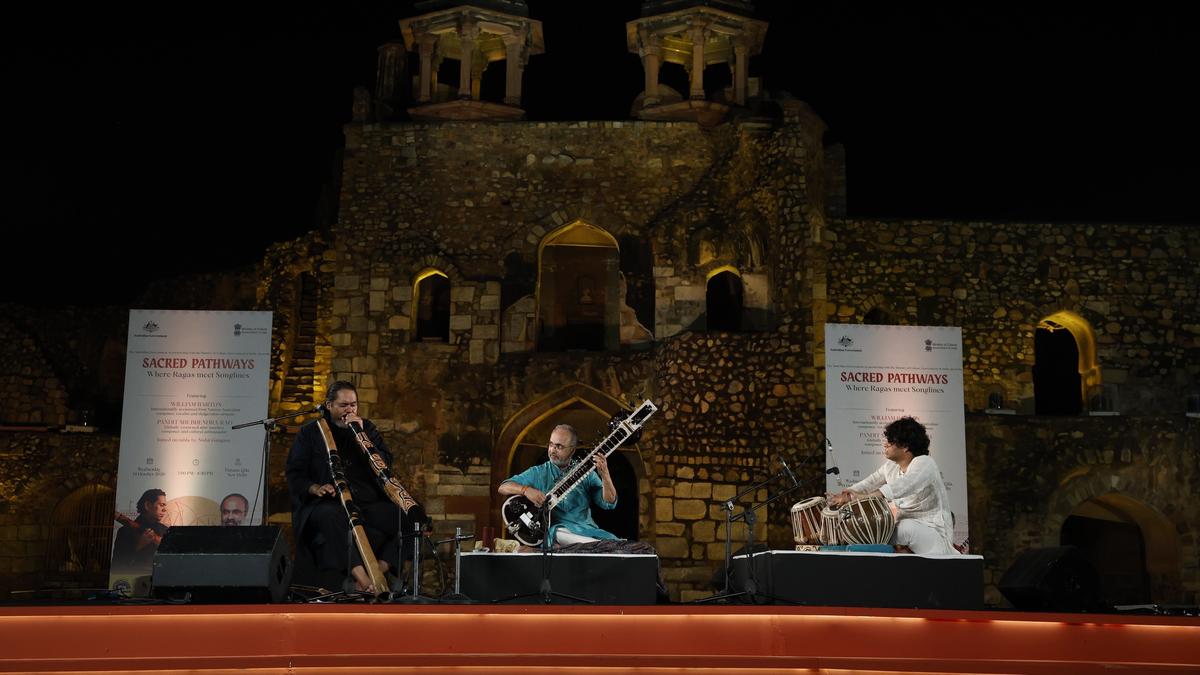
William Barton and Shubhendra Rao were accompanied by Nishit Gangani on the tabla. | Photo Credit: Special Arrangement One of the most interesting cultural shifts today is the growing trend of concerts being held in heritage spaces rather than conventional venues, where the historic setting lends its own charm and romance to the music. Delhi, fortunately, has several such monuments that are now being transformed into stages. One such is Purana Qila, one of Delhi’s oldest forts, built largely during the reigns of Mughal emperor Humayun and Afghan ruler Sher Shah Suri in the 16th century.Against this majestic backdrop, two unrelated instruments, from two faraway cultures, found a meeting point to drive home the message of harmony. The concert, titled ‘Sacred Pathways: Where Ragas Meet Songlines’, brought together the sitar and the didgeridoo, a traditional wind instrument developed by Indigenous Australians.The concert at Purana Qila marked the start of a four-city tour of the collaborative musical project, with Bengaluru, Mumbai and Chennai as the other stops. It was organised by the Australian government in partnership with the Indian Ministry of Culture. The event also served as a curtain-raiser for G’day Namaste, the Australian government’s flagship festival, scheduled to be held in December 2026 to celebrate the depth of India-Australia ties across business, education, sport, innovation and culture.Philip Green, Australia’s High Commissioner to India, rightly observed that few venues could have matched the magnificence of the ancient fort. As the concert highlighted the beauty of two traditions with a long and rich past, one could not help but imagine the layers of history buried within the monument’s massive walls.The didgeridoo has been used in sacred ceremonies by Aboriginal Australians for generations. Its deep bass tone is often associated with the sounds of the earth. William Barton, an Australian Aboriginal multi-instrumentalist, vocalist, composer, and producer, is one of the leading didgeridoo players. William Barton demonstrated the instrument’s range of sounds and its link with Nature. | Photo Credit: Special Arrangement The sitar, by comparison, is relatively a much younger instrument, perhaps only around 250 years old. However, the music played on it has continued to evolve. Sitarist Pt. Shubhendra Rao, a disciple of the legendary Pt. Ravi Shankar, is known for his innovative and collaborative works, like his guru. The Delhi concert was his first performance with a didgeridoo player, although he shared that his guru behen, Anoushka Shankar, had performed with William Barton in Australia a few years ago.However, the two instruments did not always make for an ideal pairing. Since the didgeridoo cannot produce a sequence of distinct melodic notes, the collaboration at times felt less than seamless. Drawing on their experience, the instrumentalists sought to build on the similarities between the two instruments and bridge their differences.William, worked around the instrument’s inherent limitations by singing alongside Shubhendra’s playing, by strumming his guitar, and finally joining the rhythmic section of the concert with the didgeridoo. The concert opened with William demonstrating the instrument’s range of sounds and its link with Nature. From whistles and guttural tones to deep and sustained drones the sound was powerful and unusual. Shubhendra demonstrated the melodic tone of the sitar through a brief alaap followed by a brisk drut composition. He was accompanied by the young tabla player Nishit Gangani from the Gangani gharana, known for its dance and percussion traditions. Then all three musicians came together for a joint performance.Not every concert needs to be analysed purely for its music; sometimes, its purpose needs to be celebrated. And here, it was the spirit of oneness. Published - October 22, 2026 06:23 pm IST
Sitar meets didgeridoo: A musical confluence between India and Australia
Full Article
Original Source
Read the full article at Thehindu →KhanList aggregates and links to publicly available news content. We do not host full articles from third-party sources. Always verify important information with original sources.