
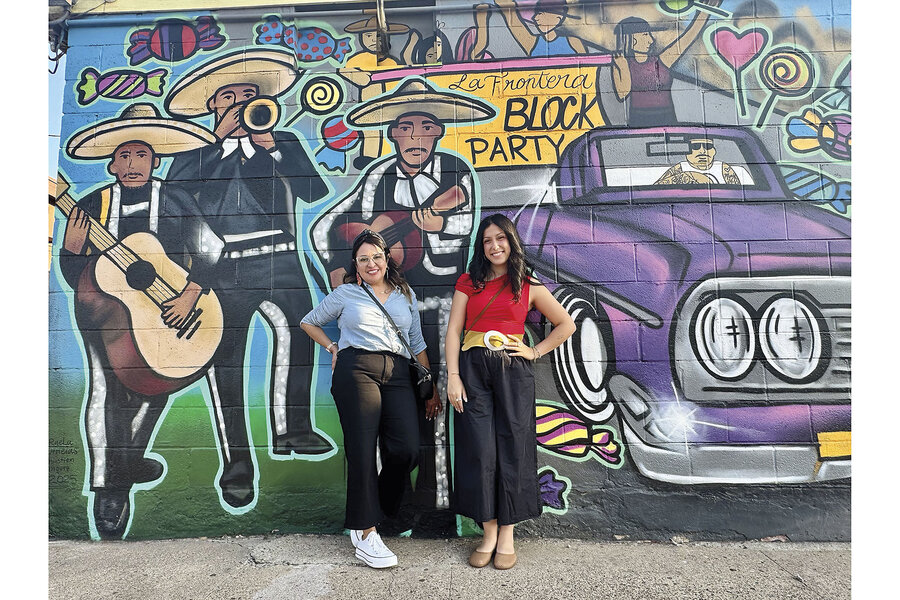
Before Karina Amalbert set out across Route 66 two years ago, much of the American West existed for her mostly as a place on a map.Born and raised in Florida, with family roots in Puerto Rico, Ms. Amalbert likes to joke that “anything past Alabama was foreign to me.” When she told her family that a new graduate fellowship was sending her to Amarillo, Texas, their response was equally revealing. “They literally were like, ‘Where is that?’” she remembers. “And I had to pull out a map.”She arrived in the Texas Panhandle and climbed into a large white rental van with a group of young Latina researchers for what would be, for several of them, their first real American road trip, in this case to conduct historical fieldwork. Why We Wrote This Route 66 was marketed as "America's Main Street," but its path led tourists and others through land where people lived and worked before the birth of the United States. When researchers looked for their stories, they made an unexpected discovery. For 16 days, the van would carry them west through the Texas Panhandle, New Mexico, Arizona, and on toward California. It had many of the ingredients of the classic Route 66 road trip: a group of young people, an uncertain itinerary, a highway stretching west.But Ms. Amalbert and her companions had been sent onto America’s most legend-full road to look for the people the folklore had largely left out.Sehila Mota Casper had spent years puzzling over that absence. “I love Route 66,” she says. “But whenever I think about Route 66, I think about it as a poetic Americana thing,” says Ms. Mota Casper, a Tejana historian and executive director of Latinos in Heritage Conservation. She thought of the country’s love affair with cars, family vacations, diners, and motels.Then she began asking a different question. “What was the Latinx or Mexicano experience along Route 66?” That question became a central thread of her organization’s Abuelas Project, a community archive built from oral histories, photographs, and digital maps. Much of the western road crossed landscapes with Mexican and Indigenous histories older than the United States itself. Today, less than 1% of the 100,000-plus places on the National Register of Historic Places reflect Latino history, Ms. Mota Casper found.“I was a kid that loved history, that loved reading,” she says. “I would go to the library every single day.” But the stories she heard in her Texas family were often nowhere in those books. “So, that’s where it all started,” she says. “Just curiosity and reading.”Finding community memoryThe team she assembled went looking for the highway’s untold stories. Not only along Route 66, as it turned out, but increasingly beside it. “In order to get at that Latino experience, we had to get off the beaten path.”In Amarillo, their first major research stop, a student fellow found Teresa Kenedy, a volunteer neighborhood historian who began connecting the newcomers with residents of the city’s historic Barrio neighborhood. The team managed roughly four oral histories that day, then they drove west.In Albuquerque’s Barelas neighborhood, the researchers documented B. Ruppe Drugstore, once the New Mexico city’s longest continuously operating pharmacy, now a museum. One of its most prominent figures was Doña Maclovia Sanchez de Zamora, who began working there in 1989, and later became part-owner. She made it a yerbería, selling traditional herbs.It was exactly the sort of history their project was seeking: an ordinary neighborhood business that had also functioned as something larger – a place of healing, knowledge, and community memory.In Flagstaff, Arizona, the team interviewed Irene Dominguez, a retired hairdresser, inside the salon she kept in her home. Farther west in Seligman, they documented Angel’s Barber Shop, opened in 1950 by Angel Delgadillo. Mr. Delgadillo was hardly unknown to Route 66 enthusiasts: After Interstate 40 bypassed Seligman, in 1987, he helped organize the movement that became the Historic Route 66 Association of Arizona, the first of its kind, and helped pioneer the revival of the old road.“We learned more from asking people questions and the face-to-face interactions than we ever could have learned out of those books,” Ms. Amalbert says.By San Bernardino, California, the team encountered a fourth variation: history not simply as memory, but as a reason to remain responsible for a place.Tamara Serrao-Leiva, a museum curator the team interviewed there, described feeling an obligation to return attention to her own community – to invest in its “shared identity.”History, she told the researchers, could draw people together and help them “really steward their place well.”Road-trip reunionTwo years after that road trip, Ms. Amalbert and Ms. Mota Casper are sitting around a table at La Frontera in Amarillo with owner Mary Martinez, whose own life seems almost designed to explain why the project was named Abuelas, which means grandmothers.It was a reunion of sorts, since Ms. Martinez was one of the people who provided an oral history of Amarillo’s Barrio neighborhood, and the women came to talk about the project.Ms. Martinez began making tortillas on this property with her mother-in-law when it was a shop in the 1970s. Then, for many years, it was her in-laws’ family grocery store. It became La Frontera restaurant in 1985, and she now owns it, over 50 years after she first started working here.“That’s how I learned so much about the Barrio,” Ms. Martinez says. “All the elders would come over here. They were all comadres and friends to my suegra. So, she knew them all, and then I got to know them.”Around the table, the conversation jumps among tortillas and grandmothers, businesses and family histories.“We realized that if we wanted to do this project, we couldn’t do it in an archive, in a different room,” Ms. Amalbert says. “It’s always over water, coffee, a table, where we get to hear these family stories.”And throughout the road trip, one pattern had become difficult to miss. Women were often not simply remembering these places. They had mostly built them – restaurants, tortillerias, and other neighborhood businesses, passing both work and stories from one generation to another.The Abuelas Project now puts those memories into interactive StoryMaps covering Texas, New Mexico, Arizona, and California, combining oral histories with photographs, historical research, and geography.“It’s grandmothers who kept our stories alive in that era,” Ms. Amalbert says.Then she offers the researchers’ road-trip advice: “Sit with the women,” she says. “You’re gonna learn some good, good stuff.”
‘Sit with the women’: Finding hidden history on Route 66
Full Article
Original Source
Read the full article at Csmonitor →KhanList aggregates and links to publicly available news content. We do not host full articles from third-party sources. Always verify important information with original sources.