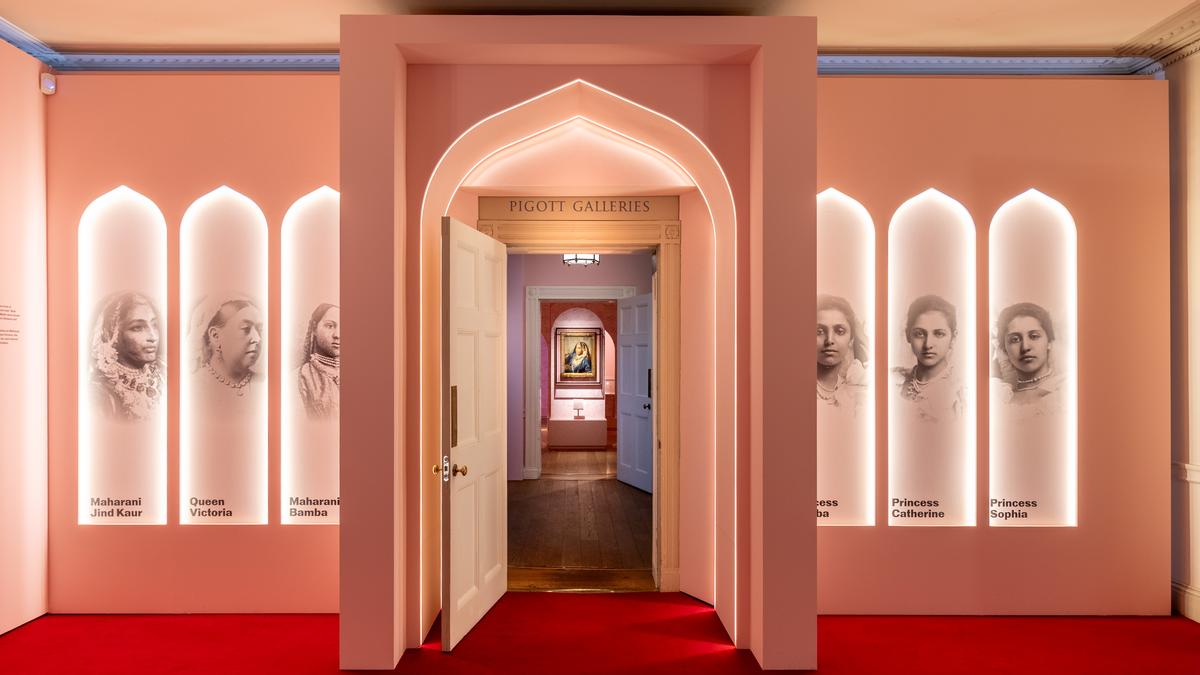
On the front cover of Sikh historian Peter Bance’s The Last Royals of Lahore, Princess Catherine is captured in a studio portrait of quiet, distant contemplation. Her head is draped loosely in shimmering silk; her necklaces and pearls radiate an old-world opulence that seems to weigh heavily upon her.At first glance, these are the standard accoutrements of Indian royalty. But look closer: her earring is not pierced through the ear, but held by a fine, looped thread. It is a silent act of defiance, a sartorial compromise that allowed her to inhabit her South Asian identity without transgressing the Victorian social norms that deferred ear piercing for young girls. It is an almost invisible detail, yet it reveals the deep tensions of a lost empire surfacing through the fault lines of adornment. Princess Catherine on the front cover of historian Peter Bance’s The Last Royals of LahoreThere is a profound, perhaps bruising, irony in Kensington Palace hosting an exhibition on three sisters who grew up in exile. It was within these gilded rooms that the British Crown once charted the very empire that forcibly removed their father from his homeland. Daughters of Maharaja Duleep Singh, the last deposed Sikh ruler of Punjab (who ruled from 1843-1849), and raised within the orbit of Queen Victoria, the sisters — Sophia, Catherine and Bamba — occupy a complex historical position. (Left to right) Princesses Catherine, Bamba and Sophia Duleep Singh dressed in gowns of white and silver for their court debut at Buckingham Palace in May 1895 The Last Princesses of Punjab manages to reopen a silenced chapter of dispossession. This is not a narrative told through the blunt force of conquest, but through the intimate fragments of queens and princesses — silk garments, personal letters and fading photographs. Their lives remain suspended between the lost glorious homeland of Punjab and their forced displacement in Britain.Family history of tragic complexityThe exhibition’s entrance features a mise-en-scène of stylised trunks stamped with addresses, a cinematic montage, and a family tree set against a pale pink backdrop — a chromatic nod to their mother, Bamba Müller, whose name in Egyptian-Arabic bears that rosy hue. The family history is one of tragic complexity. Exhibition view of The Last Princesses of Punjab A handmade, painted Indian rocking horse from Elveden Hall where the princesses were raise The father: Maharaja Duleep Singh, the boy-king who at 10 years old was forced to sign away the Koh-i-Noor and his kingdom, becoming a favourite of Queen Victoria who viewed him with a certain exotic adoration. The mother: Bamba, the daughter of a German banker and his Abyssinian mistress, raised by missionaries in Cairo and introduced to Duleep after he found himself an outcast in British matrimonial circles. Maharaja Duleep Singh’s purple velvet evening jacket, featuring gold embroidery on the cuffs The matriarch: their paternal grandmother Maharani Jind Kaur, the lion-hearted queen who once led armies. Though she appears only in fragments in the exhibition, her story sharpens our understanding of what was lost: not only sovereignty, but a lineage of female political authority. For the first time, her 1863 portrait by artist George Richmond is paired with a preparatory sketch and her personal jewellery — a pearl and gold necklace with matching jhumkas. A poignant caption reveals that while 525 items of her jewels were returned to her in London, it was on the cruel condition that she never return to India. A portrait of Maharani Jind Kaur An emerald and seed pearl necklace belonging to Maharani Jind Kaur | Photo Credit: Colin Crisford Conceptualised and curated by Polly Putnam, collections curator at Hampton Court Palace, and Mishka Sinha, , curator of inclusive history, the exhibition shifts from dispossession to defiance. We meet Princess Sophia, not as an ornament of empire, but as a firebrand suffragette selling The Suffragette newspaper at the gates of Hampton Court Palace in 1913. Princess Sophia selling The Suffragette outside Hampton Court Palace While her public activism and her role as a Red Cross nurse during World War I are well-documented, the exhibition offers a more intimate inventory of her life. We see her love of dogs, a prize-winning Pomeranian, her 1920s silver cigarette lighter, and her coral-encrusted cuticle cutters. These items paint a picture of a privileged life suspended between two worlds, culminating in her final wish: her ashes were taken by her sister to be laid to rest in Lahore. Princesses Sophia and Catherine at a suffrage dinner in 1930 A narrative that is not fixedIf Sophia’s defiance was public, Princess Catherine’s was private and radical. The exhibition highlights her decades-long relationship with her German governess, Lina Schäfer. In the vocabulary of the early 20th century, their bond was shielded as an “intimate friendship”, but here it is presented as Catherine’s most profound act of sovereignty — a diaspora within a diaspora where she chose a queer life at home, stepping entirely outside the imperial script. Most movingly, it reveals her humanitarian efforts, acting as a guarantor for at least 10 Jewish refugees fleeing Nazi Germany. Princess Catherine with her governess and long-term companion, Lina Schäfer In contrast to her sisters’ modes of engagement within Europe, Bamba gestures towards a more literal return. Settling in Lahore, she reconnected with the Punjab her family had lost. Yet, this was not a simple restoration of belonging; rather, it underscores the complexities of her identity, where return becomes an encounter mediated by memory and historical rupture.Taken together, these trajectories — Sophia’s activism, Catherine’s humanitarianism, and Bamba’s return — resist any singular narrative. Instead, they form a constellation of movements and identities spanning continents. The exhibition reveals diaspora not as fixed, but as a series of ongoing negotiations shaped by inheritance and choice. A historical banner from the National Union of Women’s Suffrage Societies | Photo Credit: Richard Lea-Hair Questions of belonging and sisterhoodEschewing spectacle, The Last Princesses of Punjab unfolds through carefully composed spaces that privilege atmosphere and reflection. Arched alcoves, plush red carpeting, soft illumination and a pink and green palette evoke South Asian architectural forms, Victorian interiors, gendered spaces and suffragette symbolism. A specially commissioned soundtrack and printed “wallpaper” — with signatures of the Duleep Singh’s family interspersed with Indian motifs — further layer these references.Material culture serves as the ultimate narrative device. Armour, jewellery, and garments are presented not as static artefacts but as vessels of loss and transformation. Three stunning magenta Banares silk dupattas hang in still silence, in a stepped formation, while a massive red woollen shawl with gold embroidery signals Bamba’s reclamation of her title as the Queen of Punjab. Three magenta Banares silk dupattas hang in a stepped formation However, amongst all the textiles and dresses, it is her bespoke lehenga that signals hybridity. A European tailored skirt with pleats, dipped hemline at the back, and made from Benares silk brocade with a gold creeper pattern. The border is equally stunning — finely woven zari depicting a densely packed diamond-shaped pattern, known as nightingale’s eye. A performative dimension of identity adapting East and West cloth and fashion.Beyond the biographies, the exhibition asks modern questions about belonging. The voices of Sikh people living in Britain today are peppered throughout. Amongst them, a group of creative women: Semira Badesha, Harpreet Nandha and Symrath Patti, who state, “The sisterhood among the three princesses and their acts of resistance resonated with us. We wanted to show the importance of community and empower others to be freely creative, despite the barriers they may face.” Princess Sophia wore these gloves when she was presented at court in 1895 Princess Sophia’s kid gloves These voices are further highlighted by two contemporary neon art works by the highly acclaimed British artist, Chila Kumari Singh Burman. Spangled Sun (2020) honours the multi-cultural world of Maharani Jind Kaur while Suffragette Luv (2026) depicts poet and activist Sarojini Naidu and lawyer-activist Mithan Lam, both leading figures of the Women’s Indian Association.Spangled Sun by aritst Chila Kumari Singh Burman But given the boldly graphic, almost pop art-style headline poster for the exhibition, there could have been more of an insight into this creative artwork rather than just commissioning contemporary art, which would have been better placed in an exhibition of their own. The poster for The Last Princesses of PunjabDiasporic defianceAs curator Putnam notes, Kensington Palace, once the childhood home of Queen Victoria — and the godmother to Sophia — offers a fitting setting to explore these entangled histories. “The exhibition invites visitors to consider the lives of royal women through the lenses of resistance, heritage and identity, pairing historical objects with contemporary responses,” she says. And as exhibition historian Sinha states, 2026 marks the 150th birthday of Princess Sophia and hopes it offers “an opportunity to centre powerful women in this chapter of our shared history”. Photos from princesses Bamba and Catherine’s Oxford years Exhibition view of The Last Princesses of PunjabThe Last Princesses of Punjab excels as a royal narrative of diasporic defiance. It frames the sisters not as victims of the British Raj, but as uneasy inheritors who transformed their displacement into a tapestry of public and private rebellion. Their stories, unearthed a century later, mirror the postcolonial condition itself — identities layered and rewritten, loyalties divided by oceans and flags. Among the fragments of silk and silver, gold jewellery and pink walls, a more complex silhouette emerges, one of women who navigated the in-between by redefining the very concept of home.The Last Princesses of Punjab at Kensington Palace till November 8. The exhibition is supported by Khalsa Jatha British Isles and various community Gurdwaras.
Sisterhood of defiance: ‘The Last Princesses of Punjab’ exhibition at Kensington Palace
Full Article
Original Source
Read the full article at Thehindu →KhanList aggregates and links to publicly available news content. We do not host full articles from third-party sources. Always verify important information with original sources.