
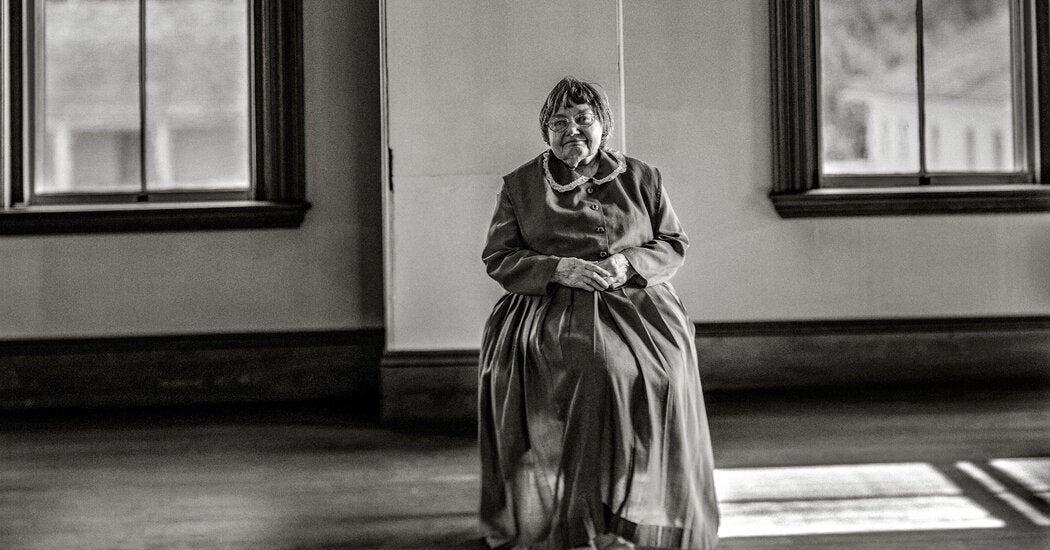
Sister June Carpenter in 2014. “I am the last and the least of the community,” she said, “and I’m very happy in that position.”Credit...Sean Alonzo HarrisNow there are only two practicing members of the last active Shaker community in the United States. Sister June was 88.Sister June Carpenter in 2014. “I am the last and the least of the community,” she said, “and I’m very happy in that position.”Credit...Sean Alonzo HarrisSister June Carpenter, a gentle librarian and one of three practicing members of the last active Shaker group in America, a Christian community of celibate pacifists, died on Nov. 3. She was 88.Her death was announced by her community in a social media post that said she had been struggling with health and mobility issues, but did not provide further details.At Sabbathday Lake Shaker Village in New Gloucester, Maine, there are 18 lovely brick and clapboard buildings bounded roadside by a white picket fence, set on a lake and 1,800 acres of farmland, woods and wetlands. But there aren’t legions of Shakers in residence.At this point, there are only two: Brother Arnold Hadd, 70, and Sister April Baxter, who joined last year and is around 60.Reports of the group’s extinction are a constant source of irritation to them. The oft-used newspaper headline, “The Last Shaker This or That,” particularly grates.Most inquiries from the news media are politely declined because of reporters’ tendency to focus on the dwindling population. In one instance, media coverage may have exacerbated the situation. In 2006, after The Boston Globe published a story about the community headlined “The Last Man Standing,” one of its members, Brother Wayne Smith, fell in love with the reporter and left.Yet the public is welcome; one never knows who might be a prospective convert.ImageSabbathday Lake Shaker Village, just south of Lewiston, Maine.Credit...Tristan Spinski for The New York TimesImageThe Shaker Meeting House has separate sides (and entrances) for men and women.Credit...Lucas Foglia for The New York TimesImageDried lavender is among the items sold at the Shakers’ gift shop.Credit...Lucas Foglia for The New York TimesThe Shaker ideology of pacifism, celibacy and communal living — and of a loving God who embraces both genders, or a Mother-Father spirit, as it is called — beckons many these days. Would-be novices are not uncommon. As Stacey Chase, the Boston Globe reporter, noted in her story, the village can receive as many as 70 inquiries a year. But not many applicants can commit.Perhaps that is why Sabbathday Lake has such a robust community of Shaker-adjacents and friends: paid workers and volunteers who maintain the museum, help with the farm work — there are some 200 sheep and a few cows — tend to the herb garden and its harvest, offer workshops and preside over the sales of packaged herbs, teas, yarn, furniture, candles and other goodies in the gift shop and online store. Sunday services at the Meeting House are open to all, not just the members.A bit of history: The Shakers landed in North America in 1774 after fleeing England, where they had been persecuted for their separatist beliefs — notably their opposition to the hierarchy of the Anglican Church — and their concept of a dual-gendered God. They earned a reputation as the Shaking Quakers because of the ecstatic movements they practiced in their worship. It was a slur, but the name stuck. Those swirling dances went out of favor decades ago, though Shakers still clap and stomp a bit, as various hymns require, during the Sunday meeting.The Sabbathday Lake community, established in 1783, was one of 11 Shaker orders in the U.S. The numbers soon swelled to 15, with some 5,000 members spread between them. In the mid-19th century, the Sabbathday Lake family, like other Shaker communities, adopted a spiritual name for itself, Chosen Land. At the time, as Jeannine Lauber wrote in “Chosen Faith, Chosen Land: The Untold Story of America’s 21st-Century Shakers” (2009), it was the smallest and poorest of all the communities. Yet it outlasted them all.When Ms. Carpenter first visited the village in the summer of 1988, she was 49; a friend took her to the dedication of its new library. In college, she had been drawn to stories of people who had religious vocations, and she felt that she, too, wanted to give her life to God. When she learned that the community needed help cataloging its archive for the new library, she volunteered to help, and felt so at home that she asked to be considered for membership.After Sabbathday Lake’s head curator, David Richards, interviewed her, he declared, “If the meek are to inherit the earth, she will get the whole thing!”Sister June may have been shy, but she had a quiet, arch sense of humor and, as the announcement of her death noted, a vast knowledge of the British royal family. In addition to working as a librarian, she tended the gardens and assisted in the kitchen.Jere DeWaters, a retired professor of photography at the University of Maine at Augusta, spent eight years at Sabbathday Lake, starting in 1986, documenting the family. He recalled Sister June’s work at the renovated library — once the village’s schoolhouse — cataloging its extensive collection of manuscripts, photographs, journals and other written material that is a treasure trove for scholars.“She was naturally shy, but had a wonderful smile when she looked up at the camera,” Mr. DeWaters said. “Not an outgoing person at all, but she did not miss a beat. One of the quiet ones, I think the old saying goes.”As Sister June told Ms. Lauber, “I am the last and the least of the community at the moment, and I’m very happy in that position. If I get into a position where I’m head of something, like when I was head cataloger at the library where I used to work, I feel uncomfortable and insecure. But I can cope with being little and low. It helps with the humility that we are striving for.”The Shakers are known for their faith, their furniture and their vast hymnody: “Simple Gifts,” often referred to by its opening line, “’Tis a gift to be simple,” is one of the best-known Shaker hymns. Sister June said she related most to another one:Great I, little i, Great I can see.Little i is pretty i, so little I will be.ImageSister June in 1993. Before she became a Shaker she was a librarian with the Brookline Public Library in Massachusetts.Credit...Jere DewatersJune Carpenter was born on June 15, 1938, in Boston, the only child of Florence (Blanchard) Carpenter and Sydney Carpenter, a lawyer in private practice who went on to serve in the State Legislature.She grew up in Brookline, in a religious family. They were regulars at the Federated Church, which combines a number of Protestant denominations, including American Baptist and Congregationalist.One day, on a trip to Boston, she recalled having a spiritual awakening as she observed the crowds. “I could see that God was within each of them,” she told Ms. Lauber. “I’ve always remembered that — that God must be inside everyone in some way, whether they realize it or not.”The feeling faded, she said, but the insight did not: “You can’t stay on the mountaintop forever. Like the Shakers say, ‘You have to come down into the valley,’ that’s where most of life is.”After studying library science at Simmons College (now Simmons University) in Boston, she earned a master’s degree in 1964 and then went to work as a librarian for the Brookline Public Library.Her father had died when she was 15, and she lived with her mother until her mother’s death in 1985.Shakers are buried without individual markers, though fellow members note the deaths in the journals they keep of their daily lives. The cemetery at Sabbathday Lake has just one gravestone. It reads simply, “Shakers.”Sister June, with typical modesty, requested no funeral service or visiting hours.Penelope Green is a Times reporter on the Obituaries desk.Related ContentAdvertisementSKIP ADVERTISEMENT
Sister June Carpenter, the Oldest Shaker, Has Died
Full Article
Original Source
Read the full article at Nytimes →KhanList aggregates and links to publicly available news content. We do not host full articles from third-party sources. Always verify important information with original sources.