
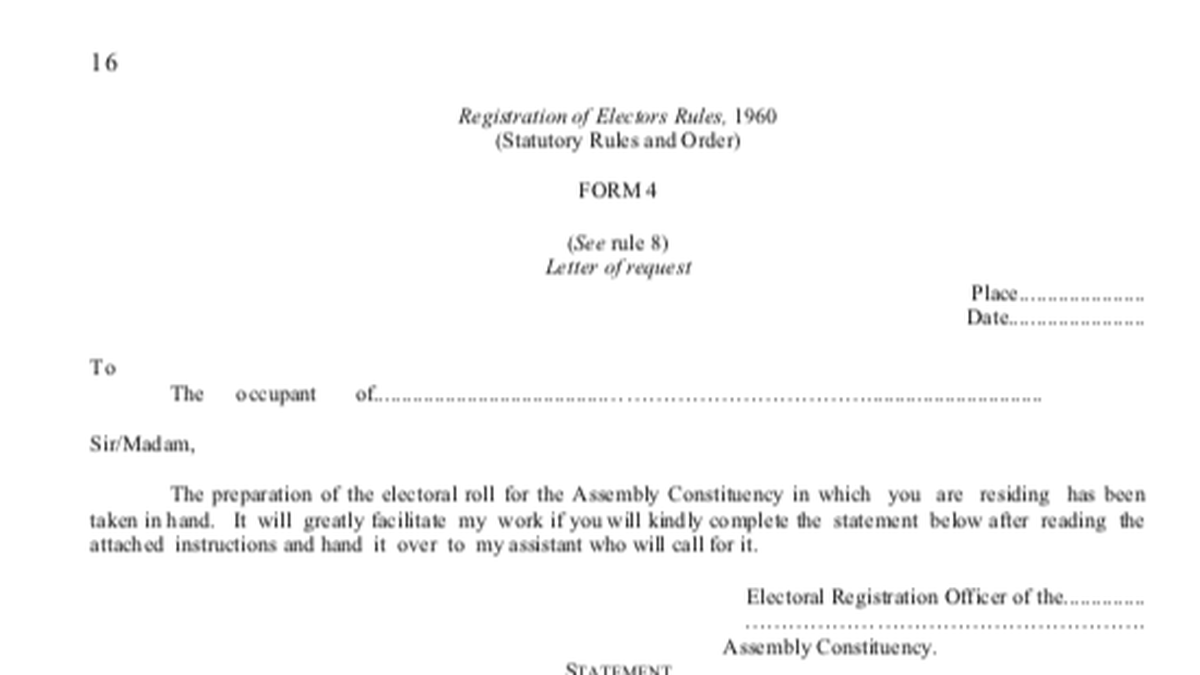
Form-4 prescribed by the Registration of Electors Rules, 1960 for collecting voters’ details. Photo credit:Special Arrangement Enumeration Forms, which are integral to the ongoing Special Intensive Revision of electoral rolls, may lack a legal basis under the Registration of Electors Rules (RER), 1960, raising questions about the Election Commission of India’s (ECI) authority to use the format to include or exclude voters from the draft rolls.Rule 8 of the RER, 1960, prescribes Form-4 issued by the Electoral Registration Officers to collect details of the electors in all kinds of revisions of the electoral rolls, be it Special Summary Revision or Special Intensive Revision.The rule states that the Electoral Registration Officers may “for the purpose of preparing the roll, send letters of request in Form 4 to the occupants of dwelling-houses in the constituency or any part thereof; and every person receiving any such letter shall furnish the information called for therein to the best of his ability.”The model Form-4 does not contain pre-printed electoral details or seek information about a voter’s parents/relatives from previous electoral rolls. It has columns for the voter’s name, age, father’s, mother’s, or husband’s name, signature, and date.On the contrary, the Enumeration Forms distributed by the ECI came with pre-printed details of the electors as per the 2025 electoral rolls. They also include columns seeking voters’ details from the 2002 SIR and, and if the voter was a minor at the time, information about their parents/relatives.This format, therefore, differs from the one prescribed under the RER, 1960, which also lays down the procedures to be followed during different types of electoral roll revisions.Rule 25, dealing with the revision of rolls, says that the electoral roll should be prepared afresh during intensive revision, with Rules 4 to 23 applying as they do for the first preparation of a roll.“Where the roll or any part thereof is to be revised intensively in any year, it shall be prepared afresh and rules 4 to 23 shall apply in relation to such revision as they apply in relation to the first preparation of a roll,” it says.Since Rule 8, which prescribes Form-4 for collecting voters’ details based on the household survey, falls within the ambit of the rules mentioned above, the ECI’s decision to use a different format has raised questions about its compliance with the rules.Telangana Chief Electoral Officer C. Sudharsan Reddy called the SIR a “de novo” preparation of electoral rolls. Critics argue that the exercise relies on the 2025 electoral rolls, prepared after a Special Summary Revision, rather than starting afresh through a household-based exercise as envisaged under Rule 8.Activist Lubna Sarwath has raised serious objections to the CEO’s characterisation of the exercise as “de novo”.“A de novo process is preparation of voter roll afresh without reference to any previous roll. Whereas the SIR 2026 undertaken by CEO Telangana has references to 2025 and 2002 electoral roll. Pre-printed Enumeration Forms and 2002 Mapping details are a testimony against CEO’s statements,” she said.Ms. Sarwath also pointed out that the term de novo has never been stated by the CEO or the ECI in any official documents relating to the SIR 2026. “In fact, CEO is using the word ‘De Novo’ for the first time, even though we as citizens have been referring to De Novo voter list process and asking for it to be implemented,” she said, citing the rules.Mr. Sudharsan Reddy, responding to a query, said Form-4 had not been used for a long time in the preparation of electoral rolls, including during Special Summary Revisions. He said the format used in the SIR was based on the ECI’s decision. Published - October 22, 2026 08:59 am IST
SIR Enumeration Form may have violated electoral rules prescribing Form-4 for collecting voter details
Full Article
Original Source
Read the full article at Thehindu →KhanList aggregates and links to publicly available news content. We do not host full articles from third-party sources. Always verify important information with original sources.