
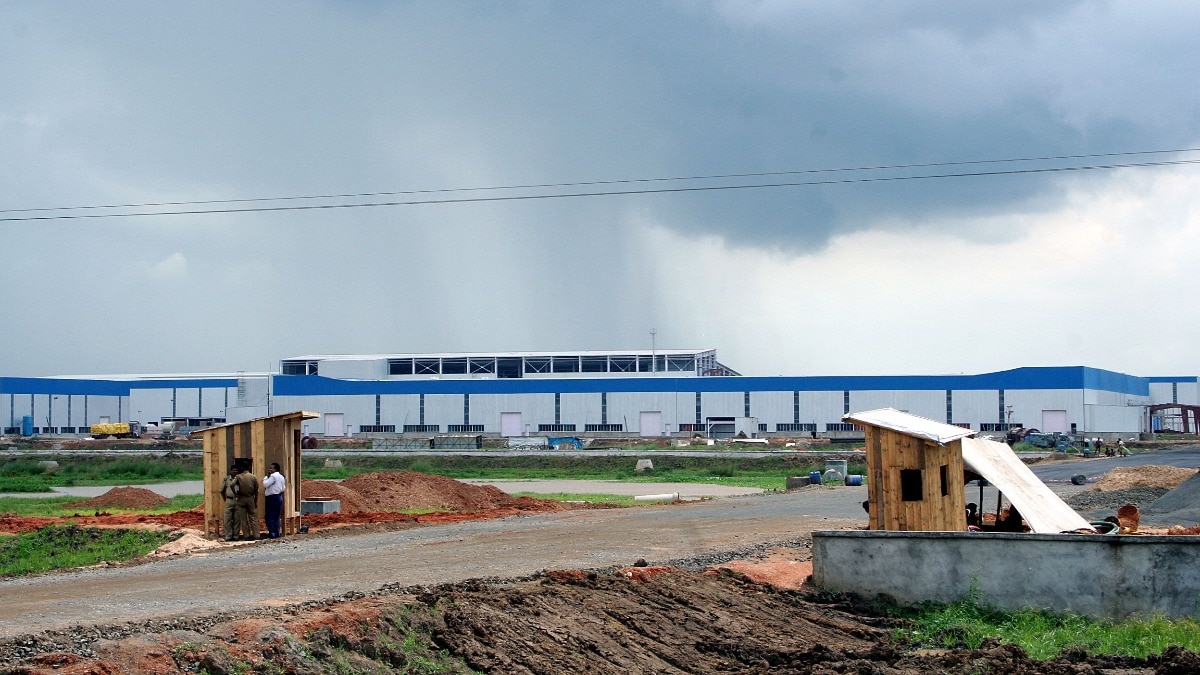
On November 21, Union Minister Sukanta Majumdar announced that commercial vehicle maker Ashok Leyland would set up a manufacturing plant in West Bengal's Singur. A day later, West Bengal Chief Minister Suvendu Adhikari said the state's industrial development corporation was acquiring 997 acres of land in the town, without specifying why. While a new factory is significant for a state often seen as hostile to big industry, there is another important detail.It was exactly 997 acres of land on which the erstwhile Left Front government had attempted to build a Tata Motors factory, only to see the Nano project collapse amid a sustained Trinamool Congress-led farmers' agitation in 2006.West Bengal has long struggled with an image of being inhospitable to big industry. While states such as Tamil Nadu and Gujarat rapidly industrialised, Bengal went through decades of de-industrialisation. The 34 years of Left Front rule saw the state's industrial base steadily weaken, a trend that the Mamata Banerjee-led Trinamool Congress government failed to reverse during its 15 years in power.It is this reputation that the Suvendu Adhikari-led BJP government is now looking to overturn, with plans to bring a new vehicle manufacturing plant in West Bengal. As West Bengal's Finance Minister said on Wednesday, "The industrial and investment policy has already been announced. Ashok Leyland has shown interest in Singur. Alongside it, several chemical companies have also expressed interest. However, everything is still at a preliminary stage, and nothing has been finalised yet," reported The Times of India.And what could be a better symbol of that change in attitude than Singur? Nearly 20 years ago, then Chief Minister and CPI(M) veteran Buddhadeb Bhattacharya embarked on an ambitious industrialisation drive. Its centrepiece was a Tata Motors plant on 997 acres in Singur, intended to manufacture the Tata Nano, then billed as the world's cheapest car.The current BJP government's bid to revive Bengal's industrial fortunes through a vehicle manufacturing plant in Singur appears to be retracing the very path taken by the Left Front, whose own industrial ambitions unravelled in the same town.So why did the Left's attempt to bring about an industrial renaissance in Bengal fail? And can Suvendu Adhikari succeed in bringing an Ashok Leyland factory to the very land once earmarked for Tata Motors? The Singur Tata Motors plant was part of CPI(M) leader and erstwhile West Bengal CM Buddhadeb Bhattacharya's ambitious plan to re-industrialise West Bengal. (Image: India Today Group) THE CPI(M) ATTEMPT TO SET UP A TATA MOTORS PLANT IN SINGURThe Tata Motors plant at Singur, a small town in West Bengal's Hooghly district, was the centrepiece of CM Buddhadeb Bhattacharya's ambitious bid to reverse the state's industrial decline.On May 18, 2006, the day Bhattacharya was sworn in as CM for a third consecutive term, Tata Group Chairman, Ratan Tata announced that the group would set up a plant to manufacture the Tata Nano in Singur.It must be noted that Bhattacharya's push for private investment was a significant departure from the traditional ideological position of the CPI(M), which had for long been wary of big capital and private corporations. In fact, he went against a whole lot of CPI(M) leaders to push forward his plan.The project ran into serious problems right from the get-go, mainly around the acquiring of 997 acres of fertile agricultural land in Singur.Within days of Ratan Tata's announcement, farmers were demonstrating over what they termed "forcible" acquisition of land, while Bhattachrya was soon taking fire from his own party colleagues, including ex-CM Jyoti Basu for "mishandling" the land acquisition.The protests soon snowballed into a major political confrontation, with the Singur Krishi Jami Raksha Committee and Mamata Banerjee's Trinamool Congress (TMC) spearheading the agitation against what they termed forcible land acquisition.Banerjee accused the Left Front government of forcibly taking away farmers' land and demanded its return. The movement gathered momentum through rallies, road blockades and an indefinite hunger strike by Banerjee in December 2006, which lasted 26 days.Despite Bhattacharya's efforts to salvage the project, the agitation continued, with violence and clashes around the factory site further escalating tensions.After a brief breakthrough in September 2008, when negotiations brokered by then Governor Gopal Krishna Gandhi led to an agreement to examine the return of land to unwilling farmers, the deadlock returned.Mamata Banerjee insisted that 400 acres be returned, while the Bhattacharya government refused to part with land from the main factory site.The Trinamool Congress resumed its agitation, and Tata Motors suspended construction work on September 3, 2008, while exploring alternative locations.On October 3, 2008, Ratan Tata announced that the company was pulling the Nano project out of Singur and the company subsequently shifted the project to Sanand in Gujarat, then ruled by the BJP, under Chief Minister Narendra Modi. Mamata Banerjee's TMC spearheaded the farmers' agitation that forced Tata Motors to pull out of its Singur operation. (Image: India Today Group) CAN THE BJP SUCCEED WHERE THE LEFT FAILED?To say that Tata Motors' pullout from Singur was a setback would be an understatement.It shattered Buddhadeb Bhattacharya's aim of re-industrialising West Bengal and cemented the state's image of being hostile to big industry in front of private investors. It also contributed to the Left Front's electoral collapse in the 2011 Assembly elections, which led to Mamata Banerjee ruling as the CM for the next 15 years.The TMC, of course, failed to attract industry, which the now Suvendu Adhikari-led BJP government has set out to do in West Bengal.There's also the hard-to-miss fact that the now CM and BJP leader, Suvendu Adhikari, was a card-carrying member of the Trinamool Congress, who rose to prominence leading his own land acquisition movement against a proposed chemical hub in Nandigram district.Singur has featured prominently in the BJP's plan to bring industry back to the state. The CM had previously stated that he would do "something for Singur", and last week came the announcement that Ashok Leyland, India's second-largest commercial manufacturer, would set up a truck-manufacturing plant there.The symbolism is hard to miss. Singur and the 997 acres that became the symbol of West Bengal's perceived hostility to heavy industry and derailed the Left Front's plan to reinvigorate the state, is now at the centre of the BJP's push to attract investments to the state.A fully operational truck factory in Singur would demonstrate that West Bengal is finally ready for business. It might be a long way before everything falls into place.Ashok Leyland is yet to present a detailed investment plan of their own, even if they have "shown interest in Singur. As state finance minister Swapan Dasputa put it, "everything is still at a preliminary stage, and nothing has been finalised yet". There is also the sensitive issue of land acquisition. Even if the same 997 acres that had been earmarked for Tata Motors and now rendered unsuitable for agriculture are to be bought for Ashok Leyland, the acquisition will have to be made carefully. The Left Front and Tata Motors had to deal with the consequences of a "mishandled" land acquisition in 2006.The challenge for Suvendu Adhikari is to pull off what Buddhadeb Bhattacharya failed to do nearly 20 years back. Singur had bid an unceremonious farewell to Tata Motors and its Nano. It is planning to welcome Ashok Leyland, and exactly on 997 acres in Singur. The journey will be worth watching, and have a strong bearing on West Bengal's future.- Ends
Singur's 997 acres: Said Tata to Nano 20 years ago, will welcome Ashok Leyland now
Full Article
Original Source
Read the full article at Indiatoday →KhanList aggregates and links to publicly available news content. We do not host full articles from third-party sources. Always verify important information with original sources.