
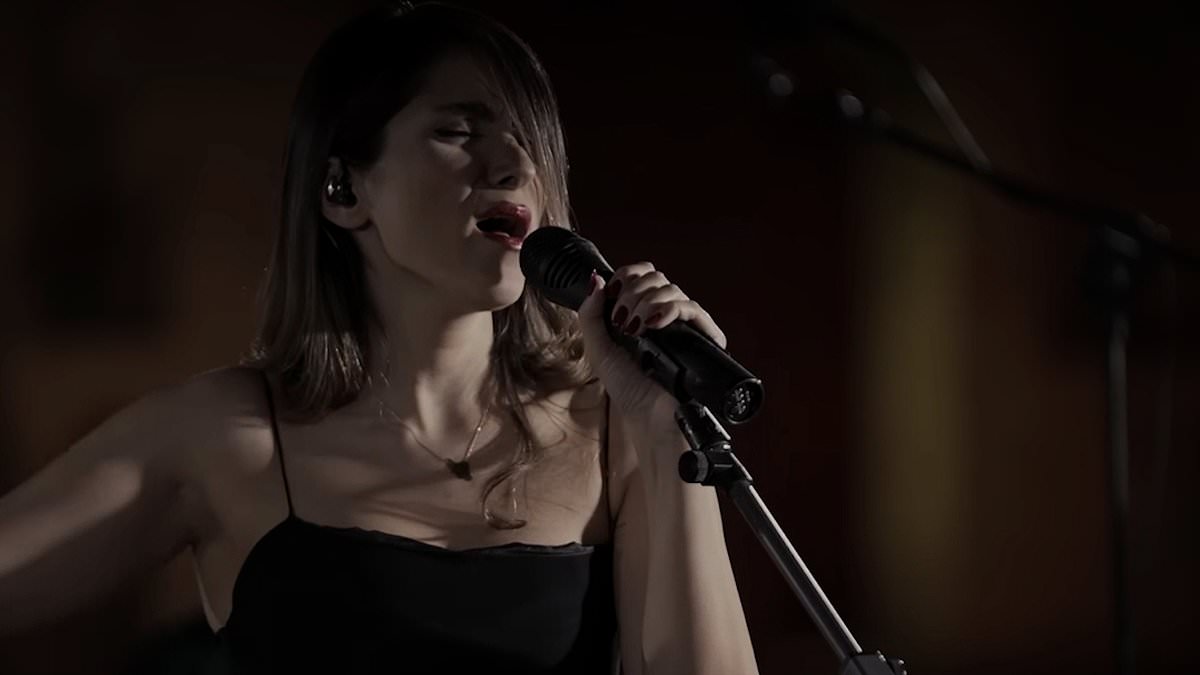
An Iranian singer who performed in a YouTube concert without a hijab will receive 74 lashes after losing an appeal. Parastoo Ahmadi, 29, appeared on a livestream in December 2024 alongside her four-man backing band with no audience present.Ahmadi performed a patriotic song titled Az Khoone Javanane Vatan (From the Blood of the Youth of the Homeland) in a long black sleeveless dress and no hijab.The performance was posted on YouTube, with Ahmadi saying: 'I am Parastoo, a girl who wants to sing for the people.'The band was arrested, and in June, a criminal court in Qom found Ahmadi and eight other musicians guilty of charges including 'offending public decency' through the publication of 'obscene and indecent material.'The singer and her band were sentenced to flogging, a two-year travel ban, and a two-year ban on engaging in artistic activities, according to reports. The group of musicians appealed the decision, but last week, a court upheld their conviction, the band's lawyers told the BBC.'In our view, holding the concert was not a crime at all,' one of the lawyers said. 'The trial court imposed one of the harshest punishments for these charges, although fines and less severe penalties were also available.' Parastoo Ahmadi, 29, was sentenced to 74 lashes for singing without wearing a hijab and this month had her appeal rejected. Video grab shows Ahmadi singing without wearing a hijab Ahmadi posted her concert on YouTube, saying: 'I am Parastoo, a girl who wants to sing for the people I love. This is a right I could not ignore; singing for the land I love passionately''The Court of Appeal, despite having the option of holding a hearing, did not hold a hearing and upheld the judgment. It appears that the main reason for issuing this judgment was to deter the recurrence of similar events.'The video has racked up millions of views, and comments on the singer's YouTube video, which is platform-banned in Iran, have praised her bravery and voice, with many saying they were moved to tears. Some hailed her as 'the woman of freedom', and one said: 'This is beyond art. It is a historical movement and a symbol of resistance against restrictions.'Women are not allowed to sing by themselves in public in Iran.It follows the introduction of a newer and harsher 'Hijab and chastity' bill, which was approved by the Iranian Parliament last year.This means that all women - including girls as young as 12 - must wear a hijab or face strict punishments.Sanctions range from fines to 15 years in prison, to even the death penalty under the charge of 'corruption on earth'.It also brings a stricter level of surveillance to monitor women and ensure they are complying. It applies to women both in public spaces and online.Ahmadi adds to the growing number of women publicly defying the Islamic Republic's laws.Following the Islamic Revolution in Iran in 1979, women were banned at first from singing altogether, then from singing or dancing solo before mixed-gender audiences.Female vocalists could perform for male audiences only as part of a chorus. But they are allowed to sing in a hall for female-only audiences.Also, based on Iranian and Islamic law, women are not allowed to appear without a hijab in front of men who are not related.In Iran, the hijab has long been a political symbol as well, particularly after becoming mandatory in the years following the 1979 Islamic Revolution.For observant Muslim women, the head covering is a sign of piety before God and modesty in front of men outside their families.There were protests across Iran in 2022 following the death of Mahsa Amini, 22, after her arrest by the country's morality police over allegedly not wearing her hijab.It also comes just days after a voice recording of an Iranian woman facing execution emerged last week, in which she begged the outside world for help.Accounting student Najmeh Amini, 23, was sentenced to death this month after being held in the notorious Vakilabad Prison in Mashhad for eight months on charges which included 'insulting the Supreme Leader' and 'clashing with security agents,' according to human rights group Iran Human Rights Monitor.Following her sentence, a leaked voice recording from inside prison emerged in which Amini desperately pleads for help.'Greetings to the people of Iran. I am Najmeh Amini, 23 years old, speaking from the central prison of Mashhad. I am leaving this message for you on 18 September 2026,' she is heard saying. In Iranian and Islamic law, women are not allowed to appear without wearing a hijab in front of men who are not related 'I am not trying to make a hero out of myself today; I only ask one thing: be my voice. I am an innocent girl, a young person with so many hopes and dreams. I have parents who are waiting for me— a family that wakes up every morning fearing my loss.'I do not want the last remaining trace of me to be a few lines in a case file.'If my voice reaches outside the prison, please do not listen to it for just a moment and then forget it!'People, I only want justice and the opportunity to defend myself. I request lawyers, legal scholars, human rights activists, and everyone who hears the voices of innocent people to review my case file.'I request international human rights organisations and responsible bodies at the United Nations to hear my voice and investigate and follow up on the status of my case.'Remember my name; I may not be able to speak again. But as long as I am alive, I hold one hope: that before the rope marks the end of my life, I see my prosperous and free Iran,' she adds.According to IHRM, Amini was arrested on January 31 after she - alongside hundreds of thousands of Iranians - took to the streets to protest against its authoritarian government.In response, security forces unleashed a deadly crackdown, in which more than 7,000 people were killed, while thousands more were arrested, according to human rights groups.Detainees have spent the last eight months in limbo as courts decide their fates.Public executions are not uncommon in Iran and are often reserved for political prisoners. They are largely carried out by hanging in a public square, where cranes mounted on trucks serve as gallows.The IHRM said: 'Issuing a death sentence against a 23-year-old student after months of arbitrary detention, reported risk of torture, and complete denial of counsel doubles the urgency for immediate international intervention to stay and overturn this sentence.'
Singer loses appeal against sentence of 74 lashes for performing without a hijab in Iran
Full Article
Original Source
Read the full article at Dailymail →KhanList aggregates and links to publicly available news content. We do not host full articles from third-party sources. Always verify important information with original sources.