
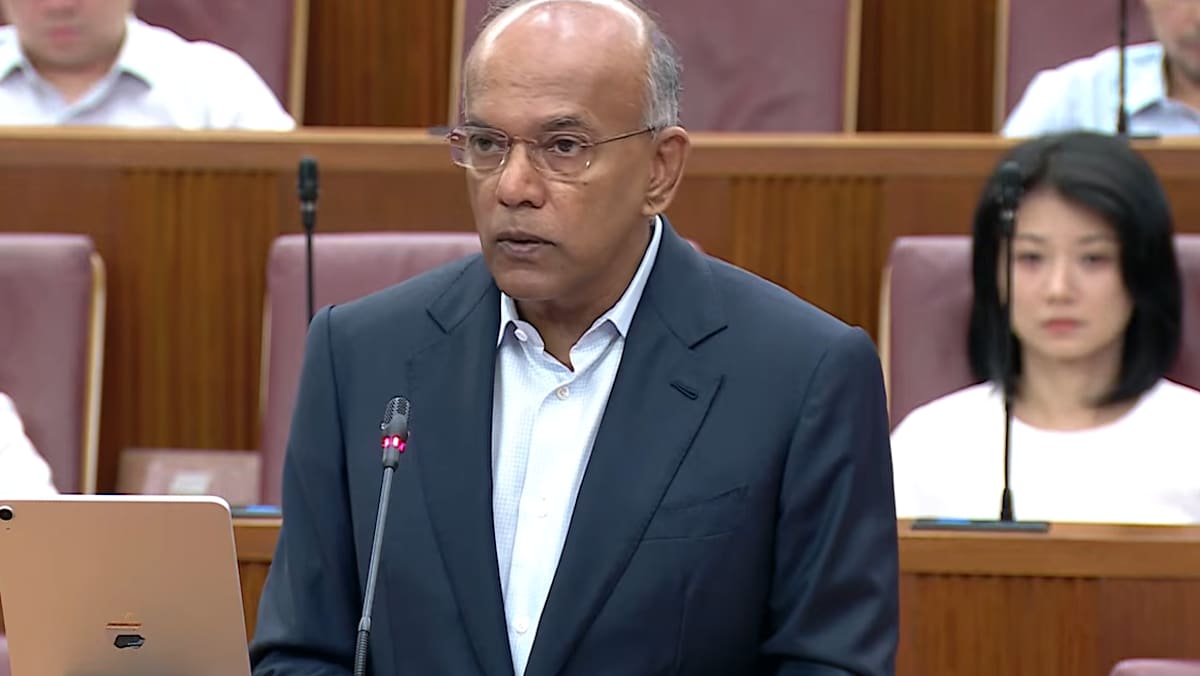
SINGAPORE: New legislation will be tabled in parliament to reinforce the deterrence approach when sentencing all scammers and those who facilitate scams "including those who are young", said Senior Minister K Shanmugam on Tuesday (Oct 6).This comes after a High Court ruling in September that allowed appeals by youth offenders and sentenced them to probation and community sentences instead of a deterrent one, putting weight on rehabilitation as the primary sentencing consideration.This rationale by the courts "contradicts the approach set out in sentencing guidelines" that recommend jail or reformative training, said Mr Shanmugam.He was responding to a parliamentary question by Mr Christopher de Souza (PAP-Holland-Bukit Timah) on whether the government will consider additional legislative provisions for youth offenders involved in scams. "We wanted this message to go out that every offender, young or old, will be very seriously dealt with. If a number of cases are dealt with in this way, many other would-be offenders would take reference," said Mr Shanmugam, who is also the Coordinating Minister for National Security and the Minister for Home Affairs."Word will get around, and people, including young people, will be much more careful. That will make it harder for scammers to operate, and help reduce the number of victims and the losses they suffer."On Sept 10, a three-judge coram comprising Chief Justice Sundaresh Menon and Justice Ang Cheng Hock and Justice Hoo Sheau Peng, dealt with an appeal case involving Mohamed Erzan Taib Zohri and six separate cases that also involve scams. The seven cases involved money mule offenders, six of whom were under the age of 21.Speaking on Tuesday, Mr Shanmugam said the sentencing guidelines had laid out that fines, probation, and community sentences are generally not appropriate, and that imprisonment or reformative training should be considered "given the need for deterrence and the public interest in suppressing scams".He noted that while it was understandable for the court to be inclined to impose rehabilitative sentences to youth offenders, the government has to consider the wider consequences of such crimes, including the huge amount of financial losses and "the full human costs of such scams".Leniency towards scammers and those who facilitate scams will lead to many Singaporeans becoming victims."And if young offenders are being treated more leniently simply because of their age, scam syndicates will have every incentive to recruit more young people as mules. We cannot allow this to happen," said Mr Shanmugam.To this end, the senior minister said the Ministry of Home Affairs (MHA) will be tabling new legislation in parliament "soon" to give effect to its policy position.The legislation will be "quite express" and make clear that the court's position in the Erzan case is not to be followed, said Mr Shanmugam."This is not the time to go soft," said Mr Shanmugam.YOUTH INVOLVEMENT IN SCAMS "PARTICULARLY" CONCERNINGMr Shanmugam noted that scams today are the most prevalent crime type in Singapore, with the police receiving an average of 90 reports on such cases every day involving about S$2 million of losses daily."My ministry is particularly concerned that many young people are getting involved in scam-related offences. In 2025, more than 1,000 youths were investigated in connection with scam reports," he said.In September, the Ministry of Social and Family Development reported that the youth offending rate rose in Singapore in 2025, driven mainly by an increase in cheating and related offences.Such offences jumped 37 per cent from 814 in 2024 to 1,114 in 2025, the highest since 2021, with youths in this category largely involved in scams as mules.In such cases, they were found to have relinquished their bank account and Singpass credentials, registered and handed over SIM cards or mobile phone lines, and facilitated transactions for scammers.The Sentencing Advisory Panel, which comprises members of the judiciary, Attorney-General's Chambers, Public Defender's Office, lawyers and MHA, worked intensively on sentencing guidelines for scam offences."The guidelines recommend imprisonment or reformative training when sentencing scams-related offenders, including those below the age of 21, except those dealt with in the Youth Court," he said.REHABILITATIVE, EDUCATIONAL APPROACHESIn general, the legislation has evolved over the years to bring in rehabilitative justice through community-based sentences, probation and reformative training, and young offenders are generally dealt with within that framework, said Mr Shanmugam.The jurisdiction of the Youth Courts, which mainly dispenses rehabilitative sentences, was also expanded in 2025 to youths below 18, he added."We take rehabilitation seriously. Young people should be given guidance, and we should try and rehabilitate them as much as possible, rather than to immediately treat them as hardened criminals," said Mr Shanmugam.However, when it comes to scam-related offences specifically, the government has made a deliberate policy judgement that deterrence and prevention must carry greater weight."That is because rehabilitation of the individual offender has to be balanced against the need to deter others from facilitating scams, and thereby prevent many more people from becoming victims," said Mr Shanmugam.He noted that MHA has tabled new legislation for scam-related offences in parliament in the last three years."When these laws were debated, parliament deliberately made no distinction between young and not so young offenders," he added.On youths, Mr Shanmugam noted that they may be attracted by the promise of quick money, misled by purported job offers, influenced by peers or approached through social media."Some may not fully appreciate that their actions can enable serious criminal activity. Criminal syndicates exploit precisely this combination of inexperience, financial temptation and digital exposure," said Mr Shanmugam.Hence, education is another key strategy to prevent youth offending, said Mr Shanmugam in response to another parliamentary question on how MHA is working with schools and parents to prevent young people from being recruited as money mules.The police work with the Ministry of Education to conduct crime prevention talks in schools and to disseminate anti-scam advisories through the Parents Gateway platform, said Mr Shanmugam, adding that a youth-centric anti-scam campaign was also launched in April.The government will also study whether structured scam-awareness and financial-literacy training would be appropriate and effective for youths who are issued with conditional warnings.
Singapore to table law reinforcing deterrent sentences for scam offenders, including youths: Shanmugam
Full Article
Original Source
Read the full article at Channelnewsasia →KhanList aggregates and links to publicly available news content. We do not host full articles from third-party sources. Always verify important information with original sources.