
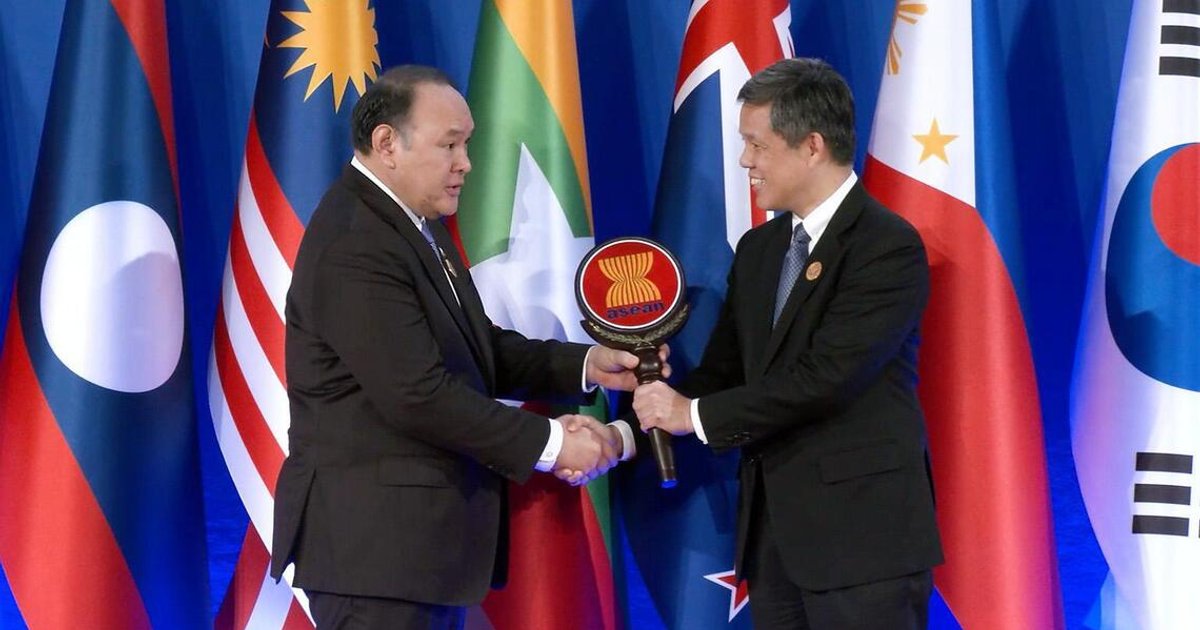
MANILA – Singapore will work with Washington and other South-east Asian countries to develop a “mutually beneficial” US-ASEAN defence cooperation framework in 2027, but has stressed that this will be pursued alongside existing defence arrangements with other key partners.Singapore’s Ministry of Defence (Mindef) made the comments in response to queries from The Straits Times about the initiative, which was proposed by US Defence Secretary Pete Hegseth at the ASEAN Defence Ministers’ Meeting (ADMM) on Oct 28.As chair of the ADMM in 2027, Singapore “looks forward to facilitating” the US proposal. “Singapore will work with the US and other ASEAN Member States to develop a mutually beneficial framework for all parties to work together in response to shared challenges and concerns,” the ministry said.MINDEF added that the proposed framework would be one of several initiatives through which ASEAN engages its external partners, reflecting the grouping’s longstanding commitment to an open and inclusive regional security architecture.“Singapore looks forward to working with ASEAN Member States and our Plus partners to strengthen defence cooperation and address shared security challenges,” it said.MINDEF also pointed to existing ministers’ meetings, maritime exercises with China, India, Russia and the US, as well as capacity-building activities involving China, South Korea and New Zealand, saying these “complement the ADMM and ADMM-Plus and reaffirm the open and inclusive nature of the ASEAN-led regional security architecture”.Washington has yet to spell out the details for the defence framework, but the initiative is expected to take shape in 2027, when ASEAN and the US mark 50 years of relations.The proposal comes as South-east Asian governments seek to deepen security cooperation with Washington without being drawn further into its strategic rivalry with Beijing.The Philippines, a US treaty ally facing maritime confrontations with Beijing in the South China Sea, has been unequivocal about Washington’s importance to regional security.Philippine Defence Secretary Gilberto Teodoro Jr said at the ADDM that a “robust US presence was necessary for peace and stability in South-east Asia and in the broader Indo-Pacific region”.Thailand welcomed the proposal as a positive step, but said it must complement existing ASEAN-led mechanisms and avoid worsening strategic competition.“It should not lead to further divisions or exacerbate strategic competition in the region,” a Thai Foreign Ministry spokesperson told ST.Malaysia also welcomed stronger US engagement, with Defence Minister Mohamed Khaled Nordin saying Kuala Lumpur looks forward to the framework next year.“Our approach has never been about choosing sides. It is about preserving the peace and stability that have allowed our region to prosper,” he said in his ADMM remarks in Cebu.Indonesia has not publicly responded to the proposal, although Deputy Defence Minister Richard T.H. Tampubolon stressed ASEAN unity and centrality during the Cebu meetings.What could the framework look like?Analysts interviewed by ST said the initiative would likely focus on maritime security, military training and capacity-building rather than resemble a collective defence arrangement.Gregory Poling, director of the South-east Asia Programme and Asia Maritime Transparency Initiative at the Center for Strategic and International Studies in Washington DC, said the framework could consolidate existing US security programmes in the region.“I think the best guess is that this would knit together a lot of the programmes focused on capacity building, arms sales and arms transfers and training that have been going on for years,” he said.Poling said the proposal could also reassure regional governments concerned about Washington’s long-term commitment. “Clearly what everybody wanted from Secretary Hegseth was reassurance about US staying power (in ASEAN),” he said.Political scientist Aries Arugay, visiting senior fellow at Singapore’s ISEAS – Yusof Ishak Institute, welcomed the proposal as a concrete opportunity to deepen Washington’s engagement with ASEAN as a grouping.“This reflects something concrete that could bind the US towards the region,” he said, adding that the initiative would need sufficient resources and follow-through to succeed.Singapore’s balancing actDr Collin Koh, a senior fellow at Singapore’s S. Rajaratnam School of International Studies, said Singapore’s close defence relationship with Washington puts it in a sensitive position as incoming ADMM chair.While Singapore considers the US important to regional security, Dr Koh said it would be cautious about appearing to promote an arrangement that other ASEAN members could perceive as collective defence or an effort to contain China.He said the framework would likely be scaled back to accommodate ASEAN’s differing priorities and military capabilities.“Potentially you might find yourself having to cater to the lowest common denominator,” he said, noting that ASEAN’s defence cooperation with external powers has traditionally been built around overlapping partnerships instead of exclusive security commitments.Singapore Defence Minister Chan Chun Sing in Cebu on Oct 29 said ASEAN needed mechanisms that could accommodate different security priorities and capabilities.“There is a diversity of aspirations, a diversity of capabilities around the world, and we will need a mechanism that allows us to build an overlapping network of bilateral and plurilateral ties in order to advance our shared interests,” he said.Singapore formally took over the ADMM chairmanship for 2027 from the Philippines during the Cebu meetings, with Minister Chan pledging to work closely with ASEAM member-states and their external partners to address evolving security challenges.While ASEAN-wide cooperation could include maritime domain awareness and humanitarian assistance, more sophisticated military activities would likely remain bilateral or involve smaller groups.“When it comes to more substantial operational capabilities, say, engaging in joint training that has a warfighting dimension, maybe not ASEAN. I don’t think ASEAN will engage in that,” he said.Dr Koh said differing military equipment and levels of interoperability would make it difficult to develop advanced joint capabilities across all 11 members.The China factorChina did not send Defence Minister Dong Jun to the ADMM in Cebu but was instead represented at a lower level, amid heightened tensions with Manila over the South China Sea.Poling said Beijing’s absence reflected deteriorating China-Philippines relations, while Washington’s proposed framework could raise wider concerns about ASEAN being drawn into strategic competition.“There are obvious practical benefits if this unlocks more US funding, more US training, more interoperability around the region,” he said.“The tradeoff is, is this seen as a US imposition or is it seen as ASEAN being roped into a US-China competition?”Even maritime domain awareness, a seemingly practical area of cooperation, would be difficult to separate from concerns over China’s activities at sea, he added.Dr Arugay offered a more optimistic assessment.He argued that deeper US engagement could help South-east Asian governments balance China’s growing influence without abandoning their relationships with Beijing“These countries will hedge, and any signal from the US balances off China’s overwhelming presence and their engagement with China,” he said.- With additional reporting by May Wong
Singapore to steer ‘mutually beneficial’ US-ASEAN defence framework amid regional sensitivities
Full Article
Original Source
Read the full article at Straitstimes →KhanList aggregates and links to publicly available news content. We do not host full articles from third-party sources. Always verify important information with original sources.