
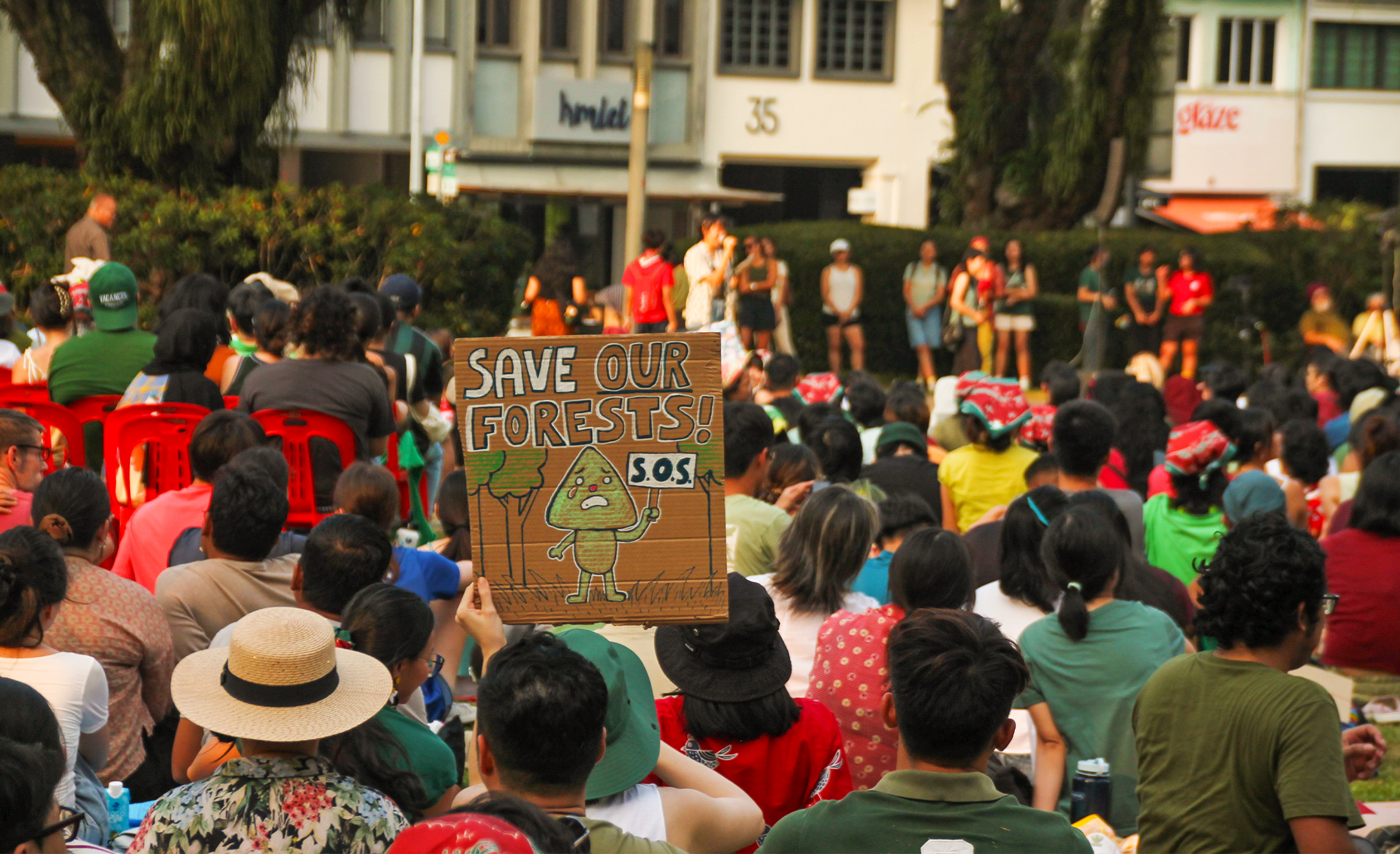
Singapore is preparing its first national climate adaptation plan as temperatures and extreme rainfall increase, but the city-state is also clearing forests for housing.The planned development of Maju Forest and Gillman Barracks has triggered rare public protests, with residents arguing that Singapore’s environmental impact assessments fail to account for forests’ role in climate adaptation.Scientists say forest loss could increase heat and flood risks, while Singapore is spending billions on engineered climate defenses such as drainage, seawalls and heat-resistant paint.The conflict puts Singapore’s “city in nature” vision under scrutiny, as conservationists question whether tree planting and managed greenery can compensate for the loss of forests. SINGAPORE — At a rare public demonstration against a state development plan, 22-year-old environmental studies student Saw Yun Ya called on the Singaporean government to redo an environmental impact assessment (EIA) for Maju Forest, arguing that it had overlooked the climate and health effects of clearing the site. The EIA for Maju, a 23-hectare (57-acre) patch of regenerating forest bordered by housing in central Singapore, was announced in July, prompting an unusually impassioned public backlash in the conservative city-state. Maju is one of several secondary forests facing development as the 744-square-kilometer (287-square-mile) city looks to address an acute housing crunch amid a growing population. Forests at Sembawang, Woodlands, Tengah and Gillman Barracks are also on the chopping block. Secondary forests cover about 16% of Singapore’s land area, having regrown over abandoned villages and plantations after much of the population was moved into high-rise housing from the 1960s. The island lost almost all of its primary forests in the British colonial era. Singapore’s EIAs assess the pollution, waste and biodiversity impacts of developing an area, and have identified critically endangered species such as the Sunda pangolin (Manis javanica) and straw-headed bulbul (Pycnonotus zeylanicus) at sites including Maju and Gillman Barracks. But residents and environmental groups say EIAs do not adequately account for the climate and health benefits provided by forests. A protester at a rally against deforestation on Aug. 16 holds a banner reading: “Know your enemy,” in reference to sites that could be used as alternatives to forest to build public housing. GCB is an acronym for good class bungalows. Image by Shu and Kareen, SG Climate Rally. “Forests are crucial for our health and well-being,” Saw told more than 2,000 people at a “Maju for the People” rally at Hong Lim Park on Aug. 16. Forests, she said, provide respite from heat and act as “natural air-conditioners.” She called for the EIA to account for the health, climate and sociocultural impacts of losing Maju before any “irreversible decisions” are made. The government will proceed with housing development at both Maju and Gillman Barracks, although more forest will be retained than originally planned following public feedback, national development minister Alvin Tan said on Aug. 14, according to an Asian news network. Tengah forest was historically home to brickwork factories as well as gambia and pepper farms, rubber plantations, and villages. In recent decades, it has been reclaimed by jungle. The forest is to be converted into a “Forest Town.” Image by Robin Hicks for Mongabay. Civic society has acknowledged the need for more affordable public housing, but is calling for alternative sites to be explored before secondary forests are bulldozed. Image by Shu and Kareen, SG Climate Rally. A natural defense against heat and floods The debate comes as Singapore prepares its first national climate adaptation plan. The government has designated 2026 the Year of Climate Adaptation, with the plan to address risks such as rising temperatures, heavier rainfall and coastal flooding. The draft plan lists biodiversity and greenery alongside heat, flood resilience, water, food, liveability and public health as focus areas. But the government has not said that protecting existing secondary forests will be an adaptation priority, or set a threshold for how much forest can be lost without undermining climate resilience. The Ministry of Sustainability and the Environment told Mongabay in a statement that it is still developing the plan, which is slated for release in 2027, and continues to engage stakeholders in a “whole-of-society” effort. The plan takes a “holistic” approach to climate adaptation that includes heat and flood resilience, as well as urban liveability, infrastructure and ecosystem resilience, and is aligned with the United Nations Framework Convention on Climate Change, the ministry said. Winston Chow, a professor of urban climate at Singapore Management University and principal investigator for the Cooling Singapore initiative, said there is substantial scientific evidence that removing forests like Maju would increase urban temperatures and flood risk and worsen air quality. Forest loss and urbanization have already heightened flood risk in areas such as Bukit Timah and Ulu Pandan. Clearing Maju could increase the risk of flash flooding of the nearby Pandan River as extreme rainfall intensifies. The economic consequences of a hotter Singapore could also be significant. A 2024 National University of Singapore study projected that hotter, more humid conditions could reduce productive working time across major sectors by 14% by 2035, costing Singapore’s economy 2.22 billion Singapore dollars ($1.73 billion) a year. Singapore has committed 100 billion Singapore dollars ($78 billion) to climate adaptation this century, including 10 billion Singapore dollars ($7.87 billion) over the next decade for structural defenses such as seawalls. In 2025, it set up a heat resilience office and launched a 40 million Singapore dollars ($31.5 million) initiative to research how heat stress affects vulnerable groups. Read more: Urban heat islands have solutions; many tropical cities can’t afford them Julie Tang, a climate organizer with SG Climate Rally, the nonprofit behind the Maju rally, said forests should be treated as adaptation infrastructure alongside seawalls, drainage systems and cooling technologies, and their ecosystem services incorporated into cost-benefit analyses for development decisions. He said the country’s urban redevelopment masterplan was outdated, and alternatives to forests should be considered as sites on which to build public housing, including golf courses and posh bungalows — which take up a lot of land. A long line of hikers walk through Maju Forest. Nature walks have been used as a way to galvanise support for unprotected secondary forests. Image by Robin Hicks for Mongabay. How much forest can Singapore afford to lose? As Singapore calculates how to balance housing needs with climate adaptation, its remaining natural areas are coming under increasing pressure. Global Forest Watch data shows a noticeable decline in tree cover over the past decade compared with the previous one. Jimmy Tan, a nature guide and food delivery cyclist, says the loss of nearby forest has affected the microclimate in built-up neighborhoods. After experiencing heat exhaustion and sleep deprivation while living in Toa Payoh, he moved to Bukit Batok, where denser secondary forests provided some relief. He describes himself as a “microclimate refugee.” “The majority of Singapore’s population does not live near nature reserves, so they will be deprived of the natural cooling effect whenever a forest in their neighborhood gets cleared in the name of development,” he said. A 2005 study found that Singapore’s downtown urban district could be up to 6° Celsius (10.86° Fahrenheit) warmer than greener areas. Singapore’s average temperature has also risen, with urban heat island effects compounding background climate-induced warming. Tan, who started a petition against the rezoning of Tengah forest last year, argues that secondary forests on state land provide ecosystem services that benefit the wider public and should, therefore, receive greater consideration in development decisions. An academic analysis of Singapore’s urbanization plans estimated that as much as 7,331 hectares (18,115 acres) of secondary forest could potentially be converted to other uses over the coming decade — equivalent to about one-10th of the island’s land area. Conservationist Jimmy Tan leading a nature walk in Tengah forest, most of which is being cleared to build a “Forest Town.” Tan has raised a petition to protect more of Tengah forest. Image by Robin Hicks for Mongabay. The entire forested area is earmarked for potential future residential use. Image by Robin Hicks for Mongabay. Green city, shrinking forests Forest loss sits uneasily alongside Singapore’s investor-friendly claim to becoming a “city in nature.” In his National Day Rally speech on Aug. 23, Prime Minister Lawrence Wong said Singapore would expand its green spaces and noted that nearly half the island is already green. “As temperatures rise around the world, our greenery helps keep our city cooler and more liveable,” he said. Conservationists question what counts as “green” in such calculations. Singapore’s headline figure of about 40% green cover includes parks, rooftop gardens and other managed vegetation. Studies have found that managed greenery does not provide the same cooling and flood-control functions as forests. An official response to the conversion of secondary forests has been the government’s OneMillionTrees movement, which aims to plant an additional million trees across Singapore by 2030. The National Parks Board says 887,044 trees have been planted since 2020. But some conservationists argue that planting saplings cannot compensate for the loss of forests. “The [OneMillionTrees] movement is not fully greenwashing, but it is a bit of a misdirect from deforestation,” said Sankar Ananthanarayanan, a Ph.D. candidate in theoretical ecology at the National University of Singapore. “We also need to be honest about the number of trees being lost.” Singapore has never rejected a forest development proposal on the basis of an EIA, although public feedback has led to parts of some green areas being retained. Environmental groups are asking whether EIAs are sufficiently equipped to evaluate forests not purely as habitat, but as infrastructure that provides climate and public health benefits. Walkers amble through Bukit Brown cemetery. Parts of the 233-hectare (576-acre) site are zoned for development under Singapore’s Urban Redevelopment Masterplan. Image by Robin Hicks for Mongabay. Benjamin Horton, dean of the School of Energy and Environment at City University of Hong Kong and former director of the Earth Observatory of Singapore, said Singapore has done more than most cities to integrate greenery into its urban environment. But clearing forests for housing shows that economic development has clearly taken precedence over climate resilience, he said. “If you talk about being future-ready and climate-resilient to attract investors, you need to walk the talk,” Horton said. “If you brand yourself a ‘city in nature’ and are trying to keep the place cool, the last thing you want to be doing is cutting down trees.” Banner image: Around 2,000 people gathered for the “Maju for the people” rally on Aug. 16. Image by Ada Cheong. As Singapore culls ‘nuisance’ birds, rapid urbanization continues to fuel an avian boom Citations: Wong, N. H., Chen, Y. (2005). Study of green areas and urban heat island in a tropical city. Habitat International, 29(3). doi:10.1016/j.habitatint.2004.04.008 Wu, Y. (2023). Study towards integrating secondary forests into future land use development in Singapore for biodiversity objectives. Sustainability, 15(4), 2916. doi:10.3390/su15042916 Li, F., Wu, C., Chen, H., Feng, X., Li, M. (2026). Optimizing Urban Green Space Ecosystem Services for Climate Resilience: A Multi-Dimensional Assessment of Urban Park Cooling Effects. Forests 2026, 17(3), 383. doi:10.3390/f17030383 Cite this articleRobin Hicks (2026). Singapore spending billions to adapt to climate change, but deforestation continues. Mongabay Conservation news. DOI: https://doi.org/10.66709/news-327585 Credits Topics
Singapore spending billions to adapt to climate change, but deforestation continues
Full Article
Original Source
Read the full article at News →KhanList aggregates and links to publicly available news content. We do not host full articles from third-party sources. Always verify important information with original sources.