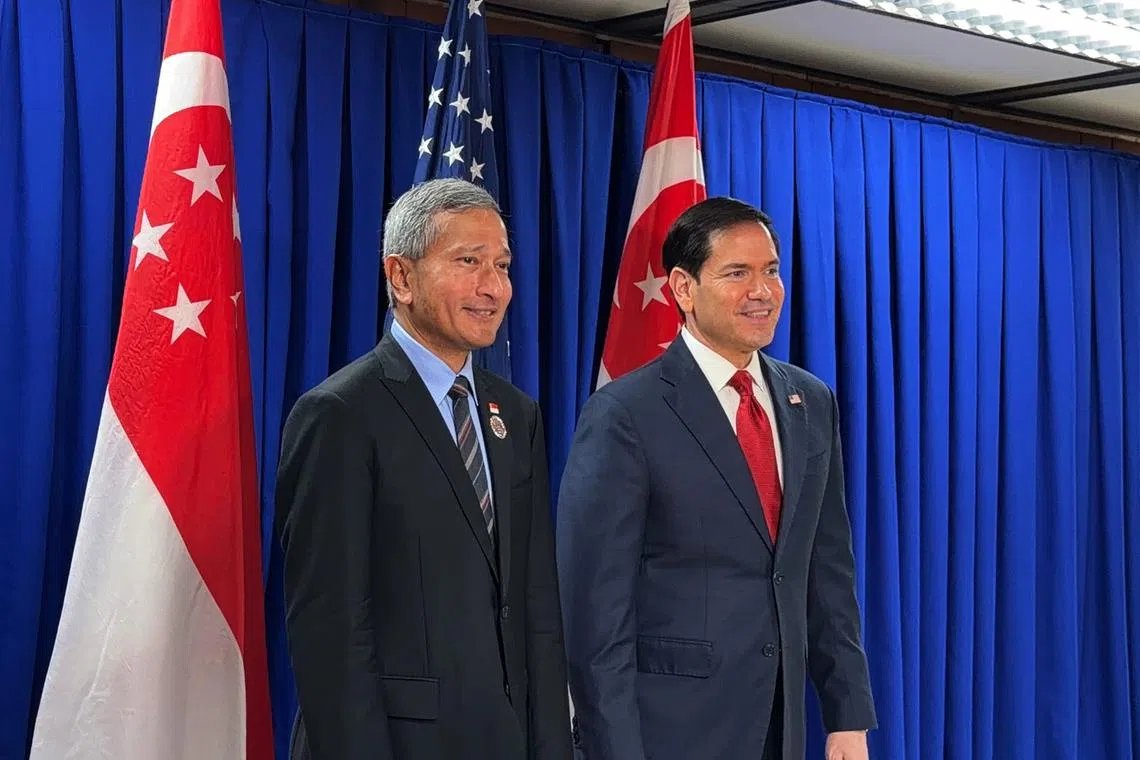
MANILA – Singapore is trying to make the point to the United States that it is “not a target” of Washington’s tariff policy, and to avoid becoming collateral damage as the Trump administration raises tariffs on trading partners around the world, Foreign Minister Vivian Balakrishnan said on July 23.Speaking to Singapore media after wrapping up a week of meetings at the ASEAN Foreign Ministers’ Meeting in Manila, Balakrishnan said he had raised the matter during a bilateral meeting with US Secretary of State Marco Rubio.“You know as well as I do that the American administration, for its own domestic political reasons, needs to raise tariff revenue. I’m not going to give you details of my discussion, but I am trying to find a way to make the point that Singapore is not a target of the US – not at all,” he said, adding that they had a “good, candid and honest-to-goodness discussion”.“He understands us, he knows Singapore, and he’s obviously someone who’s got wide experience in both diplomacy and economics. I made the point quite categorically that the US has a trade surplus against us, and in fact it is growing, and on that basis, there really is no technical or economic basis to impose tariffs upon us.”The discussion came a day before the expiry of the Trump administration’s temporary 10 per cent across-the-board import surcharge, after which Washington is expected to roll out new global tariff measures.The Trump administration has signalled that more targeted tariffs under Section 301 could follow, authorising duties against countries found to have engaged in unfair trade practices following an investigation. Singapore has rejected suggestions that it engages in unfair trade practices, including the use of forced labour in supply chains, and has told the US that it does not condone such practices.Beyond Singapore’s discussions with Washington, Balakrishnan said the uncertainty over US tariffs has reinforced the need for ASEAN to deepen economic integration and enhance its resilience.Asked about Singapore’s priorities when it assumes the ASEAN chairmanship in 2027, he pointed to three broad themes: maintaining ASEAN centrality, building resilience and strengthening regional integration.Despite growing rivalry between Washington and Beijing, Balakrishnan said both powers had approached this week’s meetings in a “careful, deliberate and constructive way”. “To their credit, both of them are trying to approach this in a careful, deliberate and constructive way,” he said.He welcomed the fact that neither side had sought to force ASEAN countries to choose between them, saying both understood that the region’s priorities remained economic development, access to technology and free trade. “This is a time to be careful. This is a time to work together. This is a time, particularly for the middle powers and the rest of us in ASEAN, to affirm international law, the habits of cooperation, to work on the basis of multilateralism, and not to resort to unilateral or coercive measures,” Balakrishnan said.He credited Philippine President Ferdinand Marcos Jr and Foreign Secretary Ma. Theresa Lazaro for steering the grouping through what he described as “quite a tumultuous period” marked by war, supply chain disruptions and contestation between major powers. “The best way to enhance resilience is to work together, integrate our economies, to make sure that we do not panic and we do not put obstacles or restrictions in each other’s way,” he said.Myanmar’s Suu Kyi not a bargaining chipAmong the most difficult issues discussed during the week was Myanmar, where ASEAN continues to insist that any change in the regional grouping’s engagement with the military authorities must be tied to measurable progress under the Five-Point Consensus peace plan. Balakrishnan said those benchmarks included reducing or ending violence against civilians and vulnerable groups, releasing political prisoners and ensuring that humanitarian assistance reaches all those in need, regardless of political affiliation. Asked whether detained former Myanmar leader Aung San Suu Kyi risked being used as a political bargaining chip, he rejected the characterisation. “She’s not a chip to be bargained over,” he said. “She’s the leader of a political party which clearly enjoys significant support in Myanmar.”Balakrishnan said Suu Kyi’s release should be seen as a means to enable reconciliation rather than an end in itself.“The purpose of the release is not just release for release’s sake, but in order to enable honest-to-goodness conversations, reconciliation and a solution that is Myanmar led and owned by the Myanmar people themselves,” he added.Asked whether ASEAN had seen enough progress to justify adjusting its approach, Balakrishnan was unequivocal.“If you ask me, has there been significant progress? Not enough progress, and certainly no progress since last week. So let’s not be premature.” He also cautioned against defining progress too narrowly through access to Suu Kyi alone, saying the larger test was whether violence had stopped, reconciliation had begun and political prisoners had been released.Myanmar remained a tragedy, he said, but ASEAN also needed to devote its political attention to other urgent challenges and opportunities. “We really need to focus our bandwidth, our minds and our political capital on creating the future, and not being stuck repeating yesterday’s wars, and winding up hostility and grievances for which there’s no easy solution,” he said.Beyond Myanmar, Balakrishnan said events further afield – including conflict in the Middle East– had reinforced ASEAN’s need to strengthen its energy resilience.While ASEAN had little influence over when or how the conflict would be resolved, he said the region had considerable untapped potential in solar, wind, geothermal, oil and gas that could make it more secure and less vulnerable to external shocks.These, he noted, require “investment, capital and technology in order to bring to fruition” – and recent events have raised that sense of urgency.Balakrishnan cited the ASEAN Power Grid as a key project, saying it was about more than laying cables, settling fees or addressing technical concerns. “It is to create a sense that we are all better off if we can engage in collective investments, in raising our capacity,” he said. “It makes us more resilient. It makes us more competitive, and it better prepares us for the future.” The opportunity and need had long been present, he added, but recent events have raised the pressure on ASEAN to turn plans into action. “The challenge is execution,” he said.On July 21, the ASEAN foreign ministers issued a joint statement expressing concern over renewed hostilities and called for the reopening of the Strait of Hormuz.The ministers will gather on July 24 to commemorate the 50th anniversary of the Treaty of Amity and Cooperation, the landmark pact that enshrined ASEAN’s principles of mutual respect, non-interference and the peaceful settlement of disputes.
Singapore seeks to avoid becoming collateral damage from US tariffs: Vivian Balakrishnan
Full Article
Original Source
Read the full article at Straitstimes →KhanList aggregates and links to publicly available news content. We do not host full articles from third-party sources. Always verify important information with original sources.