
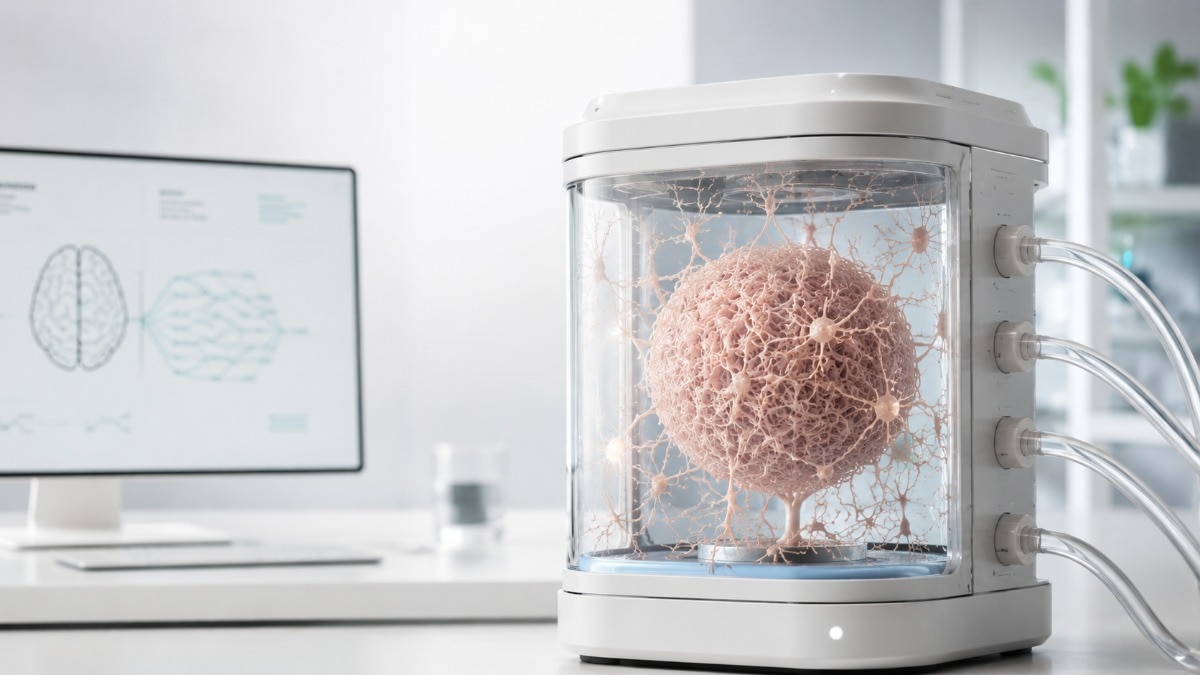
Singapore is testing a new kind of data centre that uses living human brain cells to power computing. The project aims to explore whether biological cells could make future computing more efficient.Singapore is testing a new data centre that uses living human brain cells for computing. (Representative image created using AI)AI is getting better at mimicking the way humans think, but the computers running it are still very much machines. They get their power from silicon chips made by companies like Nvidia. These chips process information using electronic circuits, a bit like how neurons in the human brain process information. However, a Singapore-based team is now working on using living human brain cells as part of the computer itself.The prototype of this supercomputer has been developed by the Yong Loo Lin School of Medicine at the National University of Singapore (NUS Medicine), data-centre operator DayOne and Australian biological computing company Cortical Labs. The team has put living human neurons into a server rack, with NUS calling the 20-unit setup the world’s first independently operated biological server rack.How does a computer made of brain cells actually work?The system has 20 CL1 units, all fitted into one server rack at the NUS Life Sciences Institute. Each unit contains around 800,000 lab-grown human neurons, so the entire rack has roughly 16 million neurons. These neurons act as the system’s biological processors. They receive electrical signals, process information and send signals back to the computer, allowing the system to learn and adapt in a way similar to the human brain.But how does the team actually put human neurons into a computer? Cortical Labs grows the neurons from human stem cells and places them on a silicon platform fitted with tiny electrodes. These electrodes can send electrical signals to the neurons and record the signals they send back. The neurons are then connected to Cortical Labs' biological intelligence operating system, or biOS. The software creates a feedback loop between the computer and the neurons. It sends information to the neurons, the neurons respond, and their responses are sent back to the computer. This allows the living cells to respond to information and learn from it rather than simply following a fixed set of instructions.Silicon processor vs biological computing A regular computer uses silicon chips to process information through electronic circuits and transistors. However the system working on living human brain cells works differently because living human neurons do some of the processing. The idea is to use the neurons’ ability to respond to signals and learn, much like they do in the human brain. But there is one challenge. These computer components are living cells, so they need a life-support system to stay alive. To keep them living, the CL1 has a built-in system to keep the neurons healthy, and Cortical Labs says they can survive for up to six months. At the Singapore facility, technicians feed the cells every three days with sugar, nutrients and pH buffers. The system also supplies oxygen, carbon dioxide and nitrogen to keep the neurons alive.Why put brain cells in a data centre?One of the main reasons is power efficiency. The human brain can handle a lot of information while using very little energy. Researchers want to find out if living neurons can do some computing tasks while using less power than traditional computer chips.Cortical Labs says its CL1 systems could also be useful when there isn't enough data to train an AI system or when things keep changing. This could be helpful in areas such as humanoid robots, cybersecurity and fraud detection, where computers need to learn and adapt quickly.The technology could also be used for drug discovery, medical research and studying brain diseases. Researchers hope it could help them better understand how human neurons learn and adapt.- EndsPublished By: Divya BhatiPublished On: Aug 24, 2026 12:21 IST
Singapore is building supercomputer that runs on human brain cells
Full Article
Original Source
Read the full article at Indiatoday →KhanList aggregates and links to publicly available news content. We do not host full articles from third-party sources. Always verify important information with original sources.