
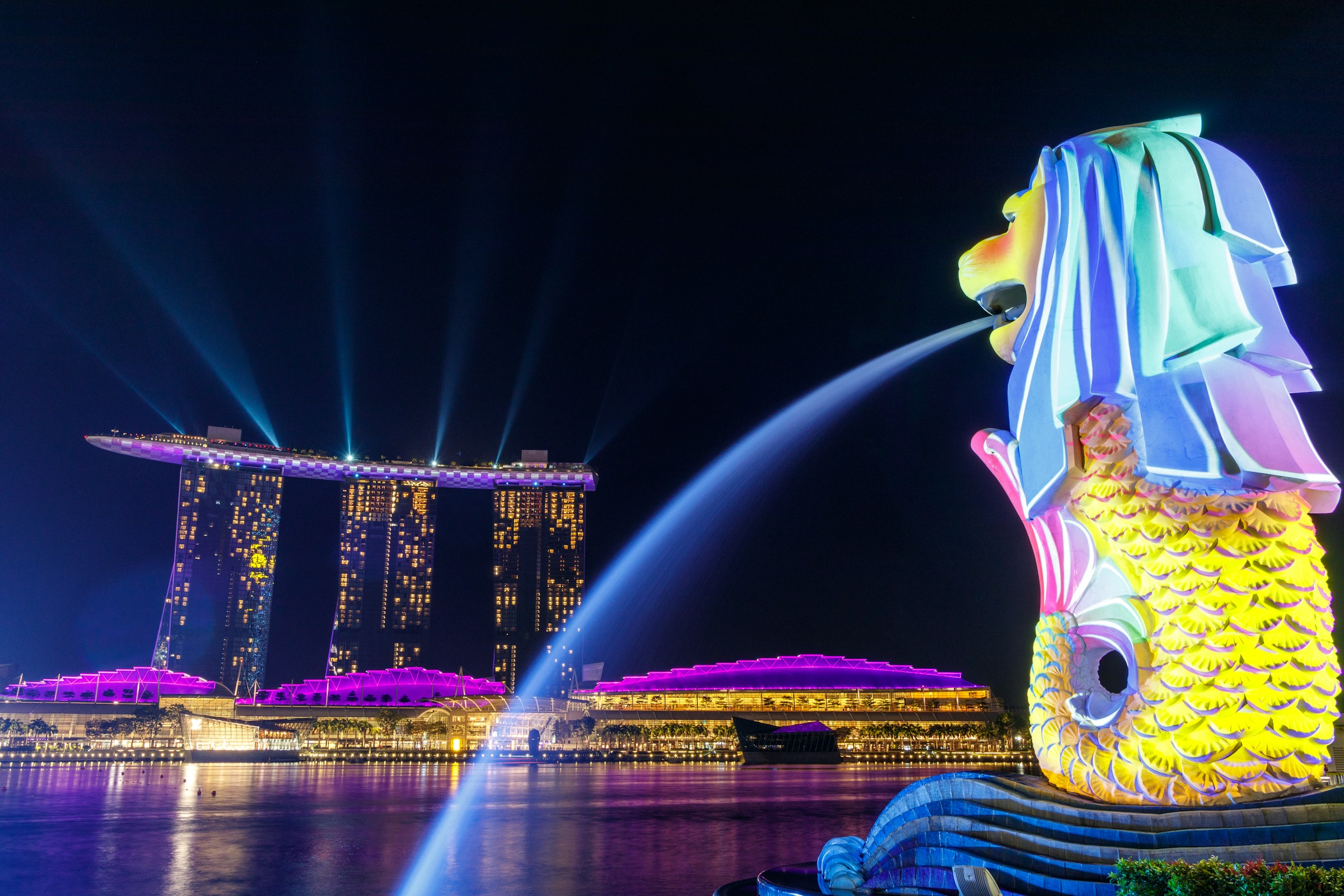
Demand for electricity in Singapore could increase to one-and-a-half times its current peak by 2031.To meet this need, the city-state is working to import clean power from neighboring countries.Costs, regulation and a potential diplomatic standoff with Indonesia have delayed the plans. SINGAPORE — With Singapore’s appetite for electricity expected to balloon by as much as half its current peak demand by 2031, the country is turning to its neighbors to pipe in clean power — in part to keep its data centers humming and support the uptake of electric vehicles. The city-state, which has little room to spare for large-scale power generators of virtually any type, has inked agreements to import electricity from Indonesia, Malaysia and Vietnam, and even as far afield as Australia. Singapore aims to reach net-zero carbon emissions by the middle of the century. In early 2025, the government said it would reduce the contribution of gas to its power-generating mix to 50% by 2035 — down from 95% currently. Singapore’s Energy Market Authority has granted conditional approval to several companies, most recently in 2024, to import a total of 3.4 gigawatts of low-carbon electricity from Indonesia by the middle of the next decade, a quarter of what Singapore estimates it will need by then. Now, those plans hang in the balance after Indonesia said it will not allow them to go ahead. There appears to be an intensifying diplomatic standoff, in part, over haze and energy. Singapore has let its frustration with the transboundary haze from its larger neighbor known. In late October, National Environment Agency publicly called on 10 Singapore-based plantation companies to take action regarding possible fires on their Indonesian concessions. The move came just over a week after Prime Minister Lawrence Wong indicated the city-state was considering legal action against companies it deems responsible for the haze. Haze is seen over Singapore on Oct. 17, 2026. Image by Gabrielle See for Mongabay. Indonesia has shot back, encouraging umrah pilgrims to avoid Singapore on their way to Mecca, while also reining in energy exports to secure supplies at home. Its decision to reduce gas exports to Singapore prompted a visit from Singapore’s foreign minister, Vivian Balakrishnan, to meet with Indonesia’s President Prabowo Subianto. Referring to Singapore’s diplomatic efforts, Frank Phuan, CEO of clean energy company Equator Renewables Asia (ERA), said he wonders whether both sides may similarly team up to find a solution to the impasse over electricity exports. “There’s a task force being set up for the fighting of the haze and the fires,” Phuan told Mongabay in an interview in Singapore in late October. “I think that is a good sign in terms of governmental relations. “I am hopeful that a task force will be set up for the purpose of energy exports, too.” In May, ERA got final approval — a three-year process that included public hearings — to begin laying the 50 kilometers (31 miles) of high-voltage direct-current cable across the Singapore Strait. Now, that’s on hold, Phuan said. Securing approval for electricity exports to go ahead likely hinges on deciding an export surcharge, calculated separately from generating and transmission costs, in addition to taxes that power producers would need to pay, he added. “It’s going to be some sort of a benefit to Indonesia, right?” Phuan said. “But how is that price being calculated? Is it inclusive of all sorts of transmission charges or just pure generation?” On Nov. 2, Bahlil Lahadalia, Indonesia’s minister for energy and mineral resources, indicated the country is holding out for a higher export price. “As long as the price is right and meets our price, then [that’s] probably fine,” Bahlil said, referring to the electricity exports, according to local media. “But if the price isn’t right, then we will prioritize domestic needs.” A group of workers installs solar panels on the roof of a warehouse near Jurong Island in Singapore, October 2025. Image by AP Photo/Anton L. Delgado. Spiraling demand At stake for Singapore is the need to meet a spiraling demand for power, which is expected to rise by more than half the current requirement to a peak of 13 GW in the next five years. In September 2023 and then again a year later, Singapore’s Energy Market Authority, its electricity and gas regulator, announced conditional approval for four consortia to import low-carbon electricity. The announcement was made at the Indonesia Sustainability Forum, an annual green investment conference, in Jakarta. ERA, a spinoff of Portugal-based EDP Renewables APAC, has secured approval to export 400 MW of electricity out of an eventual 2.2 GW in solar generating capacity and another 3.2 GW to build out a battery energy storage system. In March, the company secured $50 million Singapore dollars ($39 million) in funding to start construction. Other investors and joint ventures that have secured conditional authorization to import low-carbon electricity from Indonesia include electricity generator PacificLight Power and one of Indonesia’s largest consumer conglomerates, Salim Group, which secured the conditional approval to import 600 MW; as well as TotalEnergies of France and plantation giant Royal Golden Eagle, which got a provisional nod to pipe in 1 GW of power. Singapore is dramatically expanding its data center capacity following the end of a three-year moratorium on construction that lifted in early 2022. In August, the Singapore Economic Development Board (EDB), which promotes investment, and the Infocomm Media Development Authority, the telecommunications regulator, approved applications that would expand the country’s data center power consumption by nearly 15%. Solar panels installed in Sumba Island, Indonesia. While experts have said that pace is unlikely, there has been progress, including the rollout of 14 projects valued at $7.6 billion that will — on their own — more than triple how much electricity Indonesia generates from solar-generating capacity. Image by Asian Development Bank via Flickr (CC BY-NC-ND 2.0). The country is banning vehicles powered solely by internal combustion engines by 2030 and providing incentives for EVs. During the first 10 months of the year, EVs accounted for more than 60% of new vehicle registrations. A higher export price for the electricity may help Indonesia finance expanding its own generating capacity, including for renewables, at a time when the archipelago country is eager to wean itself off international energy markets, Mutya Yustika, a Jakarta-based researcher at the Institute for Energy Economics and Financial Analysis, told Mongabay. The Prabowo administration has proposed building 100 GW of solar energy generating capacity in the coming years before the end of the decade. While experts have said that pace is unlikely, there has been progress, including the rollout of 14 projects valued at $7.6 billion that will — on their own — more than triple how much electricity Indonesia generates from solar-generating capacity. Media reports suggest Indonesia’s annual revenues from electricity exports could reach $1.1 billion. In March 2023, when the previous administration of Joko Widodo first agreed to explore exporting electricity from renewable sources to Singapore, senior officials mused that the total investment into solar panel factories, the supporting grid, the solar arrays and subsea cable, spanning dozens of kilometers, may amount to $50 billion. “With the 100 GW target, actually the export [of] electricity will help Indonesia to achieve that huge target while fulfilling domestic demand,” Mutya said. The country is banning vehicles powered solely by internal combustion engines by 2030 and providing incentives for EVs. Image by The Transport Enthusiast DC via Unsplash. Risk and reward Exports are one of the few energy segments where renewables have found a toehold in Indonesia. In 2025, Indonesia’s electricity generating capacity from solar energy was 1.5 GW, while in Vietnam it was more than 19 GW, according to data from the International Renewable Energy Agency. Singapore has struck similar provisional agreements to import more than 4 GW of low-carbon electricity including from Australia and Malaysia, where tough competition from renewable energy producers has driven down costs. In early 2025, in a fifth round of a competitive auction in Malaysia to build utility-scale solar farms, the winning bids committed producers to tariffs ranging from 13.75 Malaysian sen (3.4 US cents) to 18 Malaysian sen (4 US cents) — about a third of the average national production cost of electricity in Indonesia. In 2021, PLN, Indonesia’s state electricity company, agreed to buy electricity from a UAE-backed solar project, Cirata, at a reported tariff of 5.8 US cents. Despite the regulatory headaches, Phuan said Indonesia still represents a compelling, if risky, opportunity: Low penetration of renewables suggests there is plenty of room to grow. As generating costs for renewables and storage fall, Phuan said companies like ERA will be well placed in Indonesia when that time comes. “Solar and storage has been reducing in cost year on year to the extent that, even in a subsidized market, you can actually make some money,” he said. “I can make good returns. I think that an inflection point is here.” Banner image: Lights shine on the Merlion as it overlooks Singapore’s Marina Bay Sands, 2019. Image by Joshua Ang via Unsplash. Cite this articleJeff Hutton (2026). Singapore investors hope for diplomatic help after Indonesia halts $50b electricity export push. Mongabay Conservation news. DOI: https://doi.org/10.66709/news-335984 Credits Topics
Singapore investors hope for diplomatic help after Indonesia halts $50b electricity export push
Full Article
Original Source
Read the full article at News →KhanList aggregates and links to publicly available news content. We do not host full articles from third-party sources. Always verify important information with original sources.