
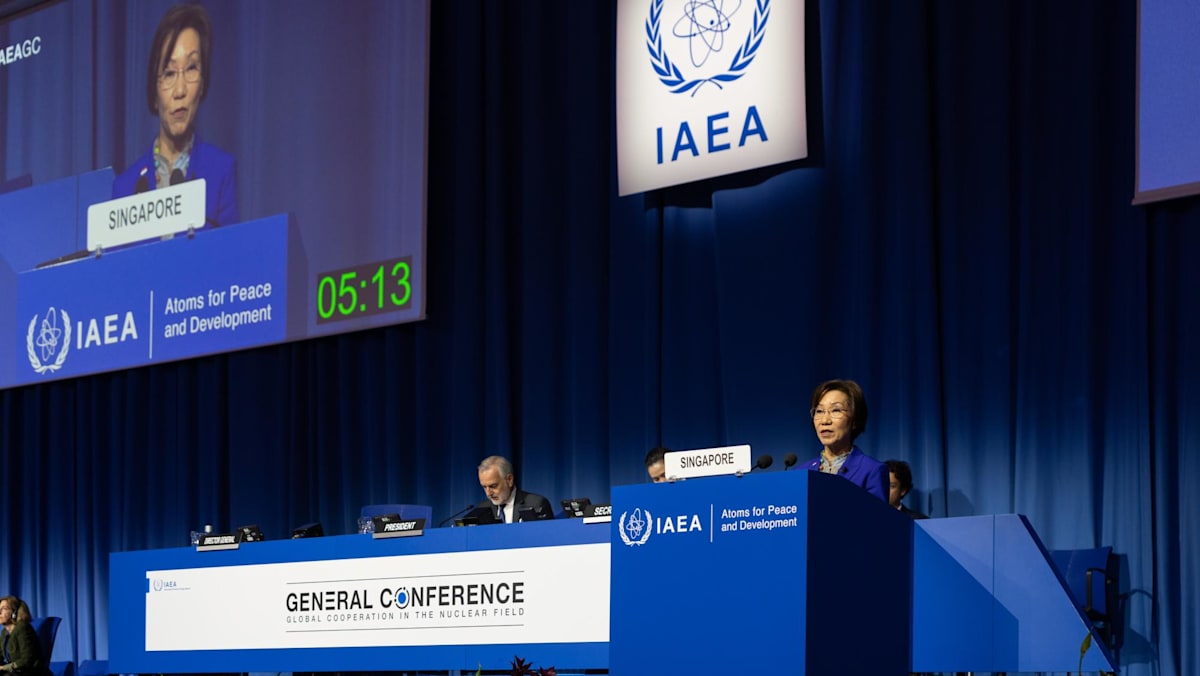
Singapore Any decision will weigh safety, environmental sustainability, economic viability and public confidence, among other considerations, says the Minister for Sustainability and the Environment. Minister for Sustainability and the Environment and Minister-in-charge of Trade Relations Grace Fu delivers Singapore's National Statement on Sep 14, 2026, at the 70th IAEA General Conference in Vienna, Austria. (Photo: Ministry of Sustainability and the Environment) New: You can now listen to articles. This audio is generated by an AI tool. SINGAPORE: Singapore is approaching nuclear energy with an open mind while recognising its constraints as a small and densely populated city-state, the Minister for Sustainability and the Environment Grace Fu said on Monday (Sep 14).Representing Singapore at the International Atomic Energy Agency (IAEA) General Conference in Vienna, Ms Fu said the country, in looking at possible pathways to meet its long-term climate and energy goals, is studying whether nuclear energy could be viable and is building its capabilities to assess advanced nuclear technologies, including small modular reactors."We approach this with an open mind, but also with a clear recognition of our circumstances as a small, densely populated, and alternative energy disadvantaged city-state," she said.Ms Fu said the country’s approach will be "deliberate, structured, and rigorous", with assessments covering nuclear safety, security and safeguards, environmental sustainability, economic viability, public confidence and Singapore's international obligations. Before any decision is made, Singapore must have the scientific, technical, institutional and regulatory capabilities needed to evaluate reactor technologies objectively, she said.To that end, Singapore is steadily developing these capabilities across government, research institutions and its regulatory system, while also strengthening cooperation with nuclear regulators and international partners to learn from their approaches to governance, regulation and safety.As part of this process, Singapore will embark on the first of three phases of a nuclear readiness review - known as an Integrated Nuclear Infrastructure Review (INIR) with the IAEA in 2027.The review will allow Singapore to benchmark its capabilities against the IAEA's milestones approach, assess the country’s readiness to make an informed decision on deploying nuclear energy, and identify areas that require further development. "The INIR mission is not a commitment to adopt nuclear energy. But it is a way to help determine whether Singapore has the expertise, institutions, and frameworks to make an informed decision," said Ms Fu, who is also Minister-in-charge of Trade Relations.She said regional cooperation would become more important as interest in nuclear energy and other nuclear applications grows across Southeast Asia.As such, Singapore will work with ASEAN member states and the IAEA to strengthen emergency preparedness and response, put regional protocols into operation, expand radiation monitoring networks and information-sharing arrangements, and conduct readiness exercises.“These efforts build confidence, improve coordination, and strengthen the region's ability to respond to a nuclear or radiological emergency,” said Ms Fu, adding that Singapore welcomes the strengthening of regional cooperation through the proposed ASEAN-IAEA strategic partnership on nuclear energy, safety, and governance.Beyond its consideration of nuclear energy, Singapore believes that building human capital, institutional capabilities and technical expertise is essential for the effective and sustainable application of nuclear science and technology, Ms Fu said.It has partnered with the IAEA since 2000 through the Singapore-IAEA Third Country Training Programme to share expertise and strengthen capabilities in the region in areas including nuclear medicine, radiotherapy, radiation protection, accelerator applications, radiochemistry, environmental monitoring and climate-related measurements. “We are a long-standing supporter of the Technical Cooperation Programme in helping member states harness nuclear science and technology for development,” said Ms Fu.“We have once again pledged our full TC Fund target share for 2027. We urge all member states to pay their contributions in full and on time.”Ms Fu said Singapore remains “gravely concerned” over nuclear safety and security amid conflicts in Ukraine and the Middle East.“Any attack on nuclear power plants will pose significant and undeniable risks to nuclear safety,” she said.“We urge all parties to respect the seven indispensable pillars and refrain from actions that could compromise nuclear safety and security of nuclear energy facilities devoted to peaceful purposes.”Singapore also remains concerned by "unresolved issues surrounding Iran’s compliance" with its legally binding safeguards obligations, Ms Fu said, adding that any nuclear material not accounted for presents a proliferation risk.She said that Singapore also continues to be concerned by North Korea’s "unconstrained development of its nuclear weapons and ballistic missile programmes", given the considerable risks these pose to regional and global peace, security, and stability.As Singapore assumes the ASEAN chairmanship in January 2027, the country looks forward to working with other ASEAN member states and the IAEA to strengthen regional and international cooperation on the safe, secure and peaceful uses of nuclear technology, said Ms Fu.
Singapore approaching nuclear energy with 'open mind' but mindful of constraints: Grace Fu
Full Article
Original Source
Read the full article at Channelnewsasia →KhanList aggregates and links to publicly available news content. We do not host full articles from third-party sources. Always verify important information with original sources.