
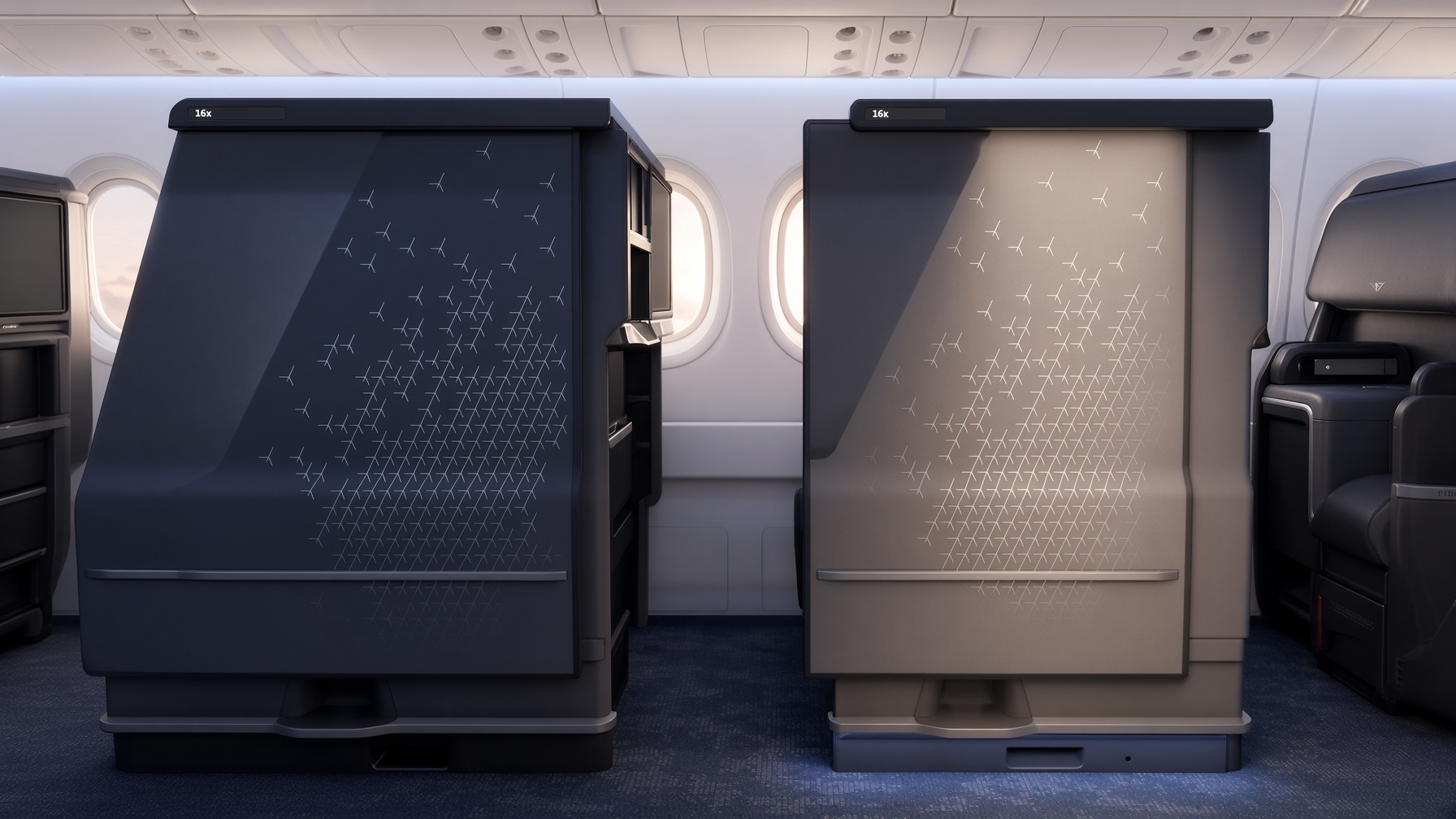
We’re about to finally see the cabins that Singapore Airlines has been developing for eight years. MileLion reports that some top elite Solitaire PPS Club and PPS Club members have been invited to an “exclusive first look” at Marina Bay Sands in Singapore on Saturday, November 7. The event is described as a reveal of the airline’s ‘reimagined travel experience,’ not just a launch of the seat. That should mean new first, business, premium economy and economy cabins, along with the next KrisWorld entertainment system, new dining, amenity kits and soft goods. The first refitted aircraft is now due in the first quarter of 2027, and that one will not have first class. This Is The Boeing 777-9 Product, Moved Onto The Airbus A350 Singapore ordered its first 20 Boeing 777-9s in 2017, when deliveries were expected in 2021 or 2022. CEO Goh Choon Phong discussed the cabin program in March 2018 and promised a “quantum leap” in first class. I wrote in 2019 that Singapore expected the new seats in 2022. By 2021, Singapore Airlines inflight design chief Betty Wong said the basic designs, footprints and configurations had been signed off after focus groups and physical mock-ups. I wrote then that the anticipated debut had moved to 2024. Neither happened, because the 777-9 did not happen. Boeing has repeatedly delayed the airplane. Singapore Airlines increased its order to 31 aircraft in 2021, but it’s not yet clear when certification will happen and it will receive the first one. In November 2024 the carrier created a Plan B: spend S$1.1 billion retrofitting 41 long-haul Airbus A350s with the same new first and business class designs intended for the 777-9. The airline originally planned to put the first refitted conventional A350 into service in the second quarter of 2026, followed by its first A350-900ULR in the first quarter of 2027. Supply chain problems and delayed certification of one of the new seats pushed that A350 to the first quarter of 2027. Singapore Airlines has withdrawn the ULR date. What Changes On Each Plane Here’s how the program appears to break down across aircraft: 34 standard long-haul A350-900s go from 42 business, 24 premium economy and 187 economy seats to 42 business, 24 premium economy and 192 economy seats. No first class. The business seat is new. Seven A350-900ULRs go from 67 business and 94 premium economy seats to four first, 70 business and 58 premium economy seats. Total capacity falls from 161 to 132, an 18% reduction. These are the airplanes that will put first class on Singapore’s nonstop U.S. flights. 31 future 777-9s will receive the same first and business class designs, plus all-new premium economy and economy products. The airline’s other 24 medium-haul A350s are not included. Neither are its current A380, 777-300ER, 787-10 or 737 cabins. The A380 will get Starlink but not these seats. On the 777-9 I expect 3-4-3 economy. That would end Singapore’s unusually generous nine-across 777 coach cabin. The 777-9 is wider, but probably not wide enough to preserve current seat width. First Class: What The Patent Suggests Singapore’s official teaser shows a suite spanning three windows, with high walls, louvred double doors, electronic window shades and a large monitor. The most revealing material is in a Singapore Airlines patent application filed in June 2022 and published in January 2024. It is a utility patent covering a cabin architecture and seat mechanisms. But its curved louvred doors match the official teaser closely enough that it’s the best evidence of what Singapore was developing. The illustrated cabin has six suites: four along the windows and a center pair. Curved walls create staggered doorways rather than two doors opening directly across a narrow aisle. The center suites have a full-height, three-panel divider that retracts horizontally into the wall. Open it completely and the two compartments become one room, with a double bed or sofa and unobstructed movement between them. The ottomans provide guest seating and storage, and the filing contemplates four people dining together in the joined suite. Illustrative six-suite Singapore Airlines patent application There’s a discussion in the patent of older products that’s being misread as the new invention. This is not a separate chair plus a wall-stowed Murphy bed. In Singapore’s design, the chair reclines and folds fully flat, the ottoman extends the sleeping surface, and the center armrests lower to create the double bed. Consistent with what I wrote in 2024, it will not be the current A380 Suite’s separate chair and fold-down bed. My best guess is six first class suites on the 777-9, just as the drawing shows, and four in one 1-2-1 row on the A350 ULR, preserving the center double suite. The A350 configuration is confirmed at four seats. Credit: Singapore Airlines Business Class Looks Like The End Of Singapore’s Biggest Compromise Singapore’s 2013 business class seat is enormous in the shoulders and still looks impressive. It is less impressive in bed mode. Most passengers sleep diagonally into a constrained footwell, and the seat has to be flipped over rather than reclining continuously from upright through lounging to bed. The teaser and the wider rendering in Singapore Airlines’ 2024/25 annual report point to a high-walled, doored, all-forward-facing staggered 1-2-1 cabin. Seats alternate closer to the window and aisle. Passengers should sleep parallel to the aircraft, and the chair appears likely to recline directly into bed. It resembles Safran’s Unity platform. I expect 4K displays, Bluetooth audio, high-power USB-C, wireless charging and much better storage. Singapore has promised new screens in first and business class. Credit: Singapore Airlines The Reveal Is More Than Just Seats Singapore Airlines is also promising its next-generation KrisWorld entertainment platform, greater personalization, improved dining, new amenity kits, and new serviceware. The carrier has separately announced Starlink for the 34 long-haul A350s, seven ULRs and all 12 A380s. Installation will run progressively from the first quarter of 2027 through 2029. There is also a strong clue about the food. I reported last year that Singapore Airlines tendered specifically for farmed caviar in business class. Apparently, business class pajamas are under consideration. The current Le Labo business class amenity kit only dates to late 2024. A more substantial refresh of the aging Lalique first class kit and bedding seems likely. Which Aircraft And Routes Will Get It First The sequence looks like: A standard long-haul A350 should fly first in the first quarter of 2027. It will debut business, premium economy and coach, but no first class. Sydney and London are the obvious candidates. I lean slightly toward Sydney because one aircraft can operate a daily roundtrip. A daily London flight requires more than one refitted aircraft. SQ306/305’s move to the A350 makes London a likely early route once there is enough fleet coverage. The A350 ULR should follow later in 2027. Los Angeles remains the best first-route guess because the three-times-weekly SQ35/36 pattern can be dedicated to one airplane, while daily JFK and Newark service requires more aircraft. Eventually all seven ULRs get first class for nonstop U.S. flying. The 777-9 comes later. Boeing now targets the first delivery to any airline in 2027, and Singapore is behind launch customers. A Singapore-bound test airframe has begun flying, but the airline has not promised a delivery date. 2028 seems most likely. I expect the patent’s six-suite first cabin and roughly 50 to 60 business seats, with Sydney, London, Tokyo or Hong Kong among the likely early routes. The 777-9s are meant to replace aging 777-300ERs and eventually some A380 flying. I don’t expect Singapore to spend heavily putting these seats into the old 777s, and the A380 only finished its last interior retrofit in 2023. Topics on this page
Singapore Airlines Will Finally Reveal Its New Cabins In November—Patent Hints At A True Double Suite
Full Article
Original Source
Read the full article at Viewfromthewing →KhanList aggregates and links to publicly available news content. We do not host full articles from third-party sources. Always verify important information with original sources.