
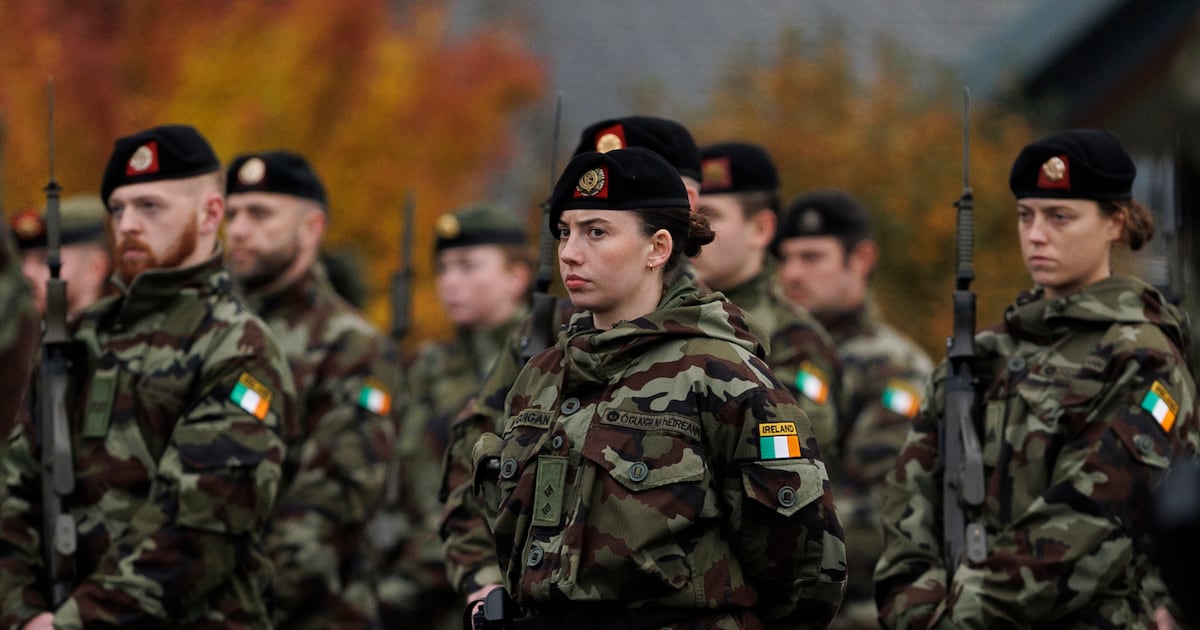
Minister of State for European Affairs and Defence Thomas Byrne is annoyed with us. Telling reporters recently that the public’s lack of understanding around the triple lock is “quite shocking”, he suggested the debate had been “characterised by misinformation”. The Dáil had been brought to new lows, he added, by Sinn Féin suggesting that Irish soldiers could participate as combat participants in foreign wars. Mary Lou McDonald, he suggested, had “plenty of time to read the legislation.” The confusion is understandable – given that the Government’s own ministers have done nothing to clarify it. Jack Chambers later similarly responded to McDonald by stating that Ireland is not joining Nato; there is no mandate for a military alliance; and Russia and China shouldn’t get to decide on Irish affairs. While this is all true, none of this answers the questions actually being asked.What the new Bill allows is what Defence Minister Helen McEntee has already told us: that Irish troops could join the new EU mission in Lebanon in a “force protection” capacity, including both peacekeeping and peace enforcement. While the Government maintains that it will stay out of Nato, it failed to elaborate on what kind of expanded military involvement this new legislation will allow. The Government needs to move beyond cries of disinformation or refuting an alliance with Nato to actually explain which of these activities it is proposing Ireland should undertake.READ MORE The Government has been quick to remove the constraints on where our forces can be deployed, but it has failed to articulate what national purpose or goals that these future deployments should serve. Before dismantling the triple lock safeguard, it should have first established the principles and boundaries to replace it.[ Nine Fianna Fáil TDs back O’Dea’s triple lock legislation amendmentOpens in new window ]Ministers repeatedly assure us that Ireland will remain militarily neutral. However the Government’s own understanding of neutrality seems to be evolving, at the same time it insists that nothing is changing. Since Russia invaded Ukraine, Ireland has maintained the position that it is militarily, but not politically, neutral. It has trained Ukrainian soldiers in tactical combat by way of an EU mission; contributed to European mechanisms supporting Ukraine’s defence; and is now discussing potential co-production of drones with Kyiv for maritime security. It is trying to create increased participation in future international military deployments by removing UN authorisations, as the European bloc moves towards a military industrial economy. None of these makes Ireland a military ally or a participant, of course. But together, they amount to a deeper integration into global defence and security co-operation. What we don’t know is whether this new, undefined neutrality is the same as the old undefined neutrality. Does it permit Irish soldiers to serve in a multinational force whose mandate involves coercive military action? Neutrality, by way of Irish national identity, needs to mean something operationally – if for no other reason than to give us a yardstick by which to later judge the Government’s decisions. Sovereignty is the rationale for getting rid of the triple lock because this mechanism is what gives foreign powers the ability to determine Irish troops deployment. There’s truth to this, given the five permanent members of the UN Security Council – the US, Britain, France, Russia and China – have veto powers. But the triple lock is not necessarily a problem of just Russian and Chinese interference – the veto power has also been used by our closest allies. In 2002, the United States vetoed the renewal of the UN mission in Bosnia to give American peacekeepers a blanket exemption from prosecution by the International Criminal Court. The veto has never been a neutral safeguard against geopolitical interference; it is merely an instrument of national interest.[ The triple lock: What is it and why is the Government trying to change it?Opens in new window ]There is a fundamental problem with this definition of sovereignty. It should not just include the freedom of the Government to act without outside constraints; importantly, it should also demand that a State define its own interests and remain accountable to its own citizens for such decisions.Removing the UN requirement may give the Government more discretion over overseas deployments, but freedom for the Government to act doesn’t necessarily mean more sovereignty for the people. In any case, history shows us that sovereignty exercised without meaningful scrutiny does little more than transfer more power to the executive. And right when the nature of security and defence is becoming more complex, Ireland is reducing its ability to scrutinise and govern the use of military power – treating safeguards as obstacles to be overcome.It’s hard to imagine that anybody doesn’t want to create an Ireland that is independent of outside actors. But there is a long list of unanswered questions that will not vanish just because ministers are frustrated by the persistence of the Opposition in asking them. What scrutiny will apply to decisions to deploy Irish troops? Who assesses whether a mission has changed character once troops are deployed? Consider what happened in Somalia, which started as a humanitarian operation and later evolved into peace enforcement before a direct military confrontation. At which stage should that change have required a new political decision applying today’s processes? Who, ultimately, gets to decide when Irish soldiers are no longer doing what they were originally sent to do?These are hard to answer, especially since we have no published threat landscape or overarching defence strategy to determine our national interests. It means that we have no logical way to understand what contribution the Defence Forces should make to international security, outside of ad hoc political decision making – the most dangerous kind.If the Government wants to avoid misinformation, some clarity on the intentionality around such questions would help. After all, these are not just technicalities but the actual substance of democratic power over military force. Deciding to send citizens into a situation where lives could be lost is the most significant power the State can exercise. The public – not just the Opposition – are entitled to not only know who makes that decision, but what guiding principles and accountability apply. Until then, ministers should get used to being annoyed with us and our so-called misunderstandings.
Sinéad O'Sullivan: If the Government wants to end triple lock misinformation, it must answer these questions
Full Article
Original Source
Read the full article at Irishtimes →KhanList aggregates and links to publicly available news content. We do not host full articles from third-party sources. Always verify important information with original sources.