
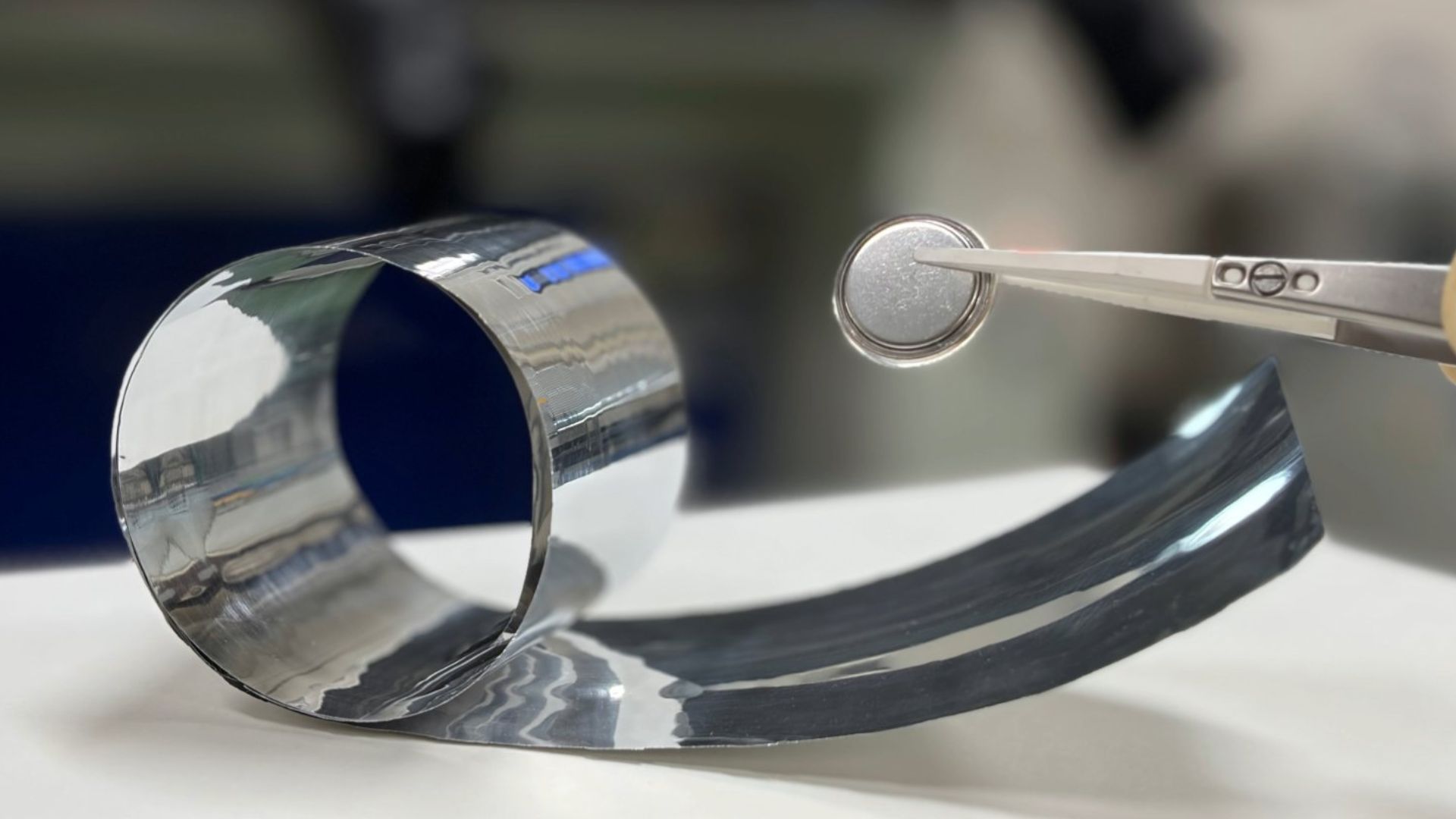
Researchers at Tohoku University and Japanese aluminum manufacturer UACJ Corporation have found a simple way to stop aluminum-foil battery anodes from crumbling during repeated charging cycles. By dissolving a trace amount of manganese directly into pure aluminum, the team stabilized the metal’s internal structure without sacrificing its high energy-storage capacity, tackling a key bottleneck for cheaper, lighter electric vehicle batteries. Conventional lithium-ion batteries rely on copper foil coated with active electrode materials, polymer binders, and conductive additives, a multi-step manufacturing process that adds weight, cost, and energy consumption. Aluminum foil offers an attractive alternative because a single sheet can store lithium ions and conduct electricity, eliminating copper current collectors and slurry-coating steps. Manganese trade-off The study addressed a persistent trade-off that has stalled commercial aluminum anodes. While pure aluminum holds large quantities of lithium, repeated charging and discharging cause severe volume shifts. As lithium ions exit the foil during discharge, a lithium-depleted layer forms at the surface and blocks deeper ions from escaping, forcing microscopic voids and cracks to open throughout the metal while side reactions with the liquid electrolyte build up resistive surface layers. Previously, engineers tried reinforcing aluminum by alloying it with about 1 atomic percent silicon. However, silicon has a high chemical affinity for lithium, which traps ions deep inside the electrode, prevents full discharge, and reduces usable capacity. To avoid that penalty, the Tohoku University and UACJ team tested an aluminum alloy containing just one atomic percent of manganese, an element with low chemical affinity for lithium and high solubility in solid aluminum. Because manganese atoms remain uniformly dissolved and do not readily bond with lithium, they slightly slow lithium diffusion through the bulk metal. That subtle drag suppresses the growth of coarse lithium-aluminum domains and prompts the foil to spontaneously form a dense network of fine internal grain boundaries during battery operation. Rather than trapping ions, those boundaries act as fast transport pathways that allow lithium to enter and exit cleanly while keeping the surrounding aluminum dense and intact. “Our study demonstrates that the internal microstructure of an electrode can be spontaneously optimized during battery operation simply by adding a trace amount of an element with low lithium affinity,” said Yuki Nakata, an assistant professor at Tohoku University’s Institute for Materials Research and co-author of the study. “By harnessing the material’s intrinsic properties without relying on complex, pre-engineered nanostructures, this approach offers a practical, low-cost strategy for designing next-generation electrodes.” Life-cycle gains needed Because the protective microstructure forms naturally during electrochemical cycling rather than requiring expensive nanoscale fabrication, the alloyed foil aligns closely with standard metallurgical rolling processes already used to produce commercial aluminum sheet at industrial scale. Still, the researchers note that additional cycle life gains are needed before aluminum-foil anodes can match the multi-year durability expected in electric vehicles and grid storage. Next, the team plans to refine the alloy composition further and pair the manganese-doped foil with protective surface coatings to curb electrolyte side reactions and push longevity toward commercial thresholds. The findings were published in Communications Material. Get the latest in engineering, tech, space & science - delivered daily to your inbox.Kaif Shaikh is a journalist and writer passionate about turning complex information into clear, impactful stories. His writing covers technology, sustainability, geopolitics, and occasionally fiction. A graduate in Journalism and Mass Communication, his work has appeared in the Times of India and beyond. After a near-fatal experience, Kaif began seeing both stories and silences differently. Outside work, he juggles far too many projects and passions, but always makes time to read, reflect, and hold onto the thread of wonder.
Simple manganese tweak could replace copper foils in next-gen EV batteries
Full Article
Original Source
Read the full article at Interestingengineering →KhanList aggregates and links to publicly available news content. We do not host full articles from third-party sources. Always verify important information with original sources.