
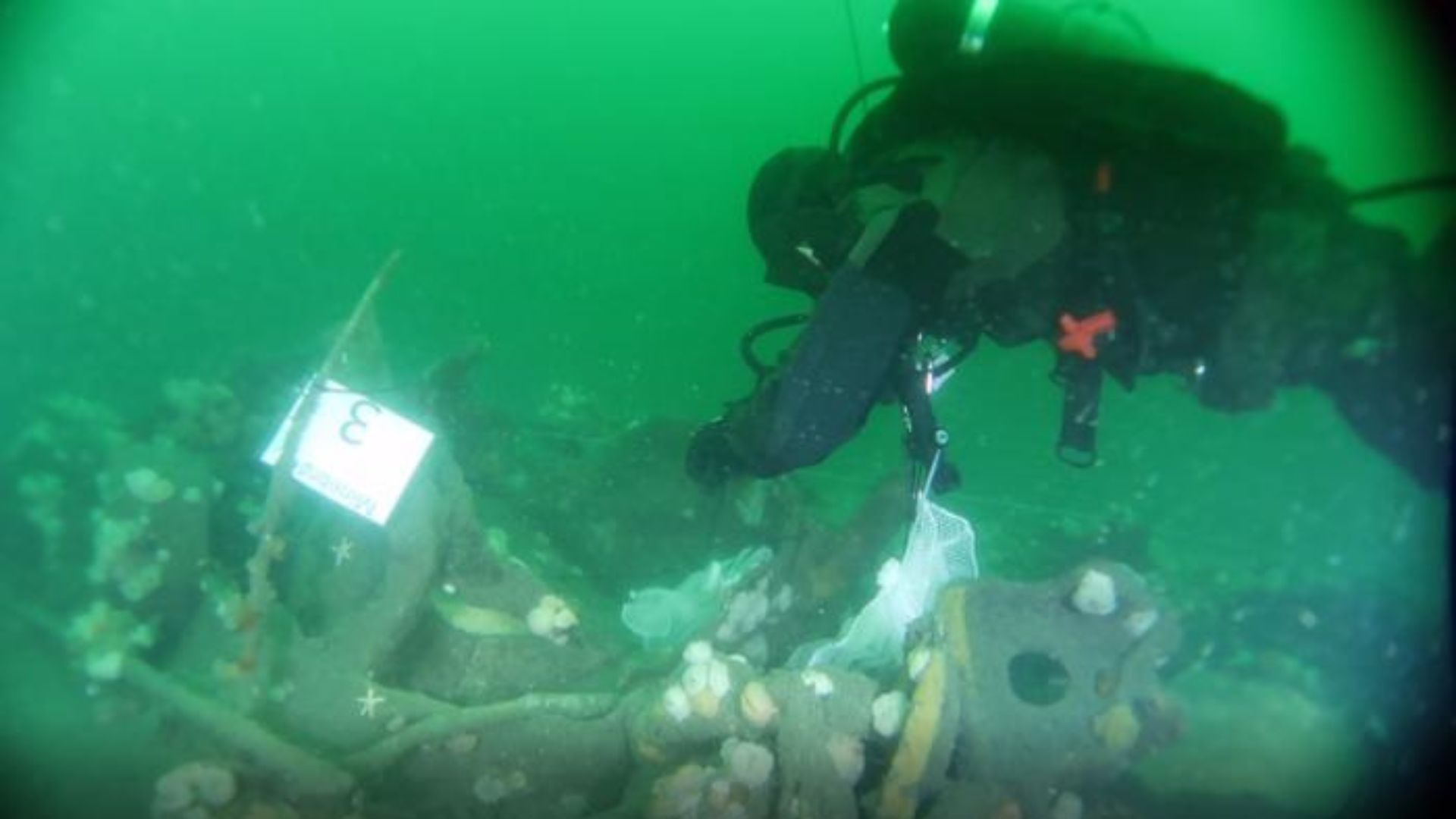
During World War I and II, thousands of ships sank. Settled on the Danish seabed, the German submarine UC-30 stands as a silent reminder of early 20th-century naval history. But beneath its rusting steel hull sits an active environmental threat. In April 1917, the U-boat struck a British mine and sank with 27 men, 18 mines, and six torpedoes onboard. The wreck vanished until 2016. Today, it is leaking. Recent investigations led by Professor Katrine Juul Andresen of Aarhus University revealed that explosive materials inside the submarine are actively contaminating the North Sea. Testing water, sediment, starfish, and mussels around the site uncovered alarming news. “We found traces of TNT in the wildlife, the seabed, and the water column. Pollution is definitely occurring. The question is how significant the effect is and how far from the wreck the pollution impacts the marine environment. It is likely a relatively localized source of pollution, but it will worsen as the wreck continues to deteriorate and expose more of the explosive material inside the mines,” Andresen said. Impacting food web During World War I, control of the North Sea was strategic leverage for both Germany and Britain to enforce trade blockades and starve their enemy into submission. Outmatched in fleet size, Germany depended on submarine warfare to target British shipping, while both nations blanketed the waters with roughly 190,000 underwater mines. This fierce rivalry culminated in the Battle of Jutland, which is regarded as the largest naval clash in history. It left over 25 ships sunk, nearly 10,000 sailors dead, and a seabed littered with hazardous historic wrecks. The problem spans far beyond a single sub. In a 2024 report prepared for the Danish Environmental Protection Agency, Andresen mapped 10,127 shipwrecks in Danish waters alone. Roughly 15 percent date back to the two World Wars. As these iron hulls corrode, exposed explosives break down and dissolve into seawater. Leaking underwater munitions pose a serious ecological and human health threat, primarily through toxic TNT transformation products like 2-ADNT and 4-ADNT, which are both carcinogenic and mutagenic. Bioindicator studies on species near wrecks like UC-30 submarine show that exposure to these chemicals damages vital enzymatic pathways, disrupts cellular metabolism, and induces oxidative stress in marine life. As filter feeders and bottom-dwellers ingest these dissolved toxins, the pollutants bioaccumulate up the marine food web. Excessive presence could threaten commercial fisheries and human food supplies. Challenges of cleanup Germany has allocated significant funding to retrieve submerged WWII munitions and shipwrecks from the Baltic Sea to prevent toxic environmental pollution caused by their degradation. Retrieving and neutralizing these explosives is costly, but controlled underwater detonations can sometimes worsen contamination, depending on local currents and seabed morphology. The researchers state that the lawmakers and experts must therefore weigh these environmental factors, since detonating the munitions in place can cause far more ecological damage than carefully retrieving them. Through the EU-funded REMARCO project, researchers like Katrine Juul Andresen are exploring gentle methods to clear WWII wrecks and submerged munitions, notably experimenting with crawling seabed robots that can map, monitor, and retrieve dangerous items for neutralization. However, active intervention is not always necessary, as buried wrecks pose a significantly lower risk of polluting the surrounding sea. “Some wrecks are fully or partially buried in the seabed. When covered by sand, the risk of polluting the surrounding sea is significantly lower. It is a matter of identifying where the environmental threat is greatest – and then deciding whether the munitions on the wrecks should be removed,” Andresen concluded. The findings were published in the Marine Pollution Bulletin in August. Get the latest in engineering, tech, space & science - delivered daily to your inbox.Mrigakshi is a science journalist who enjoys writing about space exploration, biology, and technological innovations. Her work has been featured in well-known publications including Nature India, Supercluster, The Weather Channel and Astronomy magazine. If you have pitches in mind, please do not hesitate to email her.
Silent leaks: Century-old shipwrecks are leaking toxic chemicals into North Sea
Full Article
Original Source
Read the full article at Interestingengineering →KhanList aggregates and links to publicly available news content. We do not host full articles from third-party sources. Always verify important information with original sources.