
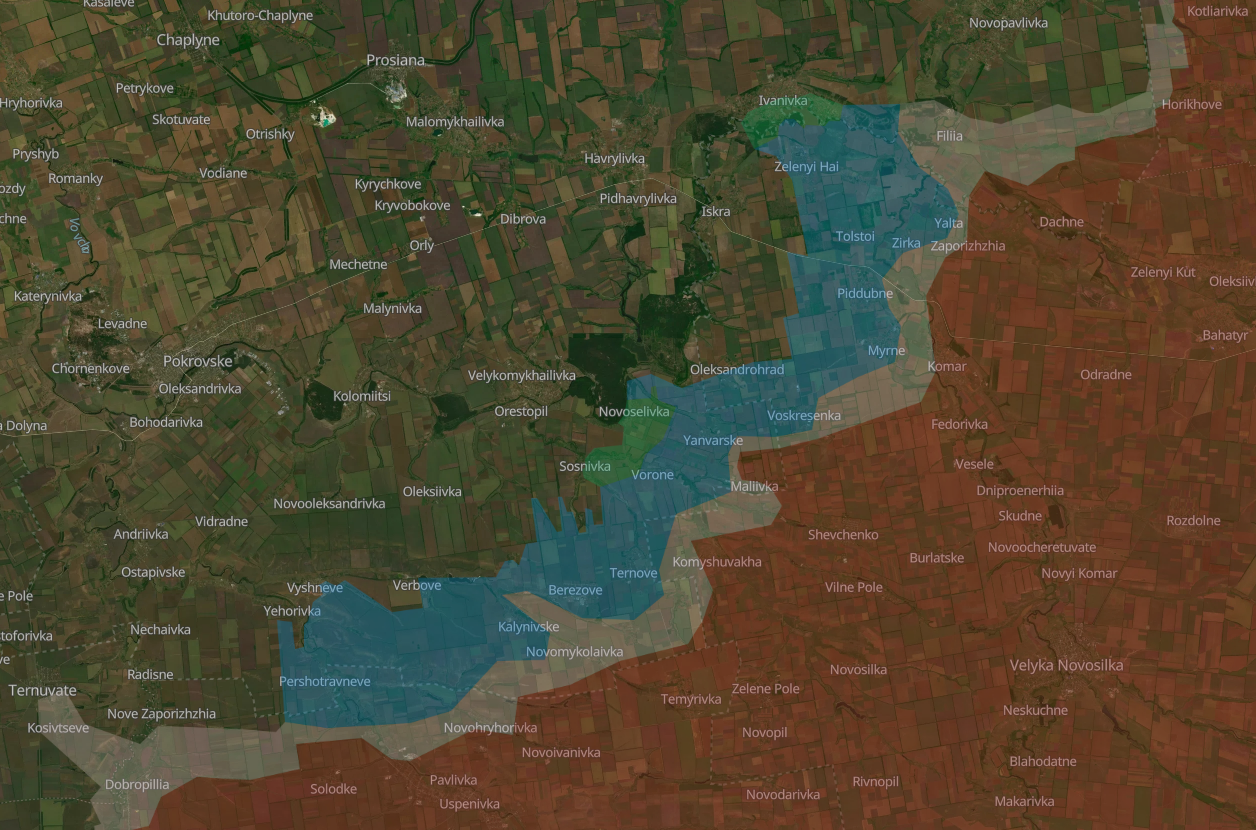
Every day, the Ukraine Battlefield update newsletter offers a clear look at how the war is unfolding on the ground. Subscribe for free here to get the full text delivered to your inbox. Ukrainians reported major advances in the Oleksandrivka direction over the past six months. In terms of area, this is Ukraine’s largest liberation of territory since autumn 2022. There was little discussion of the offensive because both units and analysts observed OPSEC. Ukrainians have stopped publishing details of Russian missile attacks. Ukrainians carried out a major attack on Novorossiysk, also hitting two frigates armed with Kalibr missiles, although the extent of the damage is unclear. Videos of the day: a Russian attack on a train; a recruitment video by Ukraine’s K2 brigade; what a stick and a string can do to a drone. There had long been reports that Ukraine was advancing on one section of the front. In the so-called Oleksandrivka direction, mainly in Dnipropetrovsk oblast, its units were clearing the area of Russian forces. Although some analysts wrote about the advances or partly recorded them on their maps, precise details were not made public. Ukrainian units published only a minimal number of videos of their advance. As French OSINT analyst Clément Molin wrote, the exception was the Skala regiment, which was seeking to cover up its own problems, about which we have repeatedly written. Most independent pro-Ukrainian accounts also respected so-called operational security, or OPSEC. The silence ended on Wednesday. Ukrainian president Volodymyr Zelensky published preliminary results of the operation, which began on 29 January. By Wednesday, Ukrainians had liberated 26 villages and 745 square kilometres of territory in this sector, he said. This is the area between Novopavlivka and Ternuvate, in the Ukrainian direction towards Velyka Novosilka. The Militarnyi website marked all the villages on a map. Most of them are in Dnipropetrovsk oblast, with fewer in Zaporizhzhia and Donetsk oblasts. With perhaps one exception — the village of Dachne — Ukrainians have driven Russian forces out of all villages in Dnipropetrovsk oblast, although some apparently remain part of the grey zone. During the operation, Ukrainians killed 9,550 Russian soldiers and wounded 6,600, according to the president. “This offensive operation of ours was carried out with precision — exactly according to plan,” the Ukrainian president said. Ukrainian Air Assault Forces took part directly in the attacks, although they were supported by other units. “Air assault troops, marines, mechanised units, unmanned systems forces — everyone performed extremely well!” Ukrainian military analyst Bohdan Myroshnykov wrote. Later on Wednesday, the Ukrainian account DeepState UA also updated its map. It expanded the area held by Ukrainians by 241 square kms, while the area controlled by Russians shrank by 118 square kms. The difference is accounted for by the shrinking grey zone. Ukrainians liberated territory between Ternuvate and Novopavlivka. Source: DeepState UA This is how it looks from the broader perspective of the eastern and southern fronts. Source: DeepState UA And a comparison with the map by the Russian account Slivochny Kapriz. The black line is roughly the boundary of Ukrainian-held territory as indicated by DeepState UA. The purple line marks the border of Dnipropetrovsk oblast. DeepState UA’s figures are lower than those reported by the Ukrainian command, partly because the account had already recorded certain advances earlier. Overall, for example, the Institute for the Study of War (ISW) wrote that its data showed Ukrainians had advanced by 627 square kilometres in this direction since 29 January — more than 100 square kilometres less than the official Ukrainian figure. The discrepancy may be due to ISW’s “conservative mapping”. Ukrainians backed up their claims with a video showing Ukrainian soldiers with flags in various parts of this front. Ukrainians advanced the most in this direction in February, May and June; by contrast, their advance slowed in July. According to US analyst Rob Lee, this means that in February and May, Ukrainians liberated more territory across the entire battlefield than Russians captured. “Russia’s Western and Eastern groupings of forces have lost more territory than they have gained this year, but the Southern, Northern, and Central military groupings continue to advance,” Rob Lee wrote. What this means: Just under 750 square kms of liberated territory over six months is not a great deal. Ukrainians have not reported liberating any town, even a small one. Nor is this direction the most important in the war; that distinction belongs rather to the fighting for cities in Donbas, towards which Russians are pressing. “In reality, this is nothing new. This offensive is not massive, is still ongoing and is taking place on a secondary front,” Molin wrote. On the other hand, by area this is the largest territory liberated by Ukrainians since the Kharkiv and Kherson counteroffensives in autumn 2022. Ukrainians did launch a major counteroffensive in summer 2023, but at the time they liberated only 376 square kilometres — and 14 villages — according to The New York Times. Territories liberated later were even smaller. The question is whether this should also be compared with Ukraine’s 2024 incursion into Russia’s Kursk oblast, debate over which has again intensified in connection with its second anniversary. At its peak, Ukrainians held almost 900 square kilometres of Russian territory. “This is literally the first successful large-scale, multi-month operation since 2024!”, Myroshnykov commented on the current operation. According to the ISW, Ukraine’s success is linked to several factors: improved operational planning by the Ukrainian command; a campaign to suppress and destroy enemy air defences; intensified medium-range strikes against Russian logistics; Ukraine’s tactical-level superiority in drones; and the disruption of Starlink signals for Russian forces in Ukraine in February. Through their attacks, Ukrainians forced Russians to keep here units that could have been used elsewhere. Information blackout. Analyst Myroshnykov wrote that he had been genuinely surprised by the high level of OPSEC, with no details of the units’ advance being made public. Russians, too, did not release information if they had it. Some said videos could be found, but Ukrainian units themselves and many pro-Ukrainian analysts did not report on them. “It was very difficult to understand the operation because information was lacking. Local Russian units tried to conceal the situation, while Ukrainian units imposed a complete information embargo, with the exception of Skala. Why is OPSEC important? Because once OSINT analysts begin talking about an operation, think tanks and journalists will also begin discussing it extensively and trying to obtain information. This means they may draw attention to a situation that a regional commander might otherwise not notice,” Molin wrote. Even the current map may not be the most accurate, since Ukrainians are seeking to continue their advance, albeit apparently more slowly. Moreover, they are quietly succeeding in a similar way on another sector of the front, although, as analyst Myroshnykov wrote, the advance is not as significant. Although he did not specify which territory was involved, there have long been reports that Ukrainians are advancing near Lyman. However, we will probably learn the details only later. It appears that we will have to get used to less information being made public. One of the first changes made so far by the Ukrainian general staff after the appointment of general Mykhailo Drapatyi as the new commander-in-chief of the Ukrainian armed forces is that it is publishing fewer details about Russian attacks. In recent days, it has stopped providing some data on Russian missile attacks. It still states how many drones attacked Ukraine and how many were shot down, but in the case of ballistic missiles and cruise missiles, only their type is disclosed — not their number, let alone how many were intercepted. The reason is apparently that this helps Russians and highlights the poor state of Ukraine’s air defences when it comes to the ability to eliminate ballistic missiles, as it does not have enough Patriot interceptors. “Twenty-eight ballistic missiles arrive and we issue an official report — 28/0. The result is: ‘The Air Force did not shoot down a single missile,’ and all our media write about it, while this report spreads across the country. Enemy sources then simply take a screenshot and publish it on their platforms, giving it enormous coverage,” Air Force spokesperson Yurii Ihnat said, according to the Liga.net website. In addition, it appears that the general staff has stopped publishing maps from the front. On Wednesday, Ukrainians carried out one of the largest — if not the largest — attacks on Russia’s Black Sea Fleet and the port in Novorossiysk. According to president Volodymyr Zelensky, they deployed a broad array of weapons: Palianytsia, Peklo, and Bars drone missiles; the Neptune anti-ship missile; nine types of aerial drones; and naval drones.
Silence ended: Ukraine reveals its largest liberation of territory in four years (Ukraine Battlefield update, Day 1,631)
Full Article
Original Source
Read the full article at Euobserver →KhanList aggregates and links to publicly available news content. We do not host full articles from third-party sources. Always verify important information with original sources.