
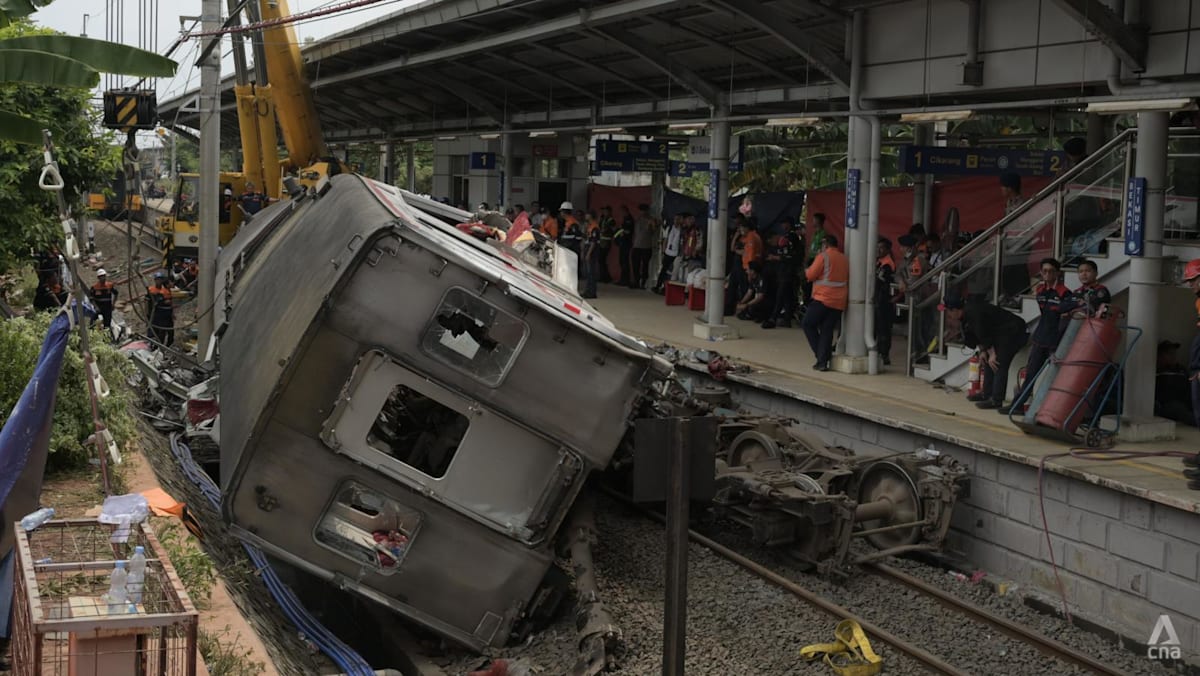
JAKARTA: Indonesian investigators found signal and communication problems were the main cause of a deadly train collision near the capital Jakarta which killed 16 in April, a report from the Transportation Safety Committee showed. The evening collision between a commuter train and a long-distance train happened on Apr 27 in Bekasi, just outside Jakarta, killing 16 people and injuring 107, said the report, which was published on the committee's website. It was not clear when the report was first released.The accident began when an electric taxi reportedly stalled at an unmanned level crossing near the East Bekasi station. At 8.48pm that day, the vehicle was struck by a commuter train travelling from east to west.Another commuter train travelling in the opposite direction was instructed to remain at East Bekasi station.A third train - an express service travelling from Jakarta to Surabaya in East Java - slammed into the stationary commuter train, crushing passengers in the packed women-only carriage at the rear.The report identified a signalling fault between Bekasi and East Bekasi stations, with the long-distance train responding to a green departure signal and not given any additional warning to slow down. "The driver did not receive a yellow signal indication informing them that the next signal ahead was showing red," the report said.It also took three minutes and 20 seconds for the operation control centre to receive information from the commuter train driver regarding the incident with the taxi, with the control centre staff unable to hear the driver clearly, the report said.The driver of the long-distance train had not received training in situations which require emergency braking, the report added.The report also highlighted the poor visibility of signals due to light pollution and damaged windshields.In the wake of the accident, experts and advocacy groups had called for heightened safety measures. Some suggested there should be separate tracks for express long-distance trains and commuter trains, and sufficient funds allocated to build overpasses to replace level crossings.A minister sparked a backlash when she suggested moving women-only carriages from the rear and front to the middle of trains, where the women passengers will presumably be more protected. Netizens questioned if she was implying that men’s lives were less valuable. Arifah Choiri Fauzi, Indonesia's Minister for Women’s Empowerment and Child Protection, later apologised and said she had "no intention of disregarding the safety of other passengers”.
Signal faults, communication problems caused Indonesia's April deadly train collision: Investigators
Full Article
Original Source
Read the full article at Channelnewsasia →KhanList aggregates and links to publicly available news content. We do not host full articles from third-party sources. Always verify important information with original sources.