
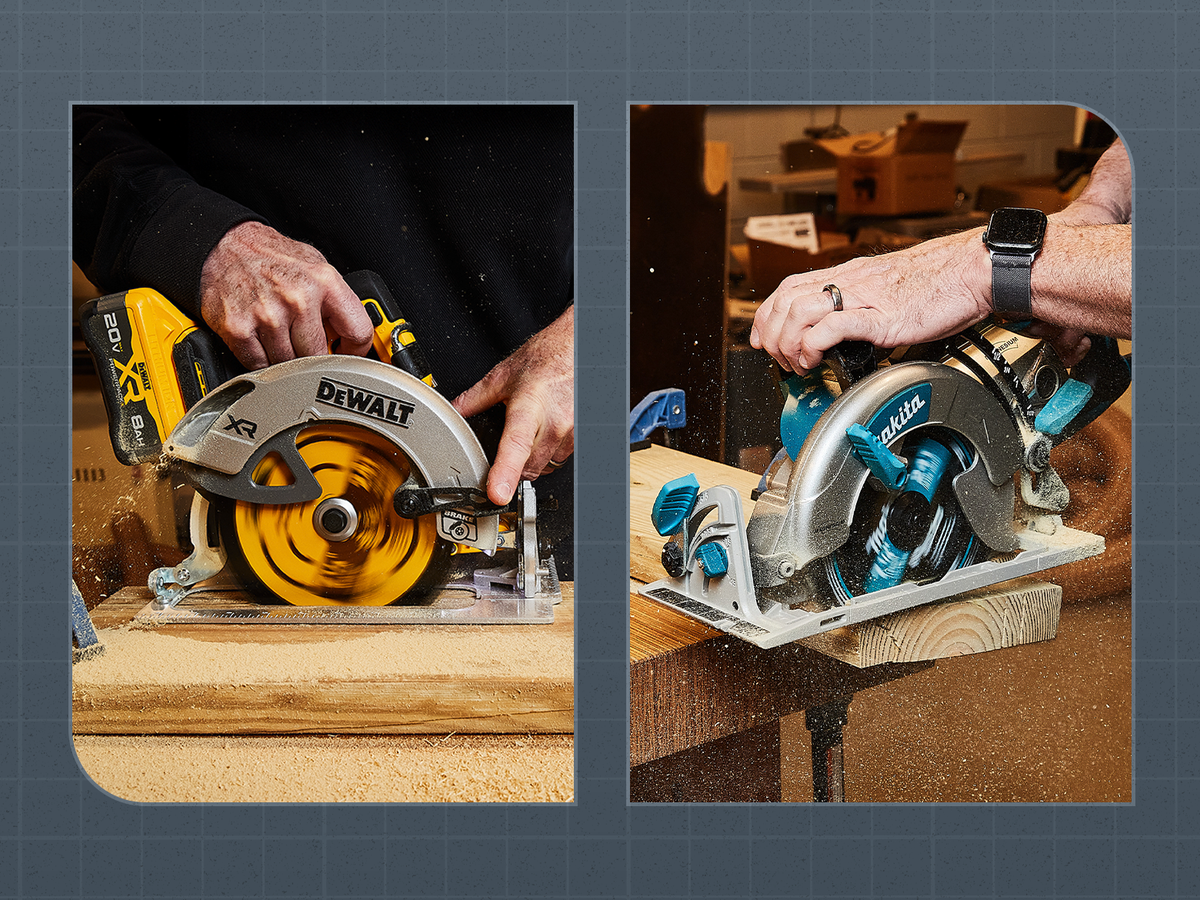
6 min readI’ve used a lot of circular saws over the course of my life, and my preferred model at any given time typically depended on whether I was working professionally or for myself. When I bought my first house in my 30s, I did the vast majority of my DIY work with a traditional DeWalt sidewinder. It was light and compact and perfect for making quick cuts through 2x4s and sheets of plywood.But when I was on a professional jobsite—either working on a framing crew when I was younger or more recently as a contractor doing heavier renovations—a worm-drive saw was a must. The most recent circular saw I retired was a Ridgid worm-drive saw. I beat the hell out of that thing, ripping through old oak flooring, occasionally hitting nails, cutting masonry and concrete with a diamond blade. It took everything I threw at it, and I hope it treats the young man I sold it to at a garage sale as well as it treated me.The differences between these two kinds of circular saws—sidewinder and worm drive—are seemingly innocuous, but the more you dig into them, you realize a little gap is more like a chasm. It’s not just about where the motor sits or which saw weighs more. Motor orientation affects gearing. Gearing affects blade speed and torque. Those choices determine the size and shape of the saw, which in turn affect balance, leverage, and sightlines, not to mention how the tool behaves while making various cuts.And cordless rear-handle saws have come along more recently and said, “We’d like to confuse you even more!” Some look and behave very much like the worm drives I grew up using without actually having a traditional worm-drive gearset inside.How a Sidewinder Circular Saw WorksA sidewinder—also called a direct-drive circular saw—positions its motor beside the blade. The motor shaft runs parallel to the blade arbor, allowing the motor, gears, blade, and handle to fit into a relatively short package.That compact layout is a big part of a sidewinder’s appeal. It typically weighs less and carries more of its mass close to your hand. If you’re cutting plywood, trimming framing lumber, building shelves, or making general repairs, there’s less saw to manage between cuts.Sidewinders also generally run at higher blade speeds. Makita’s 5007MG sidewinder has a maximum blade speed of 5,800 RPM, whereas worm-drive saws traditionally max out around 4,800 RPM. That speed gap has narrowed some over the years, as the Bosch CSW41 and the Skilsaw SPT77W-01—both worm-drive models—have maximum blade speeds of 5,300 RPM, encroaching on the sidewinders, which generally max out around 6,000 RPM.Blade choice also matters a lot, so RPM alone doesn’t determine how cleanly or quickly a saw cuts. But for the lighter-duty cutting that’s common to DIY and renovation work, the combination of speed, low weight, and compact size you get with a sidewinder saw is hard to beat.Trevor RaabThe DeWalt 20V Cordless Circular Saw is one of our favorite sidewinder saws. It impressed us with exceptional power during our hands-on tests.It starts to become an issue, however, when you’re working with dense hardwood or wet, pressure-treated lumber, when you’re making long, full-depth rip cuts, or when you’re performing demolition work. A good modern sidewinder can absolutely handle those jobs, but its higher blade speed doesn’t necessarily provide the sustained torque you need to manage a heavy load. Push it hard enough, and it’s more likely to slow or bog down in the wood, while a worm-drive saw is geared to keep pulling through the cut.Sidewinder Circular Saws We LoveSkil 15-Amp Corded Circular SawNow 16% OffMakita 5007MG Circular SawDeWalt 20V Cordless Circular SawNow 29% OffWhat Makes a Worm-Drive Saw Different?A true worm-drive circular saw positions its motor longitudinally, or behind the blade. The motor drives a gear—that’s the “worm”—that meshes with another gear connected to the blade arbor, turning the rotation 90 degrees. That gearset provides gear reduction. The blade turns slower than it does on a traditional sidewinder, but that reduction multiplies torque at the arbor.Think of it like shifting a bicycle into a lower gear: You give up speed in exchange for a mechanical advantage. That was one of the things I liked about my old Ridgid. When I buried its blade in old oak flooring or made a long, demanding cut, the saw seemed to keep pulling, rather than bogging down as the load increased.That doesn’t mean you should force a worm drive through material—you absolutely shouldn’t. Blade selection, sharpness, feed rate, and material density still matter. But when you regularly cut thick, wet, dense, or otherwise difficult material, that extra mechanical advantage can be useful.Trevor RaabThe Makita 5377 Magnesium Hypoid Saw, a worm-drive model, earned the Best Overall designation in our latest round of circular saw tests.The drivetrain also explains the traditional worm drive’s shape. With the motor extending behind the blade instead of sitting beside it, the saw becomes longer and narrower, usually with a rear-mounted handle.Worm-Drive Circular Saws We LoveMakita 5377 Magnesium Hypoid SawSkil 15-Amp Worm-Drive Circular SawNow 14% OffBest Worm-Drive Saw for Speed CutsBosch 7-1/4-Inch Worm-Drive Circular SawWhen Weight Helps—and When It Doesn’tSidewinders are generally lighter. Worm drives are generally heavier. But weight itself isn’t automatically good or bad.For a long rip through material supported horizontally, I often like a heavier saw. Set a worm drive onto a workpiece, and its mass makes it feel really stable under your hand. Its longer body also gives you leverage from behind the blade and a reassuring sense of momentum once the cut starts.Traditional worm drives also commonly use a blade-left configuration. As a right-handed user, I like the clear view that gives me of the blade and cut line, although blade position varies among both types of saw.Turn the job vertical, though, and that equation changes. Hold that heavy saw against a wall, carry it up a ladder, reach overhead with it, or pick it up hundreds of times for short cuts, and its mass becomes a liability quickly.That’s really the point: A lighter sidewinder is easier to move around. A heavier, longer saw can feel steadier when the work allows the tool to rest on the material.A Rear-Handle Saw Isn’t Necessarily a Worm DriveAnd just when you thought you had all of those differences sorted out, along comes cordless tools to throw a wrench into the gears. Many cordless rear-handle circular saws—like Milwaukee’s 2930—look like traditional worm drives. They’re long and narrow, they put the handle behind the motor, they often use a blade-left layout, and they basically mimic the torque of their heavier worm drive cousins.But “worm drive” describes a drivetrain. “Rear handle” describes the architecture of the saw.Modern cordless rear-handle saws don’t necessarily contain a traditional worm-and-wheel gearset. Manufacturers can pair brushless motors, high-output batteries, and other gearing arrangements to deliver the kind of high-load cutting performance users expect from a framing saw.So today there are really three broad categories to think about: the compact sidewinder, the traditional corded worm drive, and the cordless rear-handle saw designed to deliver many of the ergonomic and performance characteristics associated with a worm drive.Full Milwaukee M18 FUEL Rear-Handle Circular Saw ReviewWhich Circular Saw Should You Buy?For someone buying a circular saw primarily for home projects, I’d still steer toward a sidewinder in most cases. For building shelves, repairing a deck, ripping plywood, or tackling general renovations, a good sidewinder is unlikely to leave you wanting. If you expect to do a meaningful amount of framing, I’d lean toward a 7-1/4-inch model rather than a smaller 6-1/2-inch saw.If your work regularly involves framing, long rips, dense or wet lumber, demolition, or other demanding cuts, a saw like Makita’s 5377MG Hypoid—my choice for Best Overall circular saw—starts to make more sense. Its weight and length take some getting used to, but under the right conditions those same qualities become advantages.And if you want the rear-handle ergonomics and heavy-cutting capability without a cord, today’s cordless rear-handle saws offer an increasingly compelling middle ground.I’d also think about where your work is headed. If you’re buying your first circular saw because you’re hanging some shelves this weekend, don’t buy a 15-pound framing saw simply because you might build a deck someday. You could spend years lugging around capability you rarely use. But if those shelves are only the beginning—if the deck, shed, or basement renovation is already on the horizon—it can make sense to buy a saw you’ll grow into.That’s ultimately why I’ve never been able to declare either design the winner. Frankly, I own both. I’ve used sidewinders and worm drives for decades, and each became the better saw when my work changed. The question isn’t really which circular saw is better. It’s which one makes the cuts you need to make now—and whether it will still be the saw you want when you’re ready to make harder ones.Paul Russell Smith is a former NYC ironworker turned screenwriter (Grace Point) and home renovation specialist. He lives in a crooked old farmhouse in Stockton, NJ, where he’s just as likely to be clearing a clogged pipe as rewriting a third act. When he’s not working, he enjoys hiking, pedestrian beer, and cooking over a live fire. His self-proclaimed spirit animal is the English Bulldog.John Gilpatrick is a Senior Reviews Editor for Popular Mechanics, covering tools, home appliances, yard and garden accessories, and smart home tech. He previously worked for Men’s Health and has bylines on numerous other websites, covering topics as disparate as nutrition, tech, and pet care. He is also a former film critic who’s unusually fond of the Star Wars prequels, and he appeared on Pop Culture Jeopardy in 2025 while wearing jorts and a fanny pack. He is a member of the Online Film Critics Society (OFCS).
Sidewinder vs. Worm-Drive Circular Saws: Which One Do You Need?
Full Article
Original Source
Read the full article at Popularmechanics →KhanList aggregates and links to publicly available news content. We do not host full articles from third-party sources. Always verify important information with original sources.