
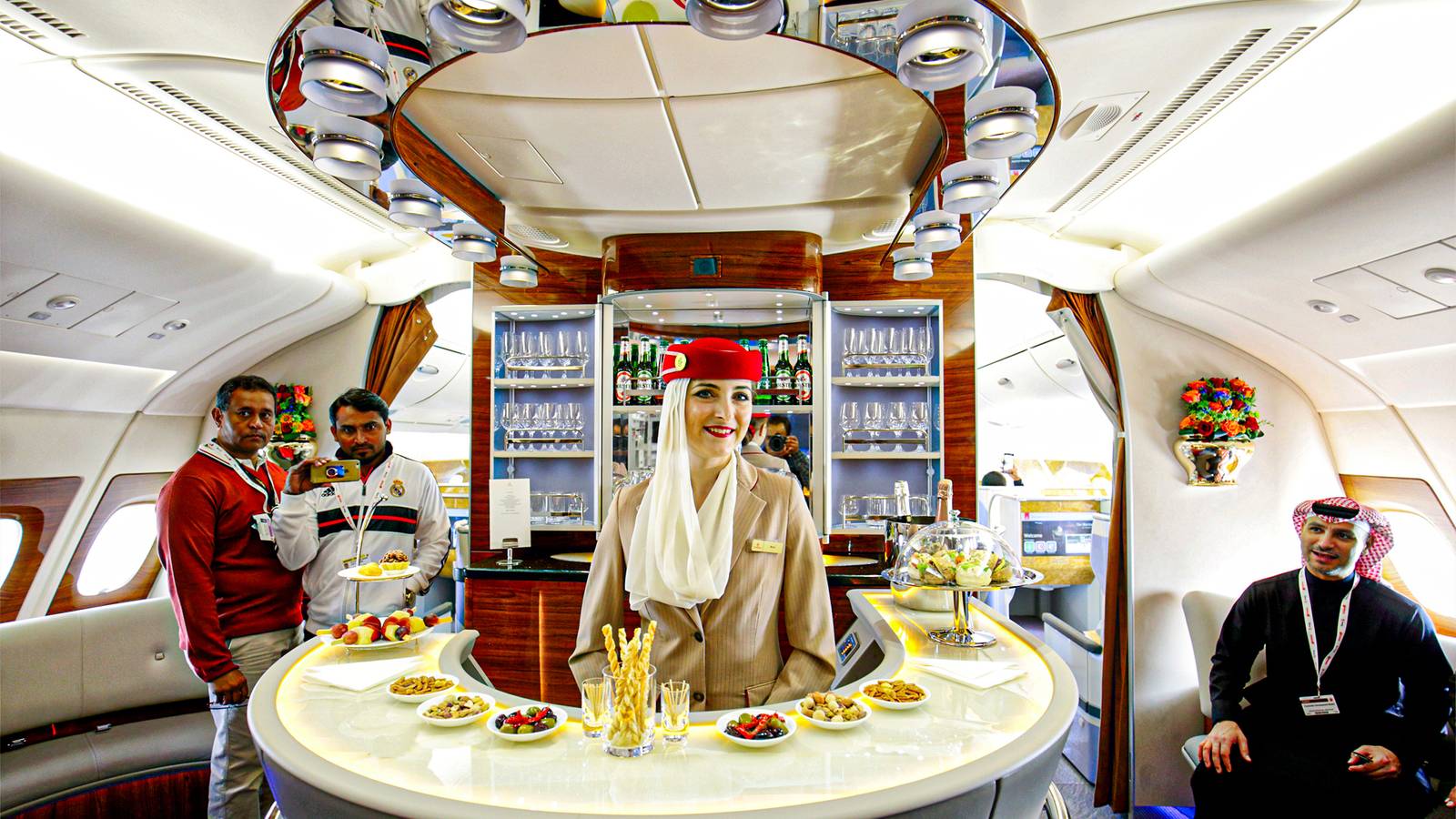
Credit: Dr Ajay Kumar Singh | Shutterstock, Simple Flying Published Nov 22, 2026, 11:00 AM EST Aaron is an aviation enthusiast and world traveler with a deep interest in aerospace history and technology. He has traveled around the world numerous times, often incorporating visits to aviation museums and historic aircraft collections into his journeys. A native of New Zealand, he is an expert in aviation and maintains a broad interest in a variety of other subjects. Sign in to your Simple Flying account The Airbus A380 Superjumbo is the world's only full two-decked passenger aircraft, and as such, it provides much more room for airlines to utilize for luxury spaces such as a bar, lounge, and showers. Still, a traveler from the past may be taken aback by how little luxury space the giant aircraft has. It is extremely rare in today's world for modern passenger airliners to have a significant amount of rest and recreation space, even though this was once the norm. In some ways, Emirates' configurations of the Superjumbo preserve a vestige of the past. Just having more space available for communal areas like bars, larger washrooms, and lounges doesn't mean that an aircraft actually will have more than its smaller predecessors. The Superjumbo is famous for its mostly Emirates configuration, having onboard lounges, bars, and showers. But this is almost a throwback to the past, with the industry moving from communal areas to privacy. As A380s age and receive their midlife refits, this trend towards privacy becomes clear even for the world's largest aircraft. The Airbus A380's Shower Credit: Emirates Perhaps the only luxury element that the A380 can exclusively claim among scheduled passenger airliners today is showers. Only two airlines have installed showers for their premium guests, Emirates and Etihad. Emirates was the only airline to fit showers to its A380s from 2008 until 2014, when Etihad took delivery of its A380s. Both airlines fit the showers in the 'crown area' at the front of the upper deck, ahead of first class. Emirates has two Shower Spas and a lavatory for its 14-seat first-class cabin. Etihad has a first-class shower suite and a private shower within The Residence on its A380s. With Emirates, each passenger can expect five minutes of hot water, tracked by a digital timer, while 25-minute slots are booked with an onboard spa attendant. The shower rooms have heated floors. Emirates A380s configured without first class also lack showers. Etihad has two lavatories for nine-first class passengers, of which one has a shower, without a heated floor and half the size of Emirates'. The Residence is a three-room private apartment above first class. Some business jets have showers as an option, while some VIP and government airlines have them. Air Force One's VC-25 has a shower in the president's private executive suite. The A380's Bars & Lounges Credit: Benson Truong l Shutterstock Emirates is also famous for its lounge at the back of the upper deck, with a staffed bar and seating for first and business class passengers. Etihad calls its lounge (complete with sofas) The Lobby. But these two rival UAE carriers are not the only A380 operators to install lounges in their A380s. Qantas says its A380 "features a stylish onboard lounge for First and Business, a private upper deck for Business and Premium Economy, and a self-service snack bar in Economy." Qatar Airways is known for its spacious bar and social lounge on the upper deck for first and business class passengers. Korean Air also has lounge areas on the upper deck. Historically, this included the Celestial Bar, although this was converted into a self-serve snack area. The spaces remain, but the dedicated bar service has largely been discontinued. The A380 is not unique in offering bars, but it is notable for being able to accommodate full-size cocktail bars. Bars and lounges are somewhat common among premium mainline carriers. Virgin Atlantic states, "Depending on your aircraft, you might find The Loft, The Booth or The Bar." The Bar is found on its A330 and 787 aircraft. However, the trend is away from these luxuries, and the airline is phasing out its traditional onboard bars by 2028–2030 as part of a cabin overhaul. Etihad: The Residence Credit: Etihad Airways Etihad's The Residence is perhaps one of the most striking offerings only found on Airbus A380s. Eithad describes it as "An exclusive three-room suite in the sky, offering complete privacy, personalised service, and refined living from door to destination." Passengers can enjoy a fully private three-room suite with a lounge, bedroom, and en-suite bathroom. The airline provides a dedicated onboard team for The Residence customers. Service includes a private chauffeur, delivery of baggage directly to the destination (skip baggage claim in Abu Dhabi), a personal guide through the airport, and more. The cost of booking The Residence is reportedly from $11,000 to $25,000 one-way. While Etihad is purchasing the Airbus A350-1000, Boeing 787-9, and 777-9 twin-engined airliners, it is unclear when it plans to retire its A380s. It recently reactivated the last stored A380, bringing its fleet to about nine. The pending retirement of A380s around the world does not mean the complete end of luxury communal space in aircraft like bars and lounges. That said, these spaces are clearly in decline (as is first class), and Emirates has suggested the showers will go when the A380s go. Qantas is bringing forward its retirement of its A380s and replacing them with A350-1000ULRs. The full bar service will be replaced by the much less opulent Wellbeing Zone. Lounge, Bar, & Smoking Room Space Of Early Transatlantic Aircraft Credit: San Diego Air and Space Museum The Graf Zeppelin airship provided the world's first nonstop transatlantic passenger service. It had a kitchen, passenger lounge and dining room (the ship's only public space), and washrooms. The Hindenburg was the next-generation development of the Graf Zeppelin and had passenger space on two decks. It boasted a dining room, lounge (with a 356-lb Bluthner baby grand piano), a writing room, and port and starboard promenades. On the lower deck, it had a barroom and, most eye-catching for a hydrogen-filled airship, a smoking room. As the world switched to airplanes away from airships, travel time across the Atlantic was cut from days to hours. The luxury space contracted, but didn't disappear. The Boeing 314 Clipper was one of the first transatlantic nonstop aircraft. Its luxury amenities were modeled after ocean liners and sleeper trains. It had separate passenger compartments, a 14-seat dining room, a lounge, and a convertible sleeping berth. The Clipper offered separate men's and women's dressing rooms with sinks, mirrors, and towels, and even a shoe-polishing service. Following WWII, the Boeing 377 Stratocruiser was also a flying ocean liner, offering sleeping berths, separate men's and women's dressing rooms, a full galley, and a spiral staircase leading to a 14-seat lower-deck cocktail lounge. There are too many early aircraft to list here that came with lounges and bars. The Boeing 747's Upper Deck As Lounge Space Credit: Airlinephoto l Shutterstock In the 1960s, as it designed the Boeing 747 Jumbo, Boeing expected supersonic long-range travel to be taken over by supersonic jets. It therefore designed the aircraft to be easily converted into a freighter. By raising the cockpit, Boeing allowed freighters to load oversized containers directly through an upward-hinged nose door. This created the upper deck and usable space behind the cockpit. As this was the 1960s and 1970s, air travel was still expensive, predominantly upper-class, and luxurious. Boeing anticipated airlines using this 'leftover space' as a luxury lounge space for premium travelers. In the early days, airlines used it as a passenger lounge and bar. Pan Am fitted it with a 16-seat cocktail lounge and restaurant with sofas, swivel chairs, and tables, and experimented with a restaurant. Era Aircraft/airship Luxury philosophy (per Airships.net, etc.) 1920s-1940s Graf Zeppelin/Hindenburg Exclusive air travel, luxury hotel with lounges and smoking room (Hindenburg) 1930s-1940s Boeing 314 Clipper Elite travel, dining rooms, sleeping berths 1940s-1950s Boeing 377 Stratocruiser Spacious cabins, sleeper berths, lounges 1960s-1970s Early Boeing 747 Mass travel with lounges, bars, restaurants 1980s-2000s 747-400, A340, 777 Higher occupancy, dedicated premium seating 2010s-present A380, 787, A350 Personal space, privacy, premium cabins (lounges disappearing) Qantas made the themed Captain Cook Lounge, American installed the Captain's Deck First Class Lounge, while Braniff used it as a lounge with contemporary furniture and a distinctly 1970s aesthetic. American Airlines leaned into the 747 LuxuryLiner marketing for the early Jumbo. Not only did American install a lounge in the upper deck, but also a standing bar in the economy cabin on the main deck. The Trend Away From Luxury Space Credit: Benson Truong l Shutterstock The Airbus A380 offered unprecedented luxury in the skies in terms of overall space, room for features, and environmental cabin comfort. However, it did not represent a move to luxury social spaces. Instead, the A380 arguably sat at the intersection of two different eras. To some extent, what social spaces and seating density are not for Airbus to decide; that is for the airlines, driven by market demand. In the past, airlines heavily advertised social spaces like lounges, restaurants, and bars. But over time, the emphasis has moved to personal space, privacy, beds, and suites. Korean Air installed them, and then abandoned its Celestial Bar is one example of the shift happening in the A380's lifetime. Instead of communal spaces, Simple Flying's articles about modern business class cabins rolling out around the world are typically more concerned with privacy doors. The new luxury is a type of personal office cubicle. If Emirates is right, and inflight showers disappear with the A380, the Superjumbo would mark a transitional moment. It arguably marks the final nail in the proverbial coffin for communal spaces on aircraft. Ironically, the much smaller Boeing 314 Clipper and Boeing 377 offered more luxury communal space than most of today's A380s. Something similar happened with the Boeing 747. Over time, the upper deck grew, but its use as a common lounge and bar space vanished.
Showers & Bars: The Onboard Spaces Only The Airbus A380 Offers
Full Article
Original Source
Read the full article at Simpleflying →KhanList aggregates and links to publicly available news content. We do not host full articles from third-party sources. Always verify important information with original sources.