
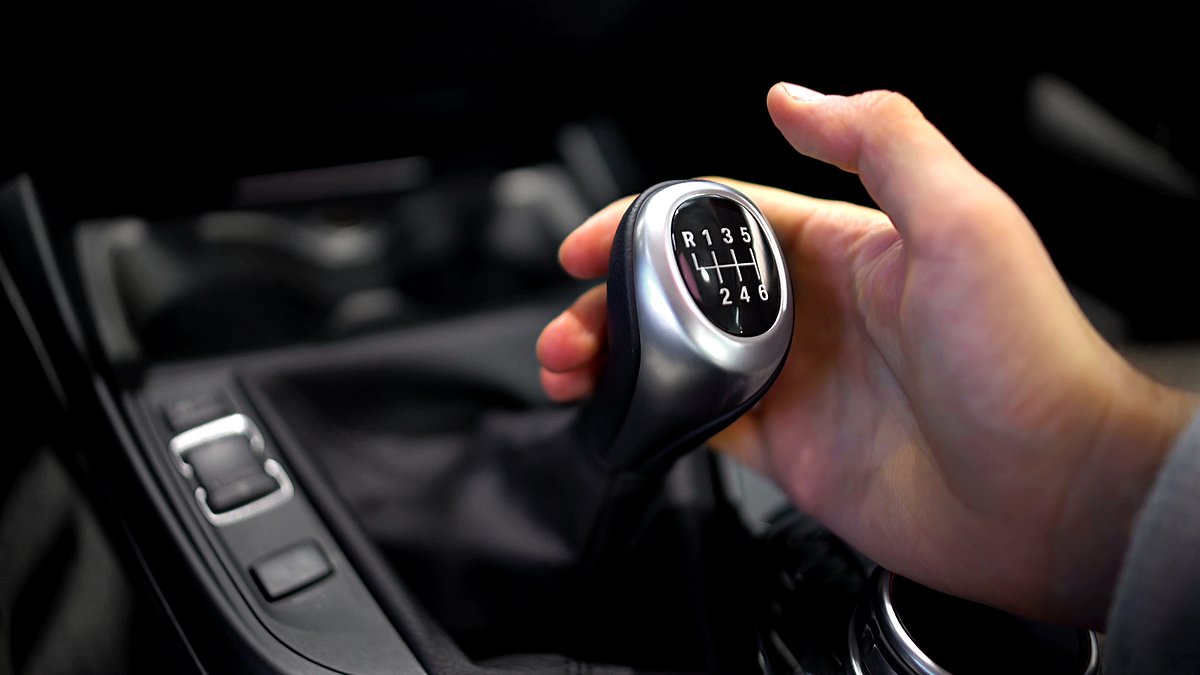
Cars with manual gearboxes are rapidly disappearing from Britain's showrooms.Earlier this year, a market-wide review found that fewer than one in four new models now come with a gear stick, down from two in three a decade ago as consumer demand shifts towards automatics.And the rapid transition to electric vehicles, all of which have automatic transmissions, has prompted experts to predict that the manual gearbox could disappear from dealerships entirely as early as 2030.This trend is also reflected in the dramatic rise in the number of learners opting for automatic-only driving licences.Last year, almost three in ten (29.5 per cent) practical driving tests were taken in automatic cars. That's a significant increase on the 8.2 per cent recorded in 2016-17 which, if passed, restricts drivers to automatic vehicles and prevents them from legally driving a manual.However, a new study by AA Cars has found that more than half of young licence holders can only afford used motors with a gear stick.This is because they are priced out of EV ownership and instead financially limited to older petrol and diesel cars, the vast majority of which have manual gearboxes.This imbalance between the rise in automatic-only licence holders and demand for cheaper used cars has led the AA to call for drivers with auto-only licences to be allowed to drive manual cars after completing a short conversion course. But should that be an option? The proportion of learners taking auto-only driving tests hit a record of 29.5% last year, but most new motorists can only afford used manual cars. Should driving test rules be revamped?A poll of 13,631 motorists by AA Cars found that 51 per cent of 18 to 34-year-olds expect their next vehicle to be a manual, despite the growing shift towards automatic-only driving tests.Much of this comes down to affordability.Used cars with automatic transmissions typically command a premium over equivalent manual models. And despite a growing second-hand EV market and rapid depreciation, EVs remain out of reach for many younger buyers.With the number of motorists holding automatic-only licences rising sharply, many new drivers are effectively limiting their options by ruling themselves out of a large section of the used market.Had they taken a manual driving test in the first place, they would have had access to a far wider range of vehicles.And with the driving test backlog created during the pandemic still forcing learners to wait almost 20 weeks for a slot, many motorists are reluctant to join the queue again to retake a practical test. AA President Edmund King has called for Britain to follow Germany's example and offer auto-only licence holders conversion courses to drive manual cars that last for just 7.5 hoursJoin the discussionShould drivers who passed in automatics be trusted to handle manuals after just a few lessons, or does this put road safety at risk?What's your view?AA calls for auto-to-manual conversion coursesBut the AA believes it has a solution.AA president Edmund King says motorists with automatic-only licences, who have already demonstrated they understand the rules of the road, should not be required to sit a full driving test again.Instead, he wants the Government to consider an approved conversion course allowing drivers to qualify to use a manual car after as little as seven and a half hours of tuition.A similar scheme has been in place in Germany since April 2021.Under the system, drivers with automatic-only licences must complete at least ten manual driving lessons, each lasting 45 minutes. They must then pass a 15-minute assessment in a manual car with a qualified driving instructor.'The way we drive is changing rapidly. More learners are choosing automatics and that trend will only accelerate because all fully electric cars and most hybrids are automatic,' King explains.'But passing in an automatic shouldn't mean being locked out of driving a manual for life unless you go through the whole test process again. 'There will still be occasions when drivers need to use a manual – perhaps for work, hiring a car or borrowing a family member's vehicle.'We are not suggesting simply handing automatic licence holders the keys to a manual. 'They should undertake proper professional tuition – potentially up to ten lessons – followed by a formal assessment by an approved driving instructor to demonstrate they can safely use gears and a clutch.'Once they have already passed their driving test and developed good road skills, it seems disproportionate to make them join a queue of several months for another DVSA test purely to demonstrate manual gearbox skills.'He added: 'A properly regulated conversion course would maintain safety standards while bringing the driving licence system into line with a motoring world increasingly dominated by automatic, hybrid and electric cars. 'It would also avoid adding unnecessary pressure to the driving-test backlog.'James Hosking, managing director of AA Cars, says a licence conversion scheme would give new drivers access to a wider range of used cars, giving them freedom, helping them commute for work and effectively support the wider economy.'For first-time buyers on tighter budgets, a manual licence keeps both manual and automatic cars in play and gives them more choice when looking for the right car at the right price.'The AA's proposed conversion route recognises how much the market has changed.'Drivers would still have to learn clutch control, gear selection and hill starts, and prove they could use them properly, but they would not have to sit another full driving test after already demonstrating that they can drive safely on the road.'However, the Department for Transport says there are no plans to change the system and that anyone wishing to drive a manual vehicle must pass a manual driving test. Automotive market analysts have forecast that the manual gearbox will be extinct for new models by 2030End of the road for manuals Latest market analysis by CarGurus found that just 67 of the 292 new models sold by the UK's top 30 manufacturers are available with a manual gearbox, down sharply from 197 models in 2016.At the current rate of decline, combined with the upcoming ban on the sale of new petrol and diesel cars, the manual gearbox could disappear from new-car line-ups before the end of the decade, the study predicts.For motorists who still enjoy the involvement of changing gear themselves, a handful of brands continue to offer a variety of manual models.Dacia leads the way, with all six of its combustion-engine cars available with a manual transmission as standard. Only the electric Spring EV is automatic-only.Ford (six models), Hyundai, Kia, Skoda and Volkswagen (five each) are the other manufacturers offering the widest choice of manual-equipped vehicles.Below is a brand-by-brand list of manual gearbox options currently available in UK showrooms. The new cars still available with a manual gearbox in 2026 Audi: A1, A3, Q2BMW: M2Citroen: Berlingo, C3, C3 AircrossCupra: Formentor, LeonDacia: Duster, Jogger, Sandero Stepway, Sandero, BigsterFiat: n/aFord: Puma, Kuga, Tourneo Custom, Tourneo Courier, Mustang, RangerHonda: n/aHyundai: Bayon, i10, i20, Kona, TucsonJaguar*: n/aJeep: AvengerKia: K4, Picanto, Sportage, Stonic, XCeedLand Rover: n/aLexus: n/aMazda: CX-30, CX-5, Mazda3, MX-5Mercedes-Benz: n/aMG: MG3, HS, ZSMini: n/aNissan: Juke, QashqaiPeugeot: 2008, 208Porsche: 911Renault: Clio, CapturSeat: Arona, Ibiza, Leon, AtecaSkoda: Fabia, Kamiq, Karoq, Octavia, ScalaSuzuki: S-Cross, Swift, VitaraTesla: n/aToyota: GR Yaris, HiluxVauxhall: Astra, Corsa, MokkaVolkswagen: Polo, Golf, Taigo, T-Cross, TransporterVolvo: n/aSource: CarGurus. *Jaguar currently does not sell any new models but its first EV due in late summer 2026 will be auto only. While most people assume that an auto-only driving test is easier to pass, this isn't reflected in success rates. Manual test pass rates sit at 52.3% while for autos it is just 44.6%Shift to auto-only licences With the skill of changing gear predicted to become obsolete within the next decade, learners are already preparing for a future without manual transmissions, with automatic-only driving test volumes reaching record highs.Latest Driver and Vehicle Standards Agency (DVSA) figures for the 2025-26 financial year show that 29.5 per cent of all driving tests were taken in automatic cars.Of the 1,998,621 practical driving tests conducted that year, 589,483 were in automatics.That is up from 26.1 per cent the previous year and 23.4 per cent in 2023-24.Five years earlier, in 2020-21, automatic driving tests accounted for just 13.8 per cent of all practical tests. A decade ago, in 2016-17, they represented fewer than one in ten (8.2 per cent).But despite the perception that automatic cars are easier to drive, pass rates remain lower than for manual tests.Last year, the pass rate for automatic-only tests was 44.6 per cent, compared with 52.3 per cent for learners taking their test in a manual vehicle.However, DVSA records show that automatic pass rates are climbing, up from just 39.8 per cent a decade ago. Growing popularity of auto-only driving tests2025-26: 29.5% of all driving tests (44.6% pass rate) 2024-25: 26.1% of all driving tests (43.9% pass rate)2023-24: 23.4% of all driving tests (42.8% pass rate)2022-23: 19.2% of all driving tests (42.7% pass rate)2021-22: 15.8% of all driving tests (41.7% pass rate)2020-21: 13.8% of all driving tests (41.5% pass rate)2019-20: 12.7% of all driving tests (39.5% pass rate)2018-19: 11.1% of all driving tests (38.8% pass rate)2017-18: 9.5% of all driving tests (38.9% pass rate)2016-17: 8.2% of all driving tests (39.8% pass rate)Source: DVSA CARS & MOTORING: ON TEST
Should motorists with automatic-only licences be allowed to drive cars with manual gearboxes after a few lessons?
Full Article
Original Source
Read the full article at Dailymail →KhanList aggregates and links to publicly available news content. We do not host full articles from third-party sources. Always verify important information with original sources.