
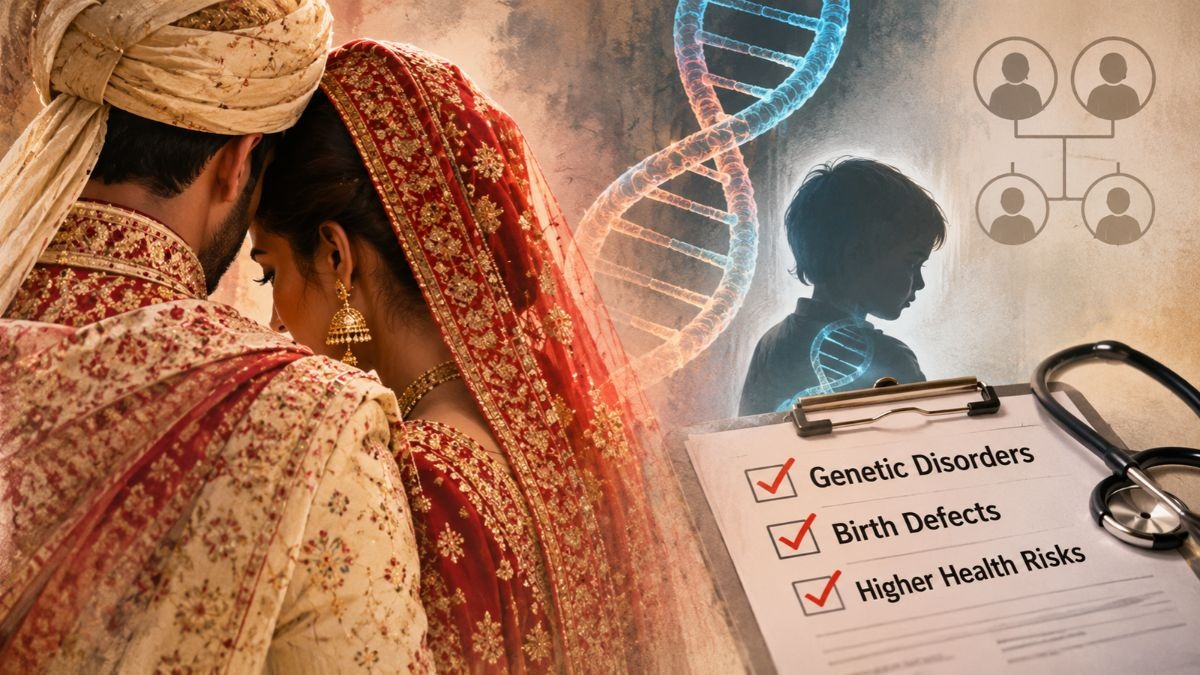
A 20-year-old law student from Bengaluru has brought an age-old societal practice under the Supreme Court's scrutiny, raising a question that India has largely avoided confronting: should marriages between close blood relatives be regulated in the interest of the health of future generations?On November 20, the Supreme Court asked the Union government to consider if a suitable legislation was needed to address marriages between close blood relatives or alternatively initiate widespread awareness campaigns about their potential genetic consequences. A bench of Chief Justice Surya Kant and Justices Joymalya Bagchi and V. Mohana, however, clarified that it was not directing the government to legislate, rather wanted the issue to be examined.The court was hearing a PIL filed by Charvi S., a student at the National Law School of India University (NLSIU) in Bengaluru, who suffers from serious visual impairment. Born to parents who were first cousins, she has attributed her condition, including cone dystrophy and retinitis pigmentosa, to the genetic risks associated with consanguineous marriages. Her petition questions whether statutory and customary exceptions permitting marriages between close blood relatives should continue without adequate public-health safeguards.The medical angleConsanguineous marriage refers to a union between individuals who share a common ancestor, generally second cousins or closer. First-cousin marriages are the most common form. The genetic explanation is straightforward. Every individual carries certain potentially harmful recessive genetic mutations. Normally, these may not manifest because the corresponding gene inherited from the other parent is healthy. However, close relatives are more likely to carry identical genetic variants inherited from common ancestors. Their children consequently have a greater probability of inheriting two copies of the same harmful recessive gene, resulting in genetic disorders.Research published in medical journal BMJ Open has found that the risk of congenital abnormalities is approximately 2-3 per cent among children of unrelated couples, compared with 5-6 per cent among first-cousin couples. In other words, the risk roughly doubles, although the overwhelming majority of children born to first-cousin couples do not necessarily have congenital abnormalities.A 2025 study, ‘The Abundance of Harmful Rare Homozygous Variants in Children of Consanguineous Parents’, published in the journal Genes, examined more than 2,500 whole genomes. It found that children of first-cousin couples had approximately 10 times as many harmful rare homozygous genetic variants as children of unrelated parents. The figure rose to 20 times among children of double first-cousin unions.The community aspectThe health implications are particularly serious in communities where cousin marriages recur across generations. This is where the debate becomes particularly sensitive. Islam, for example, permits marriage between first cousins. However, it would be incorrect to inference that cousin marriages are common among Indian Muslims or that other communities do not practise it.A study published in the Journal of Biosocial Science in 2020, analysing data from 456,646 ever-married women in the National Family Health Survey (NFHS) 2015-16, found that 9.9 per cent of marriages in India were consanguineous. The prevalence was 15 per cent among Muslims and 9 per cent among Hindus. The national average was driven substantially by southern India, where the prevalence was 23 per cent, compared with 3.1 per cent in the Northeast. First-cousin marriages accounted for 8.7 per cent of marriages nationally.An earlier study by researchers A.H. Bittles and R. Hussain, published in the international journal Annals of Human Biology in 2000, found that 22 per cent of marriages among Indian Muslim respondents in NFHS 1992-93 were between second cousins or closer. The figure varied considerably across regions.However, marriage patterns differ considerably across Muslim communities and geographical regions; and even among first-cousin couples, the absolute risk of congenital abnormalities remains relatively low, although higher than among unrelated couples.The religious, legal dimensionsThe practice is not restricted to Islam. Certain Hindu communities, such as in southern India, have traditionally permitted cross-cousin marriages and, in some communities, uncle-niece marriages. Such customs are reflected in India's marriage statistics.Under the Hindu Marriage Act, 1955, marriages within prohibited degrees of relationship and sapinda relationships are generally barred unless an established custom permits them. The Act also governs Sikhs, Buddhists and Jains.Muslim personal law permits first-cousin marriages. Jewish personal law also permits cousin marriages while Christian denominations have historically allowed certain cousin unions subject to applicable ecclesiastical rules and dispensations. The precise legal position varies across jurisdictions.Globally, cousin marriages remain prevalent in parts of West Asia, the Middle East, North Africa and South Asia, cutting across different national and cultural settings.Personal choice versus public healthThe Supreme Court's intervention opens up a difficult debate about balancing religious freedom, customary practices, individual choice and the right to a healthy life. Experts say an outright prohibition may encounter constitutional and social resistance. It could also be difficult to enforce. But ignoring the medical evidence is equally indefensible.A more practical starting point would be mandatory awareness initiatives, accessible premarital genetic counselling, voluntary genetic screening in high-prevalence communities and affordable diagnostic facilities. Couples with a family history of inherited disorders should have access to genetic assessment before planning children. The government should also decide whether scientific awareness and preventive healthcare must finally take precedence over centuries-old social conventions.Subscribe to India Today Magazine- Ends
Should India rethink allowing 'cousin' marriages on health grounds?
Full Article
Original Source
Read the full article at Indiatoday →KhanList aggregates and links to publicly available news content. We do not host full articles from third-party sources. Always verify important information with original sources.