
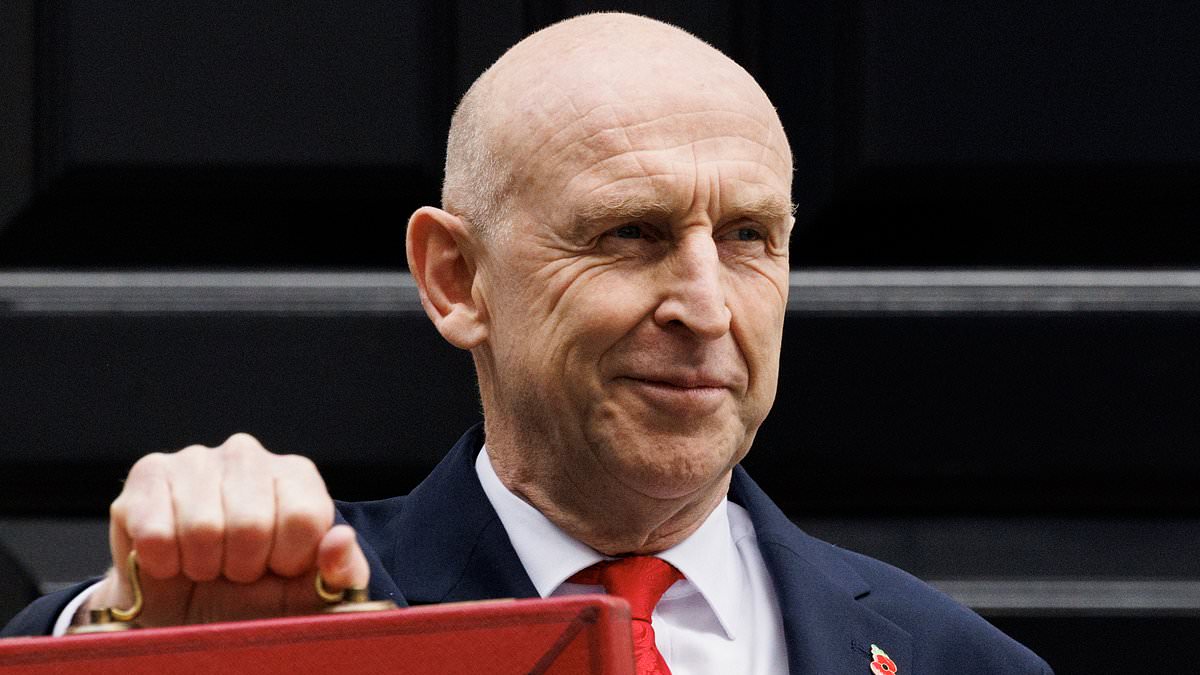
Last week I spoke to a senior Treasury Minister about today’s Budget. ‘What you have to remember is there’s no such thing as a “small Budget”,' they said. ‘No, there aren’t going to be any major headline-grabbing announcements on tax or spending. But it’s still going to be a significant moment’.It is indeed a significant moment. Because John Healey’s cautious economic incrementalism signals more clearly than ever that we are heading for a snap election in 2027.The Chancellor was remarkably candid about the scale of the challenges facing the country. Donald Trump’s war in the Middle East had created massive global economic insecurity, he warned. ‘We did not want this war,’ he declared. ‘We rejected calls from the leader of the opposition to jump two-footed into it. It is a war that has driven up costs on British families and businesses. Inflation, which was due to fall, has now risen, driven by higher oil prices.'Ordinary working families are still being hammered by the cost-of-living crisis, he admitted. British businesses are struggling against unprecedented economic headwinds, he acknowledged. Spiralling debt meant he had to raise additional taxes – albeit in ‘a balanced way’, he conceded.So taken in the round, it was a grim economic picture. And it clearly required hard choices – some tough medicine and radical thinking to get the economy back on track.But no hard choices were taken. The medicine turned out to be a spoonful of honey. And the radical, out-of-the-box thinking that was pledged by Andy Burnham in his party conference speech last month was nowhere to be seen. John Healey’s cautious economic incrementalism signals more clearly than ever that we are heading for a snap election in 2027, writes Dan Hodges The out-of-the-box thinking, which Andy Burnham pledged in his party conference speech last month, was nowhere to be seen in today's BudgetInstead, the economics were subordinated to some unashamedly populist politics. Twenty million households in council tax bands A-D would be given a £100 pre-election bribe, paid directly into their bank account, he announced. Although the Chancellor obviously didn’t describe it as a bribe. It was, he said, ‘energy support’.There had been speculation Mr Healey would renege on the Prime Minister’s pledge to transfer the remaining £1.2billion surplus from the miners’ pension fund to the last of the miners. This would have flown in the face of his strategy of shoring up Labour’s left flank and created alarm amongst Labour MPs in marginal Red Wall seats. They, and the miners, needn’t have worried. Every single penny of the fund would be handed over, he declared, to loud cheers.Military and defence experts had been equally alarmed by reports Mr Healey would shy away from his demand – backed up by his dramatic resignation as defence secretary – that defence spending be raised to 3 per cent of GDP by 2030. Again, their concerns were laid to rest. The commitment would be honoured, he proclaimed. Though where the money would come from, he declined to say. That could wait for another day. Or, more specifically, a day after the next election.Over the past week, Mr Burnham has again attempted to convince the country he has no plans for a quick dash to the polls. But, at times, his Chancellor was almost comically transparent about what his real plans are. The VAT cut would be extended to July 2027, he revealed. As would the freeze on fuel duty.But the biggest tell of all was his announcement on the banks. To make the books balance, or to make them marginally less unbalanced, he had identified a clear target. A 3 per cent bank surcharge would be introduced to ‘support ordinary people’, he announced. Then, looking directly at Kemi Badenoch, he fired the general election starting gun. ‘I challenge the leader of the opposition, does she support today our support for British families and British firms?’ he asked. ‘And does she back the action we’re taking to pay for it?’It was a thinly disguised trap. One that Mr Healey has laid now and intends to finally spring in the summer of next year. But then, so was the entire Budget.In terms of pre-election giveaways, what the Chancellor announced was relatively thin gruel. But as Mrs Badenoch accurately pointed out, the Government’s credit card has now been maxed out. The financial markets are casting an increasingly wary eye over the monthly statements.So, his scope for political largesse was limited. As a result, Mr Healey and Mr Burnham have opted to defer the painful treatment and opted to tell the patient they can make do for now with some bed rest and herbal remedies.And in the short term it may well work. No10 and No11 have skilfully won the pre-budget expectations battle. The ‘bloodbath’ predicted by the Government’s opponents has not materialised. For voters still reeling from Rachel Reeves’ 2025 tax bombshell, today’s announcement may well be met with a sigh of relief.But that relief will be short-lived. The ‘breathing space’ promised by the Chancellor will not last for long.Because the reality is that, populist though this Budget may appear, it has failed to address any of the fundamental structural problems facing the British economy. In the face of war in the Middle East, there is nothing here that can hope to significantly stimulate growth. The debt mountain is soaring. As is inflation. Public spending is accelerating. The deficit is widening. Mr Healey’s fiscal headroom is narrowing. And there was nothing announced today that will even scratch the surface of these problems. Mr Burnham and Mr Healey have put off the difficult decisions in the Budget and clearly made the decision that nothing can risk Labour’s recovery in the pollsJust before the conference season opened, Mr Burnham stated there would be no general election before 2029. But short of starting his speech by declaring, ‘This is a Budget for a May 2027 election,’ I’m not sure how much clearer Mr Healey could have been on what the Government’s real plan is.If the Prime Minister did intend to ‘go long’, then Mr Healey would have used the tried-and-tested template. The difficult decisions would have been taken now: Spending cuts would have been announced, tax rises would not have been deferred and the pre-election traps and bribes would have been saved for another day.Under this template, in 2027 or 2028, the Chancellor would then deploy the well-worn mantra: ‘We asked you to make some sacrifices. You did. Now you will see the benefits.’Instead, the difficult decisions have been put off. Mr Burnham and Mr Healey have clearly made the decision that nothing can risk Labour’s recovery in the polls. Or shut the window on a snap election next year.Mr Burnham can deny it until he’s blue – or red – in the face. This was a nakedly cynical, politically skilful, pre-election Budget.
Short of starting his speech by declaring 'This is the Budget for a May 2027 election', I'm not sure how much clearer John Healey could have been on what the Government's real plan is: DAN HODGES
Full Article
Original Source
Read the full article at Dailymail →KhanList aggregates and links to publicly available news content. We do not host full articles from third-party sources. Always verify important information with original sources.