
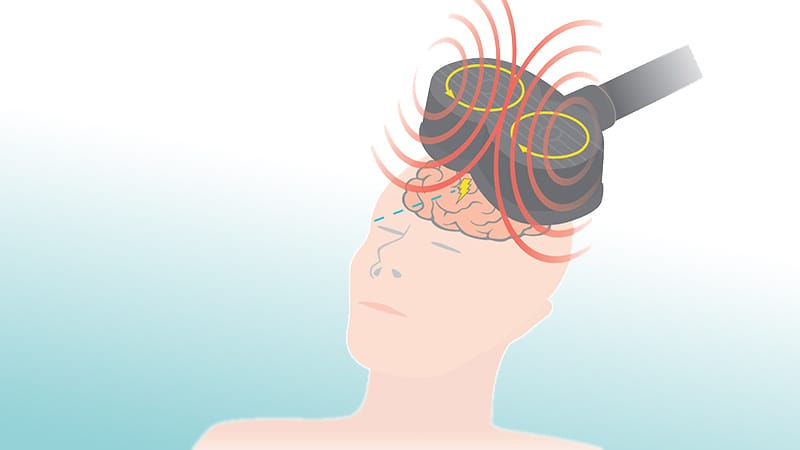
Teens who have medication-resistant depression may find relief from a brain stimulation treatment that can be completed in 2 weeks, according to a randomized, sham-controlled trial published in Pediatrics.Intermittent theta-burst stimulation (iTBS) uses rapid magnetic pulses to activate areas of the brain involved in mood regulation. Standard treatment requires daily appointments over roughly 1 month, while accelerated protocols can compress treatment into multiple sessions a day over a period as short as 5 days.The study findings are consistent with improvements observed by Andrew Leuchter, director of the Neuromodulation Division at the TMS Clinical and Research Service at UCLA, who treats teens with accelerated iTBS.“We see frequently that within just 2 or 3 days of the start of treatment, patients notice that their mood is better, their anxiety is diminished, they have more energy, they feel more motivated, they’re able to concentrate better on schoolwork,” and become more interested in socializing, Leuchter, who was not involved with the research, said.Ample research on iTBS and accelerated iTBS in adults shows improvements in depressive symptoms. Efficacy of its use in teens, however, has been limited. Researchers aimed to fill this gap.The findings come at a critical time. At least 3 million adolescents in the US have depression, and roughly 30% of these do not respond to medications or cognitive-behavioral therapy. Many teens also struggle with medication adherence and may want to avoid the side effects of prescription drugs, said Ashvin Sood, MD, MPH, attending child psychiatrist at Washington Interventional Psychiatry in Washington, DC.“We’ve been in a youth mental health crisis prior for a very long time, and the pandemic did not help anything,” Sood, who treats teens using the accelerated method and was not involved in the study, said.The study took place in 2025 and included 56 teens aged 10-17 years (mean age, 14.9 years; 75% women) with major depressive disorder who had not responded to one or more trials of antidepressants lasting at least 1 month. A group of 28 received sham stimulation.Over the course of 10 days, researchers from West China Hospital of Sichuan University in Chengdu, China, tested once-daily sessions of 1800 magnetic pulses, a higher dose than standard iTBS. Researchers used functional MRI to identify individualized stimulation targets in the area of the brain governing anhedonia, or the inability to experience pleasure.After the 10 days, teens in the intervention group showed an average 9.46-point reduction in depression scores compared with 3.04 points in the sham group (P = .002). After 1 month, the between-group difference was 4.54 points (P = .03).Improvements in anhedonia were significantly greater in the treatment group, accounting for 42.1% (95% CI, 19.1%-307.5%) of the treatment’s antidepressant effect. No serious adverse events occurred. Headache was the most common adverse event, affecting 21.4% of participants in each group.The improvements in anhedonia were notable, wrote Yupei Pearl Hu, MD, psychiatrist at Remède Therapy in Brookline, Massachusetts, in an accompanying editorial.“Greater anhedonia is associated with more severe illness and suicidality and may predict poorer treatment response,” Hu wrote.The shorter treatment course could be more practical for adolescents who have difficulty attending daily appointments over a month or more, Leuchter said.Whether the 10-day protocol is as effective as conventional iTBS is unclear, which typically involves about 36 sessions, Leuchter said. The study also followed patients for only 1 month, leaving questions about the durability of the benefits.Regarding the use of functional MRIs, implementation in clinical practice may be limited by cost and limited availability of the technology, Sood said.Leuchter was also skeptical about their efficacy.“MRI work is still experimental,” Leuchter said. “We do not know whether using structural or functional MRI for greater personalized functional targeting leads to better treatment outcomes than simply choosing a target based on surface landmarks.”The sources in this article reported no conflicts of interest.Brittany Vargas is a journalist covering medicine, mental health, and wellness.
Short-Course Brain Stimulation Helps Teens With Depression
Full Article
Original Source
Read the full article at Medscape →KhanList aggregates and links to publicly available news content. We do not host full articles from third-party sources. Always verify important information with original sources.