
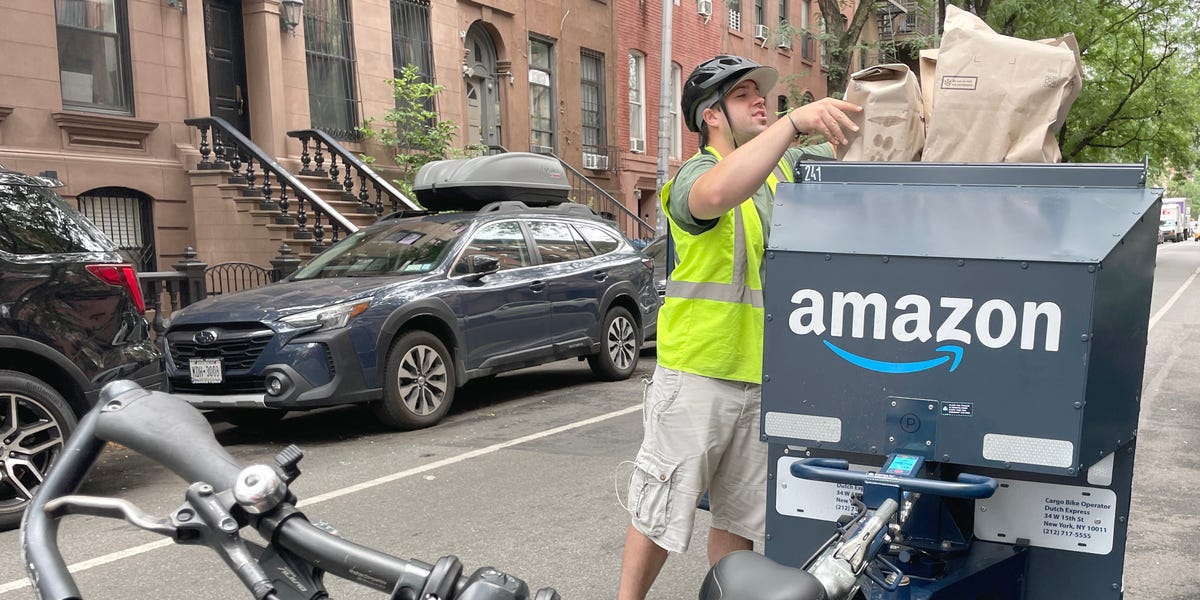
Shoppers turn to Amazon for fresh produce and seafood, helping it take market share from supermarkets Amazon's expanded fresh food delivery is helping it win market share from more traditional retailers. : Deb Cohn-Orbach/UCG/Universal Images Group via Getty Images Amazon is gaining ground in grocery thanks to items like fresh shrimp and berries.Roughly a year after expanding same-day fresh grocery delivery to thousands of cities and towns in the US, Amazon's perishable grocery sales are booming — and taking market share from traditional retailers, according to data from market research firm Nielsen IQ.Sales of groceries such as seafood, dairy, and produce on Amazon increased severalfold between June and August, per Nielsen IQ's data. Amazon also posted market share gains in the food category for the year through late August as traditional grocery stores lost it, Nielsen found. Amazon gained market share in food sales, both overall and online, as rivals such as grocery stores lost it. Nielsen IQ "Shoppers are increasingly embracing Amazon for categories that historically represented one of the largest barriers to online grocery adoption," Nielsen wrote in its report.Amazon has spent years trying to break into grocery, though it hasn't hit a home run in the category as it did with books or cloud computing. The company acquired Whole Foods, opened and shuttered another brick-and-mortar grocery chain, and created a selection of private-label groceries, among other steps.The Nielsen IQ data suggest that Amazon's latest push — toward delivering fresh groceries quickly across much of the US — is yielding some results in the competitive grocery space.Many of the shoppers buying fresh foods on Amazon come from households with incomes over $100,000 and tend to be older, according to Nielsen IQ. They also tend to be frequent Amazon users, placing more orders and spending more money on the platform than an average user.That means fresh groceries, one of the most frequent purchases for US households, are "a potentially important lever for increasing shopper frequency and overall spend" on Amazon, the report reads.To keep the momentum going, Amazon will need to take on formidable rivals. One is Walmart, which already uses its stores and its own army of gig workers to deliver groceries same-day. Amazon is considering opening about 1,000 same-day fulfillment centers around the US by 2031, Business Insider reported in September. That move would create the same sort of advantage that Walmart has by placing more fulfillment centers close to more customers, one analyst said.Do you have a story idea about Amazon's retail operations? Contact this reporter at abitter@businessinsider.com or via encrypted messaging app Signal at 808-854-4501. Use a personal email address, a nonwork WiFi network, and a nonwork device; here's our guide to sharing information securely. Read next Business Insider tells the innovative stories you want to know Business Insider tells the innovative stories you want to know Business Insider tells the innovative stories you want to know Business Insider tells the innovative stories you want to know Alex Bitter is a senior retail reporter covering Uber, Lyft, DoorDash, Instacart, and related companies. His coverage ranges from the experiences of gig workers to what's happening inside the world's biggest ride-hailing and delivery companies.Alex has also written about the retail and food industries. Convenience store chain Sheetz ended its "smile policy" after his reporting. Alex lives in the Washington, DC, area, where you can find him studying ancient coins or searching for Civil War artifacts with his metal detector in his free time.Got a tip? Reach out at abitter@businessinsider.com or via encrypted messaging app Signal at +1 (808) 854-4501. Amazon Grocery Food More Delivery Retail E-Commerce
Shoppers turn to Amazon for fresh produce and seafood, helping it take market share from supermarkets
Full Article
Original Source
Read the full article at Businessinsider →KhanList aggregates and links to publicly available news content. We do not host full articles from third-party sources. Always verify important information with original sources.