
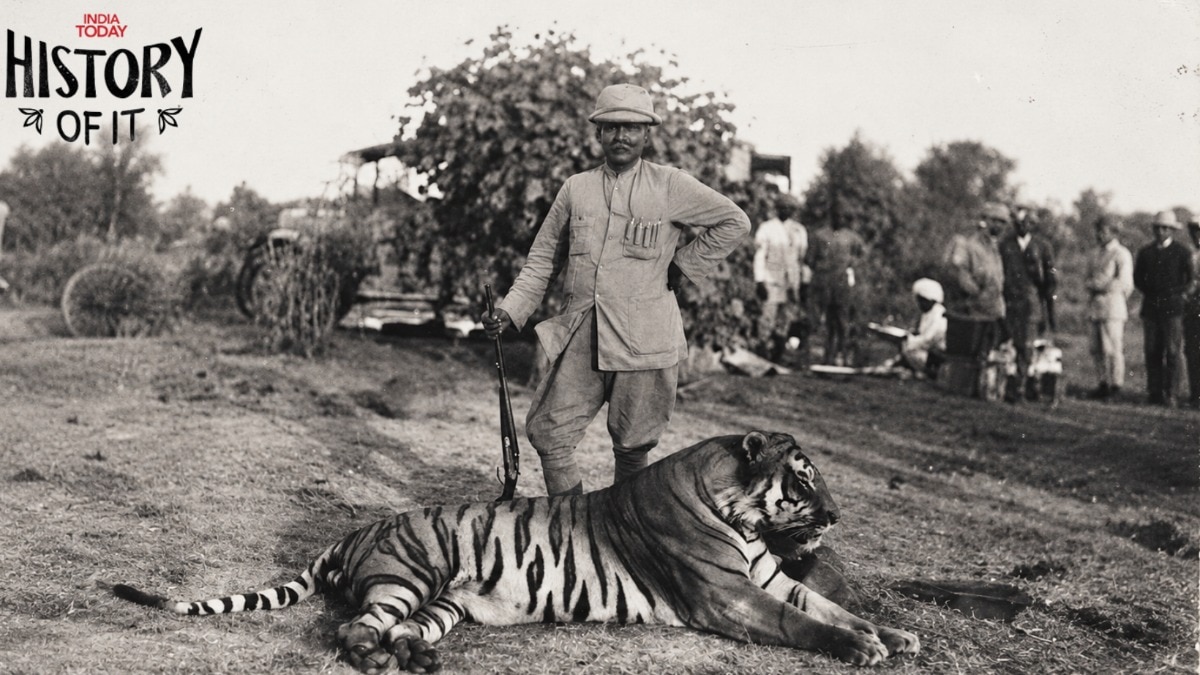
A tiger for Rs 150, a leopard for Rs 35, a bear or sambar for Rs 50, and a chital or nilgai for Rs 30. These were the shooting fees the state government of Rajasthan had framed in 1957. Back then in India, hunting wild animals was legal and a popular holiday activity among foreigners and Indians, who would fancy it, and afford it. Then, there were permits to obtain, hunting blocks to book, and professional shikari to hire. Back then, foreigners coming to India sought something beyond Agra's Taj Mahal, Kashmir's snow-clad mountains and Rajasthan's forts and palaces. India offered them a chance to experience the adventures they had read about in Jim Corbett's Man-Eaters of Kumaon, witness the royal grandeur they saw in The Illustrated London News, and a chance to return home with the skin of the Royal Bengal Tiger as a trophy.The newly independent country was short of foreign exchange and was eager to attract foreign visitors. Largescale hunting, inherited from the British Raj and the maharajas, was a business catering to Americans and Europeans. Government-approved operators arranged expeditions. Advertisements were put up in American magazines and the Tourism Department helped shikar businesses publicise their services abroad. A tiger, which would later become the face of India's conservation movement, was then a tourist attraction that could be shot.There was a contradiction, though. In 1956, then Prime Minister Jawaharlal Nehru was urging Indians to preserve wildlife, even as his government's tourism department was promoting the country's forests as places to hunt.As India marked Wildlife Week between October 2 and 8 (an occasion to celebrate India's wildlife and the efforts made to protect it), we revisit the little-known chapter of independent India's history, when the government encouraged foreign tourists to visit the country to hunt them. Around the same time, a column published in the British magazine The Economist on October 4, highlighting how India had brought back tigers, lions, rhinos and elephants, was slammed for describing India as a "poor country". Critics, including Assam CM Himanta Biswa Sarma, accused the magazine of a colonial mindset. Others on social media reminded the London-based outlet of the British Raj's role in the large-scale hunting and destruction of India's wildlife. They had a point. But there is another side to the story. The British popularised trophy hunting on an enormous scale, but the practice did not end when they left India in 1947. Independent India continued to allow hunting and even promoted it to attract foreign tourists and their dollars.So, how was hunting made a part of India's tourism business? A vintage British Raj-era advertisement for Army & Navy Stores in Calcutta, offering hunting and fishing equipment to shikar enthusiasts. (Photo: Social Media) HUNTING TIGERS WAS A MATTER OF PRIDE AND PRICE; ROYAL SHIKAR SURVIVED END OF BRITISH RAJTo begin with, humans have hunted animals for food and survival since prehistoric times. Even during the Neolithic period, as people began farming, settling down, and domesticating animals, hunting continued. Over centuries, it also acquired social and ceremonial significance in some societies. As kings and kingdoms became grand, hunting got another meaning. It became a display of courage, status and power.In ancient India, rulers went on hunts, even as Mauryan emperor Ashoka is known to have imposed restrictions on the killing of certain animals, as recorded in his edicts. Later, under the Mughals, hunting developed into an elaborate royal pastime, with elephants, attendants and large parties accompanying rulers into the forests.Mughal emperor Akbar had a dedicated hunting establishment, described by his court historian Abu'l Fazl in the Ain-i-Akbari, and reportedly employed as many as 50,000 men to round up wild animals during a grand hunt in 1567.The British took enthusiastically to shikar. Tiger shooting became a measure of prestige among colonial officials and visiting dignitaries. Photographs of hunters posing beside dead tigers and other animals were treasured souvenirs. Their skins and mounted heads found their way into their drawing rooms in Europe.Indian princes and kings, too, picked the "etiquette". Some rulers kept records of the animals they killed, and the numbers were sometimes staggering. For example, the Maharaja of Surguja (in Chhattisgarh), Ramanuj Saransingh Deo, reportedly claimed to have killed his 1,100th tiger by 1953. A November 1998 India Today Magazine report, drawing on ornithologist Salim Ali's recollections, put the eventual tally at 1,157. This was six years after India's Independence. The British had gone, but their hunting culture, and that of the princely states, had not.After Independence, India didn't immediately introduce a uniform national ban on hunting. Wildlife regulation was largely a matter for individual states. They issued licences, designated hunting areas and prescribed shikar fees.The shooting fees we saw earlier, Rs 150 for a tiger, Rs 35 for a leopard, and Rs 50 for a bear, listed under Rajasthan's Forest (Hunting, Shooting, Fishing and Water Poisoning) Rules, 1957, reveal how formally hunting was regulated in independent India. Mind you, these were shooting charges, not the full cost of a hunt. Hunters also had to pay for permits, professional shikari and trackers, transport, accommodation, food and other arrangements for the expedition.For foreign tourists, there were professional hunting agencies who would take care of much of the arrangement, but not smokes and the drinks. A 1940s hunting film presented by Nu-Art Films Inc., showing hunters pursuing and shooting tigers and other wild animals in the jungles of Southeast Asia.TEN DAYS, $620, AND A CLEAR SHOT GUARANTEEDIn the 1950s, hunting in India had become a business aimed at foreign tourists, particularly Americans, who were willing to pay handsomely for the chance to shoot a tiger. Just how openly India was courting these hunters reveals a report published in The New York Times (NYT) on March 14, 1954.In a travel article titled 'Big Game in India', correspondent Robert Trumbull described how the country was trying to attract American visitors. "India has decided to shoot for those tourist dollars in 1954," he wrote.The tourist, he added, was being encouraged to shoot India's tigers. According to Trumbull, government-approved shikari, or hunting agents, were offering 10-day jungle expeditions for $620 per person. The price covered everything except drinks and cigarettes. The most startling part was the assurance of a "clear shot guaranteed", the newspaper reported.The advertisement-like promise shows how confidently tiger hunting was being marketed to foreign visitors. Trumbull's story also offered an interesting contrast. At Lake Periyar in Travancore (now in Keralam), a new hotel catered to tourists who preferred cameras to guns. Visitors could watch elephants, deer, buffaloes and occasionally tigers from boats on the lake. The hotel, the Indian correspondent of the NYT wrote, was surrounded by a moat to keep elephants from wandering in. A vintage advertisement by the Government of India Tourist Office in the US invited American tourists to experience the thrill of tiger hunting in India's jungles. (Social Media) TIGER SHIKAR WAS GOVERNMENT-PROMOTED TOURISM. JUST A CALL AWAY IN NEW YORKThe government also facilitated and announced hunting opportunities in India to the world. It promoted hunting tourism through a 136-page illustrated handbook titled 'With Gun and Rod in India'. It introduced the foreign readers to hunting opportunities in the Himalayas, the Deccan and the Indo-Gangetic Plain, along with bird shooting and fishing. It even included maps to guide sporting tourists.A 1956-57 report of the Lok Sabha Estimates Committee referred to the book, issued by the Tourist Branch, then under the Ministry of Transport, and recommended translating it into French and Spanish to attract more foreign tourists. It also recommended giving due consideration to the recognition of shikar agents from under-represented regions.In its 1968-69 report on the Department of Tourism, the Lok Sabha Estimates Committee recorded how Indian travel agents, hoteliers and shikar outfitters promoted tourism overseas through "advertisements in travel trade magazines", participation in international conventions and promotional trips abroad. During these tours, they distributed publicity literature and showed "films on shikar" to foreign audiences. Significantly, the report revealed that the government's Tourism Department released the "necessary foreign exchange" to help these agencies undertake such promotional activities.This means that hunting businesses were not operating in the shadows. Attracting foreigners was a part of the government's job. Writing in Sanctuary Asia Magazine in 2021, wildlife conservationist Aditya Panda recalled that commercial shikar operators had multiplied after Independence, particularly to serve American clients. He also wrote that India's Tourism Department advertised hunting holidays in New York and London to bring in much-needed foreign exchange.A 1950s advertisement by the Government of India invited American tourists to experience the thrill of a tiger "shikar", promising an adventure "found only in the lush jungles of India". It also promoted fishing and small-game hunting, urging adventurous sportsmen to visit India. Interested tourists were directed to travel agents or the Government of India's tourist offices in New York and San Francisco for further information and literature. A vintage advertisement promoting tiger hunting in India through Allwyn Cooper Ltd. and US-based Klineburger Bros. (Photo: Social Media) A November 1998 India Today Magazine report described Allwyn Cooper, an outfitting company run by the Shukla brothers of Madhya Pradesh, which reportedly charged $2,500 for a 15-day tiger hunt during the period when such hunting was legal. The package was far more expensive than the $620 expedition reported in 1954, by the New York Times.Apart from the experience of hunting, tiger skins or mounted trophy were also part of the appeal. This demand helped create another, more destructive market. Tiger skins were increasingly sought after in international fashion and trophy circles. As demand grew, legal hunting became entangled with poaching and the trade in animal parts.HOW INDIA BANNED SHOOTING OF TIGERS, OTHER ANIMALS AND STARTED TO SAVE THEMWildlife historian Mahesh Rangarajan in 1998 estimated that around 20,000 tigers were shot for sport between 1860 and 1970, according to the India Today Magazine report. While hunting was a reason for the disappearance of wild animals (including tigers), other factors such as forest clearance, expanding agriculture, shrinking prey populations and conflict with people, played their parts.Commercial hunting took a heavy toll on India's wildlife. The trade of animal skins added to the slaughter. The threat triggered the need for stronger laws and stricter protection necessary.India had established the Indian Board for Wildlife in 1952, and PM Nehru had spoken about the need to protect forests and animals. But conservation and hunting tourism coexisted through the 1950s and 1960s. By the end of the 1960s, the arrangement had become harder to defend. International concern over endangered species was growing, and India's wildlife populations were under pressure. In the 1960s, tiger skins from India fed the fur trade in the US and Europe, while in later decades, poached skins were smuggled through Nepal to Tibet and China for ceremonial clothing, luxury decor and trophies. (India Today) Under PM Indira Gandhi, India moved towards stronger restrictions on tiger hunting and the export of skins. A nationwide tiger-hunting ban followed in 1970.The decisive legislative change came with the Wild Life (Protection) Act, 1972, which established a broader national framework for protecting wild animals. It regulated hunting and controlled the wildlife trade. The law retained limited exceptions, but the era of routine commercial trophy hunting was ending. In April 1973, India launched Project Tiger with nine reserves. Now, instead of attracting foreigners to shoot tigers, the government is now trying to secure enough habitat and prey for the animals to survive and reproduce.Over the following decades, India's tiger population, estimated at just 1,827 in 1972, recovered to an estimated 3,682 in 2022. Conservation efforts also helped protect other threatened animals, including Asiatic lions in Gujarat, one-horned rhinoceroses in Assam and elephants across several states. India has come a long way from the days when the government invited foreigners to shoot tigers in its jungles.- Ends
Shoot a tiger for Rs 150: How Indian govt wooed the world to hunt in India
Full Article
Original Source
Read the full article at Indiatoday →KhanList aggregates and links to publicly available news content. We do not host full articles from third-party sources. Always verify important information with original sources.